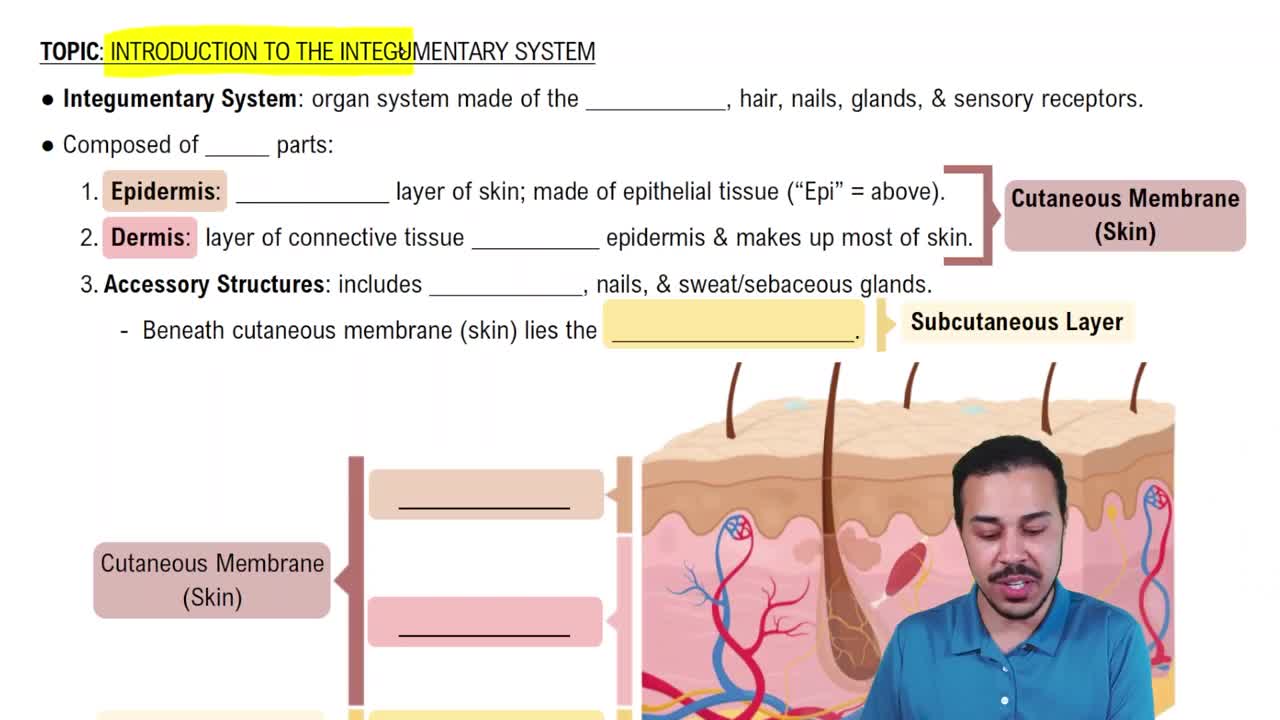
A subcutaneous layer deep to the skin, mostly adipose tissue that absorbs shock, insulates, and anchors skin to underlying structures.
Name the layers of the epidermis from deep to superficial.
Stratum basale, stratum spinosum, stratum granulosum, stratum lucidum (only in thick skin), and stratum corneum.
What are the four main cell types in the epidermis?
Keratinocytes, melanocytes, dendritic (Langerhans) cells, and tactile (Merkel) cells.
What is the function of keratinocytes?
Produce fibrous protein keratin, form most epidermal cells, tightly connected by desmosomes, and are replaced every 25-45 days.
What role do melanocytes play in the skin?
Produce melanin pigment, which protects keratinocyte nuclei from UV damage by forming pigment shields.
Describe the stratum basale.
Deepest epidermal layer with a single row of mitotic stem cells; some become keratinocytes, others remain stem cells; contains melanocytes.
What characterizes the stratum spinosum?
Several layers of keratinocytes connected by desmosomes with abundant melanosomes and dendritic cells.
What happens in the stratum granulosum?
Cells flatten, nuclei and organelles disintegrate, keratinization begins, and cells accumulate keratohyaline and lamellar granules.
Where is the stratum lucidum found and what is its characteristic?
Only in thick skin; a thin, translucent band of a few rows of flat, dead keratinocytes above the stratum granulosum.
What is the stratum corneum composed of and its function?
20-30 layers of dead, flat, keratinized cells that protect deeper layers from environment, water loss, abrasion, and penetration.
What are the two layers of the dermis?
Papillary layer (areolar connective tissue with collagen and elastic fibers) and reticular layer (dense fibrous connective tissue).
What are dermal papillae and their function?
Peglike projections in the papillary layer containing capillary loops and sensory receptors; form friction ridges (fingerprints).
What are cleavage lines in the dermis?
Patterns of collagen fibers in the reticular layer that run parallel to the skin surface; important for surgical incisions.
What pigments contribute to skin color?
Melanin (only pigment made in skin), carotene (yellow-orange pigment), and hemoglobin (pinkish hue in fair skin).
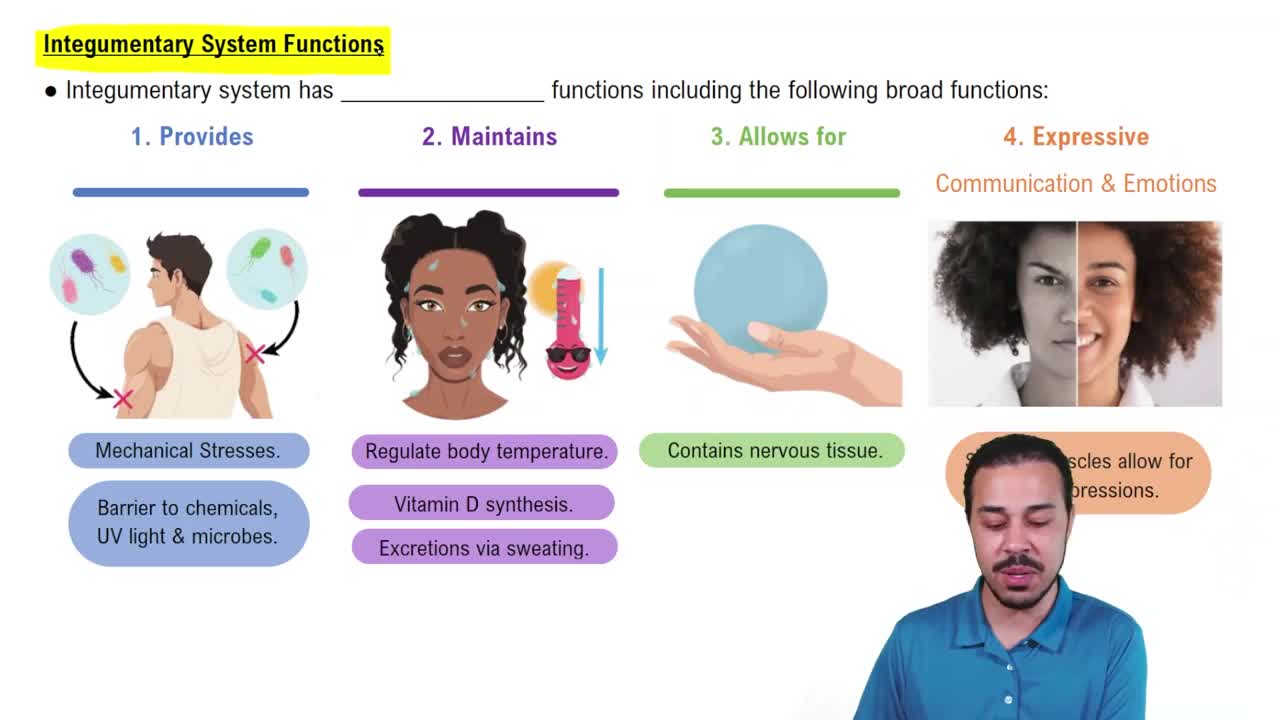
What are the main functions of the integumentary system?
Protection, body temperature regulation, cutaneous sensation, metabolic functions, blood reservoir, and excretion.
What are the three types of barriers provided by the skin?
Chemical barriers (skin secretions, melanin), physical barriers (keratinized cells and glycolipids), and biological barriers (immune cells).
Describe the difference between eccrine and apocrine sweat glands.
Eccrine glands regulate temperature by producing watery sweat; apocrine glands produce viscous sweat in axillary and anogenital areas, starting at puberty.
What is the function of sebaceous glands?
Secrete oily sebum that softens hair and skin and has bactericidal properties; mostly associated with hair follicles.
What are the three major types of skin cancer?
Basal cell carcinoma (least malignant), squamous cell carcinoma (can metastasize), and melanoma (most dangerous, from melanocytes).
How are burns classified by severity?
First-degree (epidermal damage), second-degree (epidermal and upper dermal damage with blisters), and third-degree (full thickness, nerve endings destroyed).
 Back
 06:54