Skip to main content
Anatomy & Physiology
My Course
Learn
Exam Prep
AI Tutor
Study Guides
Textbook Solutions
Flashcards
Explore
Try the app
My Course
Learn
Exam Prep
AI Tutor
Study Guides
Textbook Solutions
Flashcards
Explore
Try the app
Back
Integumentary System - Anatomy & Physiology
You can tap to flip the card.
What are the two main layers of the skin?
You can tap to flip the card.
👆
What are the two main layers of the skin?
Epidermis
(outermost protective shield) and
Dermis
(underlies epidermis and makes up bulk of skin).
Track progress
Control buttons has been changed to "navigation" mode.
1/23
Recommended videos
Guided course
06:54
Introduction to the Integumentary System
24081
views
820
rank
3
comments
Guided course
03:40
Integumentary System Functions
15633
views
394
rank
1
comments
Guided course
02:47
Map of the Lesson on Integumentary System
13780
views
649
rank
6
comments
Terms in this set (23)
Hide definitions
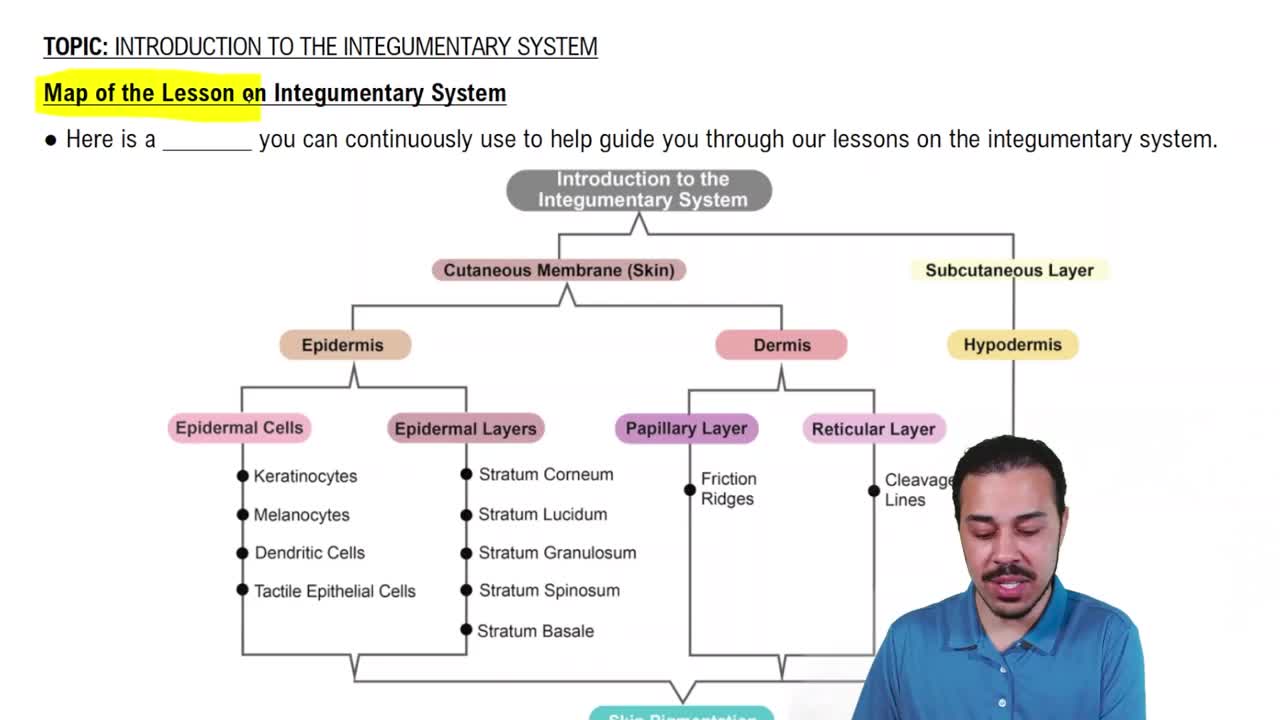
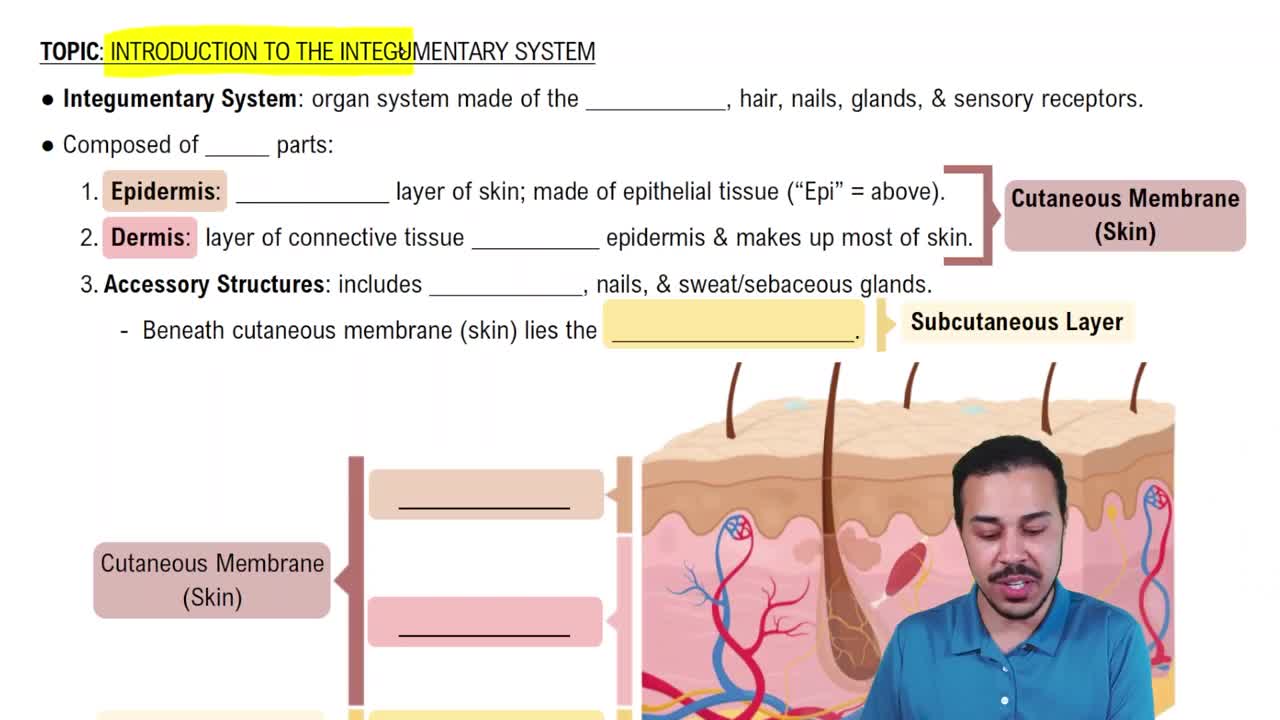
What are the two main layers of the skin?
Epidermis
(outermost protective shield) and
Dermis
(underlies epidermis and makes up bulk of skin).
Name the five layers of the epidermis from deepest to most superficial.
Stratum basale, Stratum spinosum, Stratum granulosum, Stratum lucidum, Stratum corneum.
What is the function of the stratum basale?
Deepest epidermal layer; single row of mitotic stem cells that produce daughter cells; firmly attached to dermis.
Describe the stratum spinosum.
Several cell layers thick; keratinocytes with pre-keratin filaments attached to desmosomes; contains melanosomes and dendritic cells.
What happens in the stratum granulosum?
Cells become flattened; keratinization begins; cells above this layer die.
What characterizes the stratum corneum?
20–30 rows of flat, dead, keratinized cells; accounts for 3/4 of epidermal thickness; cells still protect despite being dead.
What are the two layers of the dermis?
Papillary dermis
(areolar connective tissue with dermal papillae) and
Reticular dermis
(dense irregular connective tissue).
What are dermal papillae and their function?
Fingerlike projections of dermis into epidermis; form friction ridges that enhance grip and sense of touch.
What causes stretch marks (striae)?
Extreme stretching of skin causing dermal tears and silvery white scars.
What pigment is made in the skin and protects keratinocyte DNA from UV damage?
Melanin
, produced by melanocytes and packaged into melanosomes.
What are the other pigments affecting skin color besides melanin?
Carotene
(yellow-orange pigment) and
Hemoglobin
(pinkish hue in fair skin).
What are some clinical signs indicated by skin color changes?
Cyanosis (blue, low oxygen), pallor (pale, stress or anemia), erythema (red, inflammation), jaundice (yellow, liver disorder), bruises (blood leakage).
List the main functions of hair.
Senses insects, protects head from trauma, prevents heat loss, shields skin from sunlight, eyelashes protect eyes, nose hairs filter air.
What can nail appearance indicate?
Yellow nails may indicate respiratory or thyroid issues; spoon nails suggest iron deficiency; Beau's lines indicate severe illness.
What are the two main types of sweat glands?
Eccrine glands
(thermoregulation, all skin except nipples/genitalia) and
Apocrine glands
(axillary and anogenital, milky sweat, start at puberty).
Describe eccrine sweat glands.
Most numerous; abundant on palms, soles, forehead; ducts open to skin surface; secrete sweat with pH 4-6 for thermoregulation.
Describe apocrine sweat glands.
Located in axillary and anogenital areas; secrete viscous, milky sweat with fatty substances; ducts empty into hair follicles; active at puberty.
What are sebaceous glands and their function?
Oil glands associated with hair follicles; secrete sebum that softens hair and skin and has bactericidal properties; stimulated by androgens.
List the major functions of the skin.
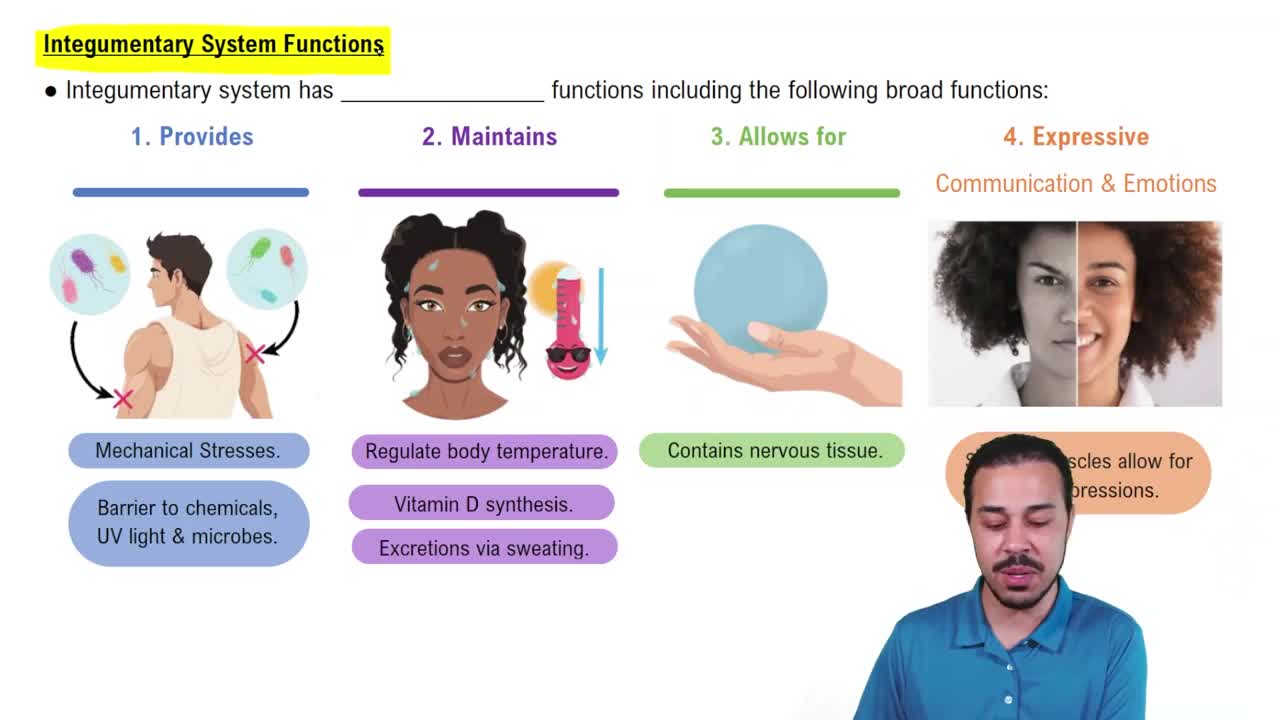
Protection (chemical, physical, biological barriers), temperature regulation, cutaneous sensation, metabolic functions, blood reservoir, excretion.
What are the three major types of skin cancer?
Basal cell carcinoma, squamous cell carcinoma, and melanoma.
What is the 'rule of nines' in burn treatment?
Body divided into 11 sections each representing 9% of body surface area to estimate fluid loss from burns.
When are burns considered critical?
If >25% of body has second-degree burns, >10% has third-degree burns, or face/hands/feet have third-degree burns.
What are common treatments for severe burns?
Debridement, antibiotics, temporary coverings, and skin grafts.
 BackBack
 06:54