Back

Integumentary System - Anatomy & Physiology

Control buttons has been changed to "navigation" mode.
1/27
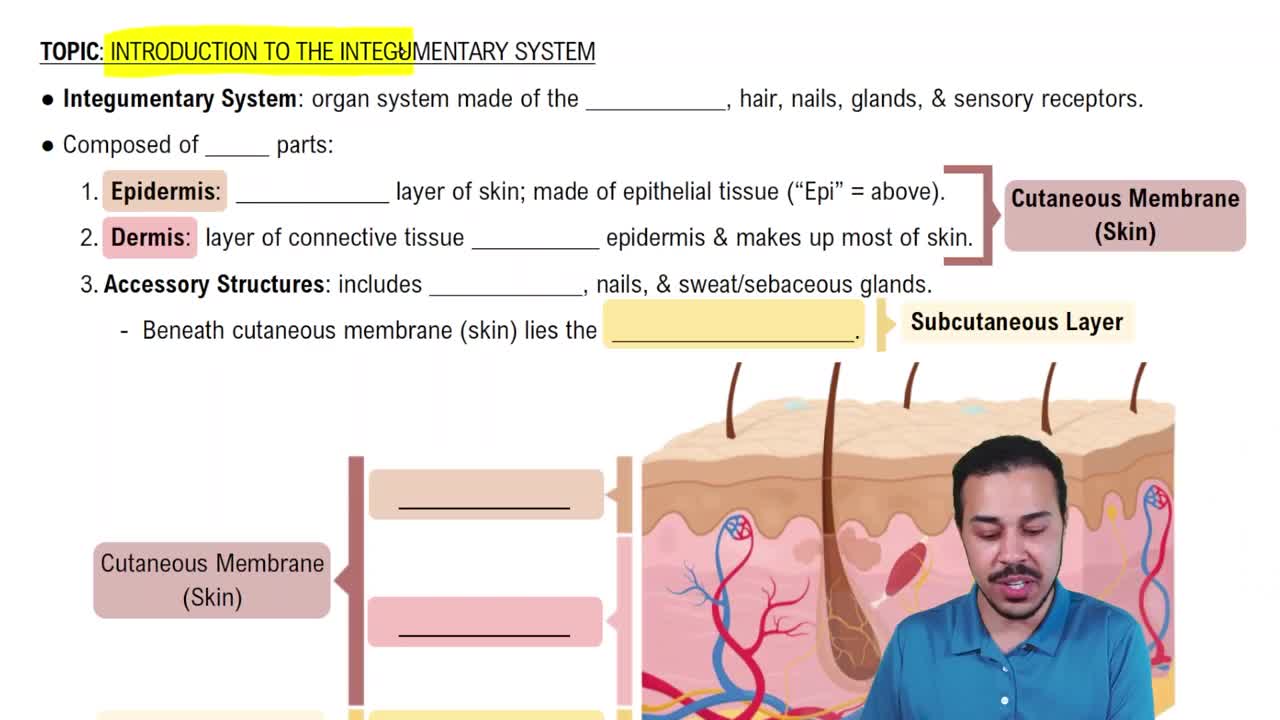
  • What are the two major parts of the integumentary system?

    The cutaneous membrane (skin) and accessory structures such as hair, exocrine glands, and nails.
  • What are the layers of the cutaneous membrane?

    The epidermis (superficial epithelium) and the dermis (underlying connective tissue).
  • What is the subcutaneous layer and its function?

    Also called the hypodermis, it is loose connective tissue beneath the dermis that separates the integument from deeper tissues and stabilizes skin position.
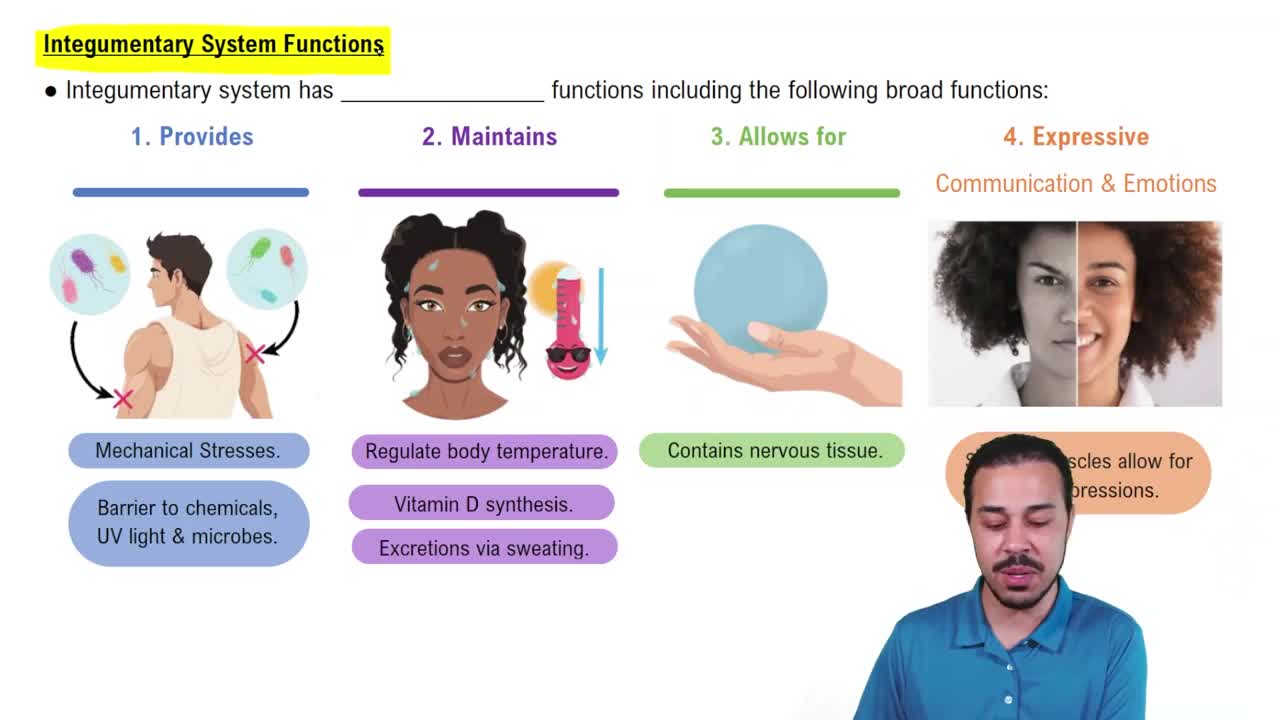
  • List five general functions of the integumentary system.

    Protection, temperature maintenance, synthesis and storage of nutrients, sensory reception, and excretion and secretion.
  • What type of epithelium composes the epidermis?

    The epidermis is composed of stratified squamous epithelium.
  • What is the difference between thick and thin skin?

    Thick skin has five layers of cells and is found on palms and soles; thin skin has four layers and covers the rest of the body.
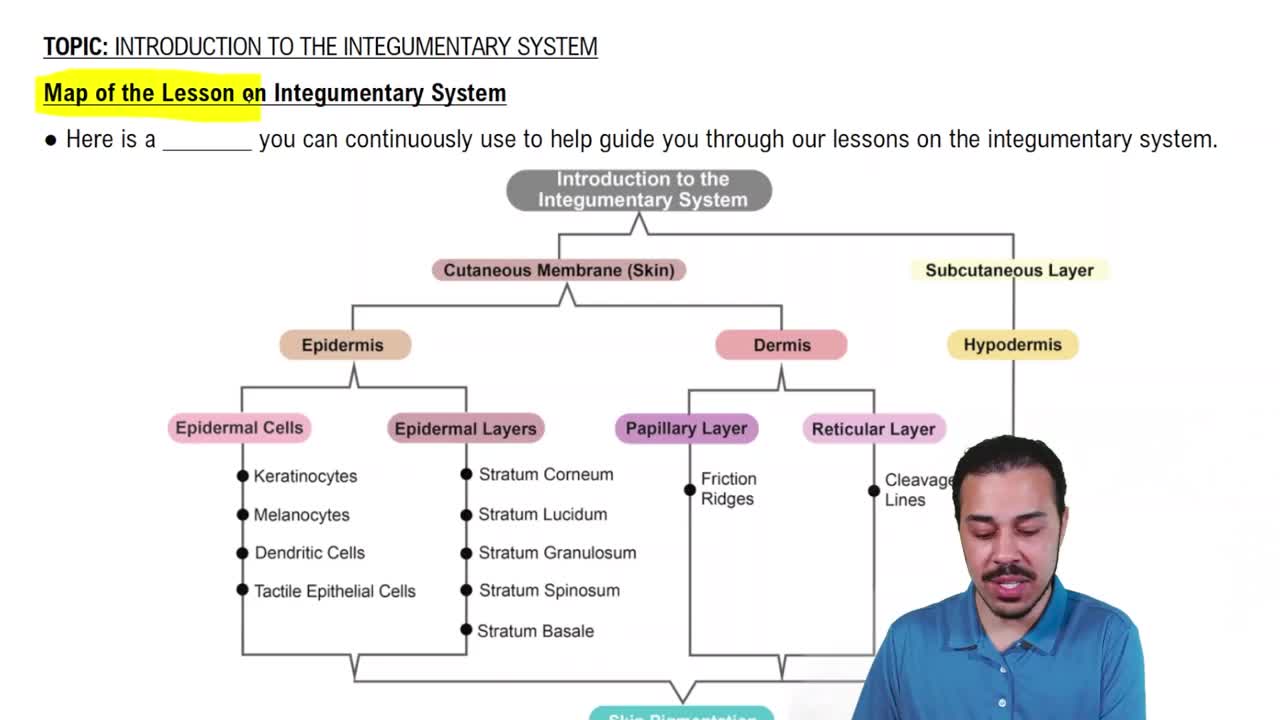
  • Name the five layers (strata) of the epidermis from deep to superficial.

    Stratum basale, stratum spinosum, stratum granulosum, stratum lucidum (only in thick skin), and stratum corneum.
  • What cells are found in the stratum basale?

    Basal cells (stem cells), melanocytes (pigment producers), and Merkel cells (touch receptors).
  • What is the function of epidermal ridges?

    They increase surface area for diffusion, strengthen the bond between epidermis and dermis, and form fingerprints.
  • What pigment types influence skin color?

    Carotene (orange-yellow) and melanin (red-yellow and brown-black).
  • How does melanin protect the skin?

    Melanin absorbs ultraviolet radiation, protecting DNA in deeper layers from damage.
  • What causes skin redness during exercise or heat exposure?

    Dilation of superficial blood vessels in the dermis increases blood flow, causing flushed red skin.
  • How is vitamin D3 produced in the skin?

    Epidermal cells convert a cholesterol-related steroid to vitamin D3 when exposed to UV radiation.
  • What are the two major layers of the dermis?

    The superficial papillary layer and the deeper reticular layer.
  • What is the primary tissue type in the papillary layer of the dermis?

    Areolar connective tissue containing capillaries, lymphatic vessels, and sensory neurons.
  • What is the function of the reticular layer of the dermis?

    Provides strength and flexibility with dense irregular connective tissue, collagen, and elastic fibers.
  • What is the role of the subcutaneous layer?

    It stabilizes skin position, stores fat, and is a site for subcutaneous injections.
  • Describe the structure of a hair follicle.

    A tubular structure extending into dermis/hypodermis, containing epithelial stem cells in the hair matrix surrounding the hair papilla.
  • What are the three layers of the hair shaft?

    Cuticle (outer, hard keratin), cortex (middle, hard keratin), and medulla (core, soft keratin).
  • What are the two types of sweat glands?

    Apocrine sweat glands (active at puberty, secrete into hair follicles) and eccrine sweat glands (merocrine secretion, secrete watery sweat onto skin surface).
  • What is the function of sebaceous glands?

    They secrete sebum, an oily lipid that lubricates hair and skin and inhibits bacterial growth.
  • What are nails composed of and where does nail growth occur?

    Nails are made of keratinized epithelial cells; growth occurs at the nail root beneath the cuticle.
  • What are the four phases of skin regeneration after injury?

    Inflammation, migration, proliferation, and scarring phases.
  • What is granulation tissue?

    A combination of blood clot, fibroblasts, and capillary network that forms during the migration phase of wound healing.
  • How are burns classified by depth?

    First-degree (epidermis only), second-degree (epidermis and part of dermis), and third-degree (full thickness including hypodermis).
  • What is the Rule of Nines?

    A method to estimate the percentage of body surface area affected by burns, dividing the body into multiples of 9%.
  • How does aging affect the integumentary system?

    Thinner epidermis, reduced immune response, decreased melanin, dry skin, hair thinning and graying, sagging skin, and slower repair.