Skip to main content
Anatomy & Physiology
My Course
Learn
Exam Prep
AI Tutor
Study Guides
Textbook Solutions
Flashcards
Explore
Try the app
My Course
Learn
Exam Prep
AI Tutor
Study Guides
Textbook Solutions
Flashcards
Explore
Try the app
Back
Integumentary System - Anatomy & Physiology
You can tap to flip the card.
What are the two major parts of the integumentary system?
You can tap to flip the card.
👆
What are the two major parts of the integumentary system?
Cutaneous membrane
(epidermis and dermis) and
accessory structures
(hair, glands, nails).
Track progress
Control buttons has been changed to "navigation" mode.
1/20
Recommended videos
06:54
Introduction to the Integumentary System
19048
views
647
rank
3
comments
03:40
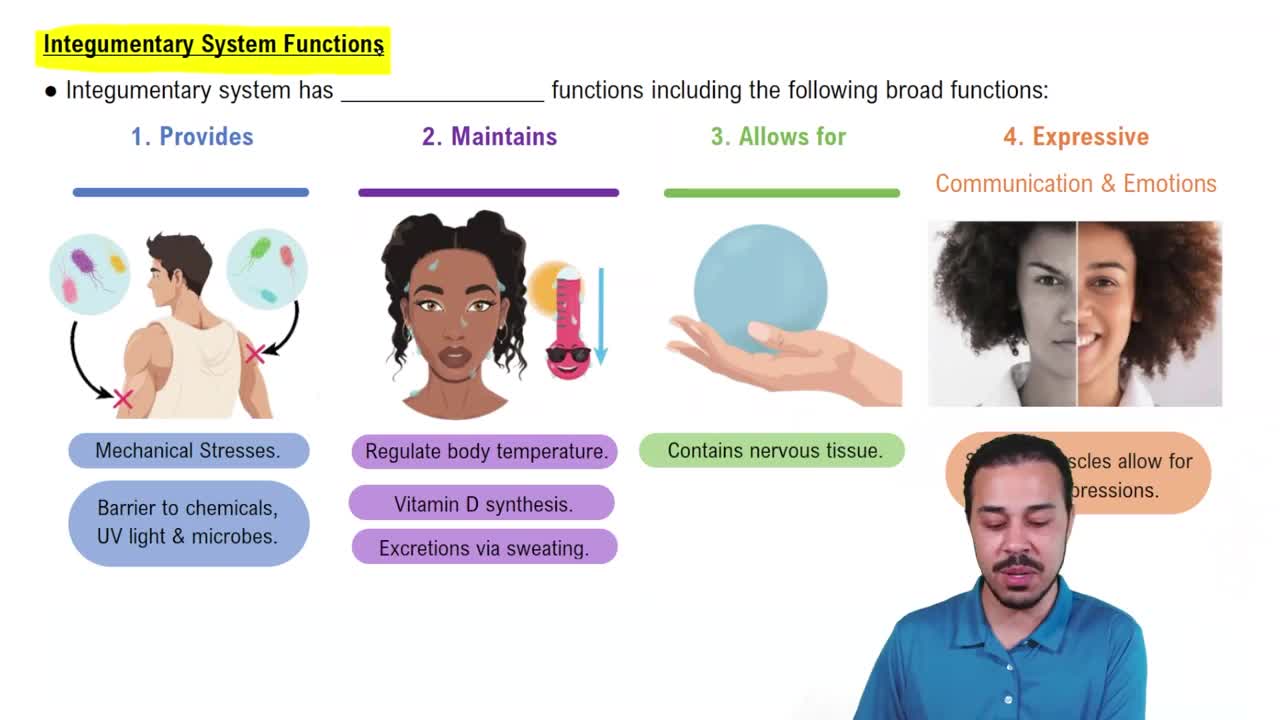
Integumentary System Functions
12464
views
318
rank
1
comments
02:47
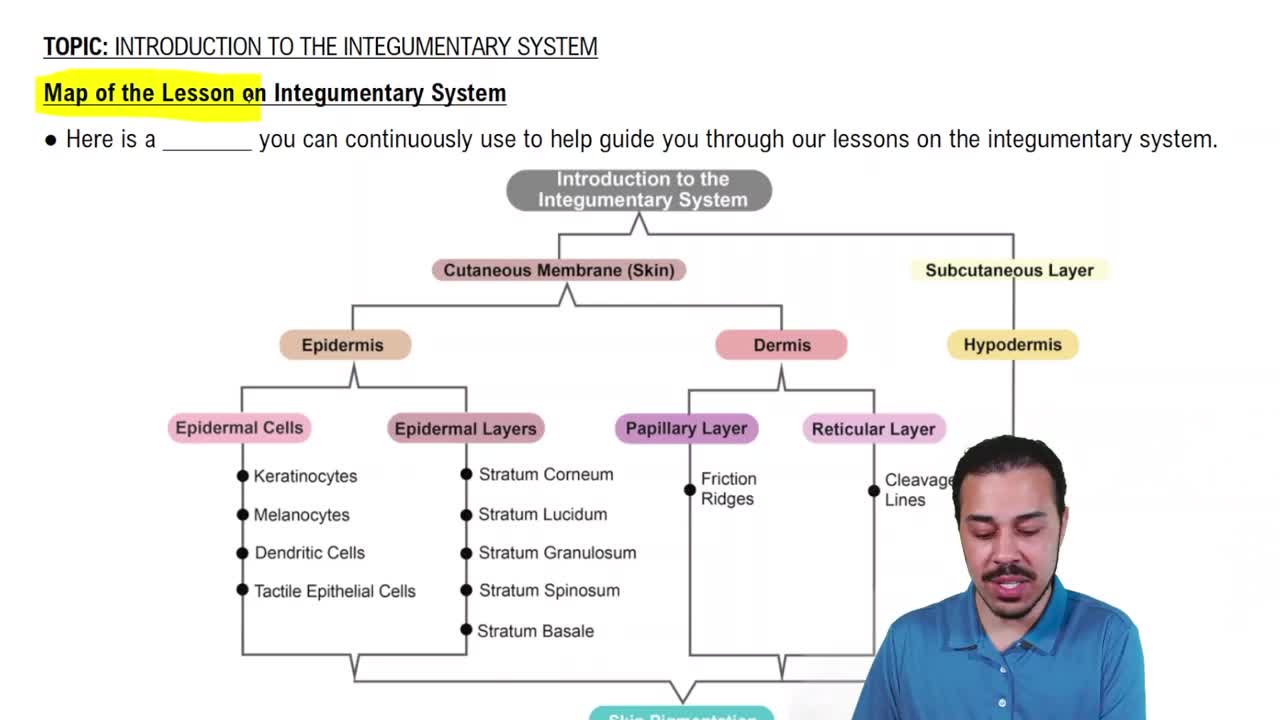
Map of the Lesson on Integumentary System
10853
views
501
rank
2
comments
Terms in this set (20)
Hide definitions
What are the two major parts of the integumentary system?
Cutaneous membrane
(epidermis and dermis) and
accessory structures
(hair, glands, nails).
What percentage of body weight does the integumentary system represent?
Approximately
16%
of body weight.
What are the main functions of the integumentary system?
Protection, excretion, temperature regulation, melanin and keratin production, lipid storage, sensory detection, immune response, and vitamin D3 synthesis.
What are the three layers of the skin?
Epidermis
,
Dermis
, and
Subcutaneous layer
.
What type of epithelium composes the epidermis?
The epidermis is made of
stratified squamous epithelium
.
What are keratinocytes?
The most abundant epithelial cells in the epidermis that produce
keratin
.
Difference between thin and thick skin?
Thin skin has
4 layers
of keratinocytes and covers most of the body; thick skin has
5 layers
and covers palms and soles.
What is the function of the stratum basale?
It produces new keratinocytes, contains melanocytes for pigment, and Merkel cells for touch detection.
What cells are found in the stratum spinosum?
Keratinocytes connected by desmosomes and dendritic (Langerhans) cells for immune defense.
What happens in the stratum granulosum?
Keratinocytes begin keratinization and form a water-resistant barrier.
Where is the stratum lucidum found and what is its function?
Only in thick skin; it adds extra protection and reduces friction.
What is the role of the stratum corneum?
It protects against abrasion, pathogens, and water loss with multiple layers of dead keratinized cells.
What is Epidermal Growth Factor (EGF) and its functions?
A peptide growth factor that promotes basal cell division, keratin production, epidermal repair, and glandular secretion.
What layers compose the dermis?
The
papillary layer
(superficial) and the
reticular layer
(deep).
What is the subcutaneous layer composed of?
Primarily
adipose tissue
that stores lipids and provides insulation.
What is the function of melanocytes in the epidermis?
They produce
melanin
which protects underlying tissues from UV radiation.
How does the epidermis receive nutrients and oxygen?
By diffusion from capillaries located in the dermis.
What sensory functions does the integumentary system provide?
Detection of touch, pressure, pain, vibration, and temperature stimuli.
What is the role of the subpapillary plexus?
A network of blood vessels in the dermis that supplies the skin and helps regulate temperature.
What accessory structures originate in the dermis?
Hair follicles, exocrine glands, and nails.
 BackBack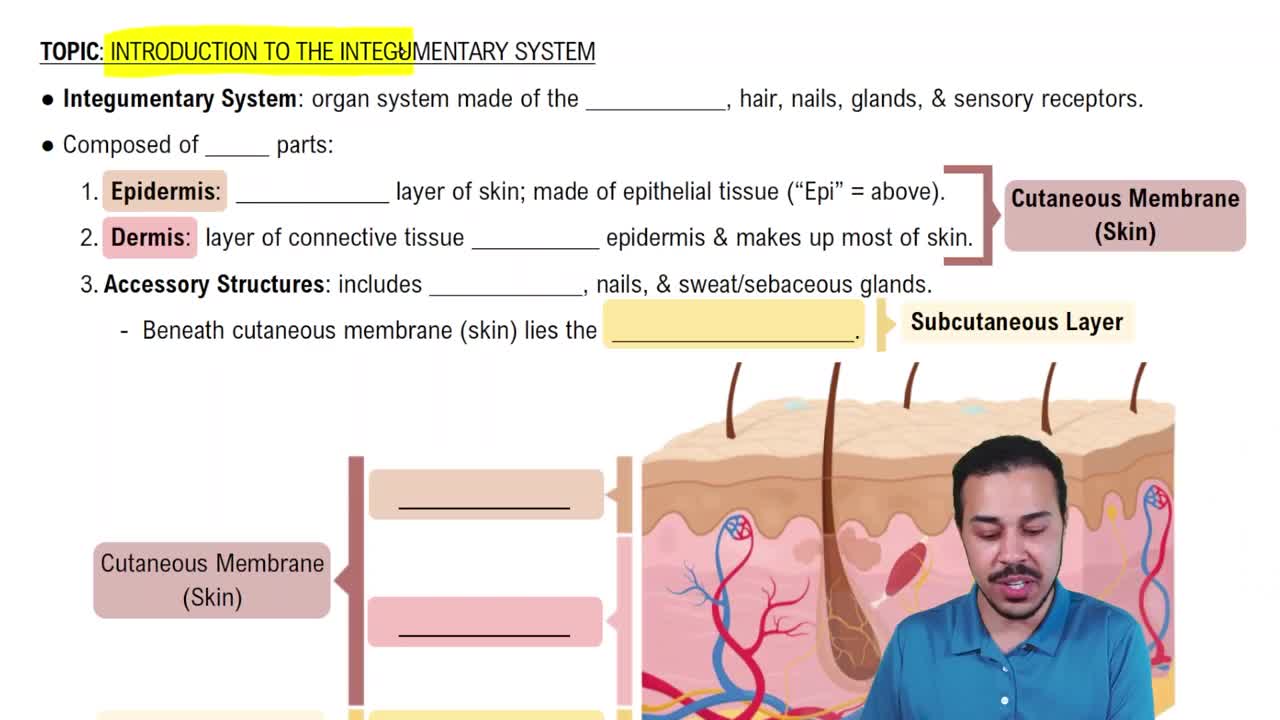
 06:54
06:54