Back

Integumentary System - Anatomy & Physiology

Control buttons has been changed to "navigation" mode.
1/28
  • What are the main components of the integumentary system?

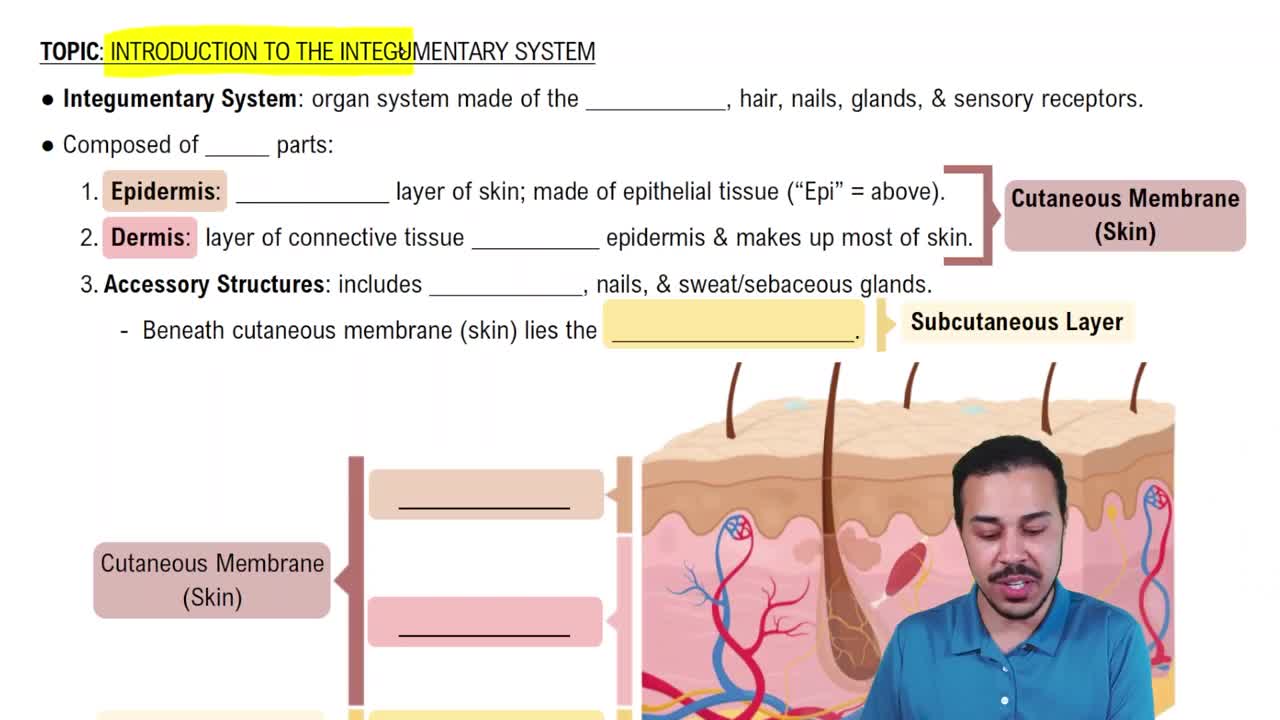
    Skin, sudoriferous (sweat) glands, sebaceous (oil) glands, hairs, nails, and subcutaneous tissue.
  • What are the two main layers of the skin?

    Epidermis (outermost, epithelial, avascular) and dermis (underlying, dense connective tissue, vascular).
  • What is the subcutaneous tissue and its functions?

    Also called hypodermis, mostly adipose and areolar connective tissue; anchors skin to muscles, provides shock absorption and insulation.
  • Name the four main cell types in the epidermis.

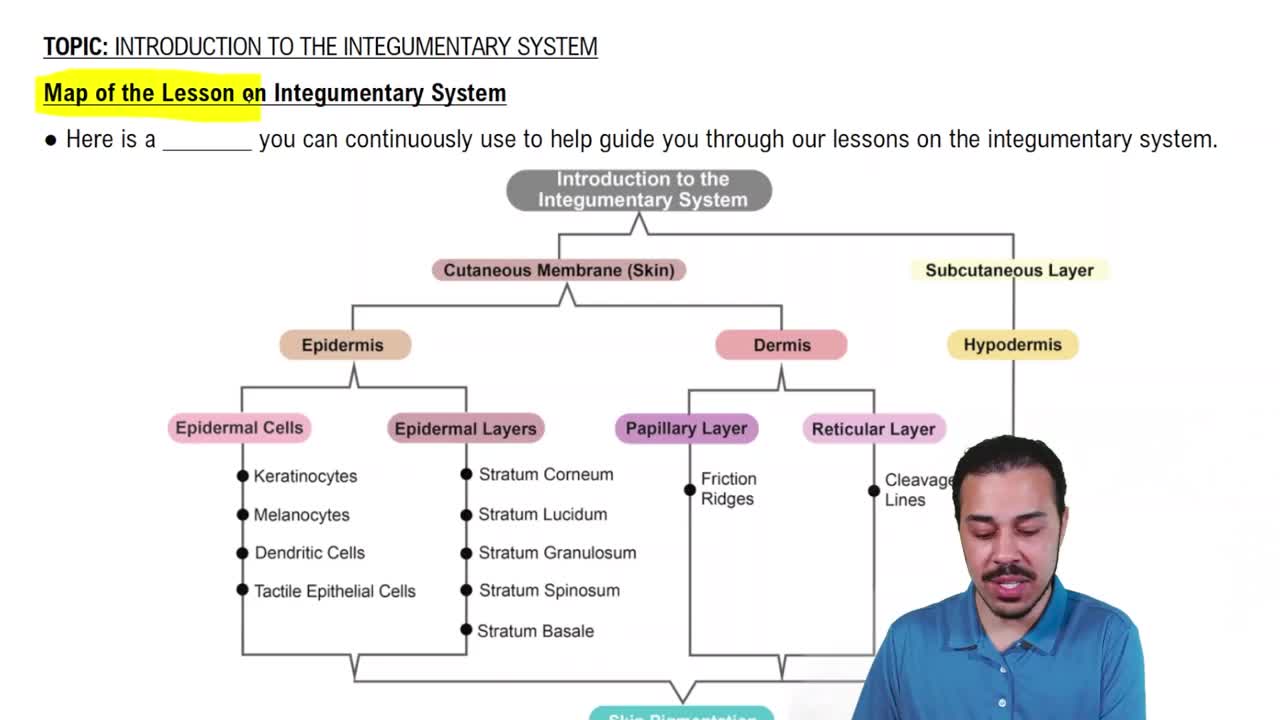
    Keratinocytes, melanocytes, dendritic (Langerhans) cells, and tactile (Merkel) epithelial cells.
  • What are the five layers (strata) of the epidermis?

    From deep to superficial: stratum basale, stratum spinosum, stratum granulosum, stratum lucidum (only in thick skin), and stratum corneum.
  • What is the function of keratinocytes?

    Produce fibrous keratin that protects skin; major epidermal cells; renew epidermis every 25–45 days.
  • What role do melanocytes play in the skin?

    Produce melanin pigment to protect keratinocyte DNA from UV damage by transferring melanosomes.
  • Describe the stratum basale.

    Deepest epidermal layer; single row of mitotic stem cells; attached to dermis; contains melanocytes; also called stratum germinativum.
  • What characterizes the stratum spinosum?

    Several layers thick; keratinocytes with pre-keratin filaments attached to desmosomes; contains melanosomes and dendritic cells.
  • What happens in the stratum granulosum?

    Cells flatten, nuclei disintegrate; keratinization begins; cells accumulate keratohyaline and lamellar granules; cells above die.
  • Where is the stratum lucidum found and what is its characteristic?

    Only in thick skin; thin, translucent layer of dead keratinocytes above stratum granulosum.
  • What is the stratum corneum and its functions?

    20–30 rows of dead, keratinized cells; protects deeper layers, prevents water loss, and acts as barrier against abrasion and pathogens.
  • What are the two layers of the dermis?

    Papillary dermis (superficial, areolar connective tissue) and reticular dermis (deep, dense irregular connective tissue).
  • What are dermal papillae and their function?

    Fingerlike projections of papillary dermis into epidermis; contain capillaries and sensory receptors; form friction ridges for grip.
  • What are cleavage lines and why are they important?

    Lines in reticular dermis where collagen fibers run parallel; important for surgical incisions as cuts heal better when parallel.
  • What causes flexure lines in the skin?

    Dermal folds near joints where skin is tightly secured to underlying structures, causing deep creases visible on hands and feet.
  • What is melanin and how does it affect skin color?

    Pigment made by melanocytes from tyrosine; protects DNA from UV; amount and type determine skin color variations.
  • Name the three pigments that determine skin color.

    Melanin, carotene (yellow-orange pigment), and hemoglobin (pinkish hue from blood).
  • What are the main functions of hair?

    Senses insects, protects scalp from trauma and heat loss, shields skin from sunlight, filters particles in nose, and protects eyes with eyelashes.
  • What are the three parts of a hair shaft?

    Medulla (core), cortex (flattened cells around medulla), and cuticle (outer overlapping cells).
  • What is the hair follicle and its key structures?

    Extends from epidermis to dermis; includes hair bulb, hair matrix (growth zone), papilla (capillaries), and arrector pili muscle.
  • What are the two main types of sweat glands?

    Eccrine (merocrine) glands for thermoregulation and apocrine glands in axillary and anogenital areas, secreting milky sweat.
  • What are sebaceous glands and their function?

    Oil glands that secrete sebum; lubricate skin and hair; bactericidal; mostly associated with hair follicles.
  • What are the main functions of the skin?

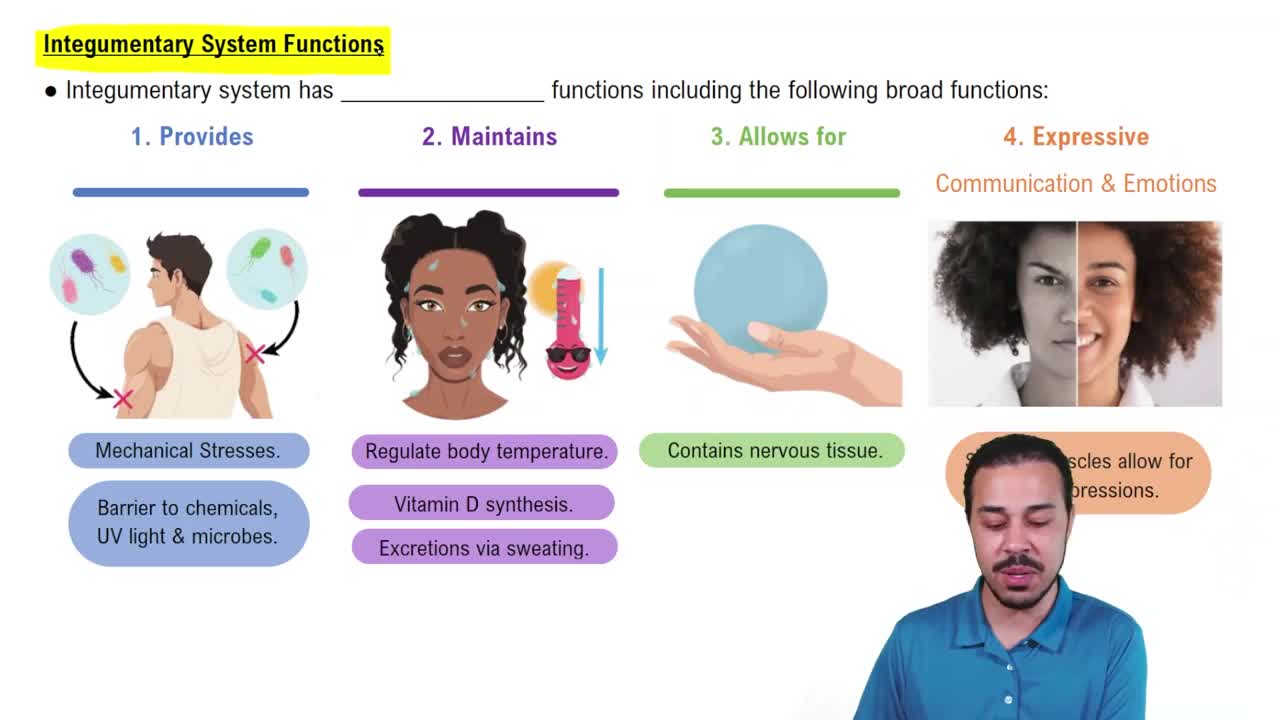
    Protection, body temperature regulation, cutaneous sensations, metabolic functions, blood reservoir, and excretion.
  • What are the three types of barriers the skin provides?

    Chemical (acid mantle, antimicrobial secretions), physical (keratinized cells and glycolipids), and biological (immune cells like dendritic and macrophages).
  • What is the ABCD rule for recognizing melanoma?

    A: asymmetry; B: border irregularity; C: color variation; D: diameter >6 mm; E: evolution or change over time.
  • How are burns classified by severity?

    First-degree: epidermal damage; second-degree: epidermis and upper dermis with blisters; third-degree: full thickness, nerve endings destroyed.
  • What is the rule of nines in burn assessment?

    Body divided into 11 sections each representing 9% of surface area to estimate fluid loss and burn extent.