Skip to main content
Anatomy & Physiology
My Course
Learn
Exam Prep
AI Tutor
Study Guides
Textbook Solutions
Flashcards
Explore
Try the app
My Course
Learn
Exam Prep
AI Tutor
Study Guides
Textbook Solutions
Flashcards
Explore
Try the app
Back
Integumentary System - Anatomy & Physiology
You can tap to flip the card.
What are the main components of the integumentary system?
You can tap to flip the card.
👆
What are the main components of the integumentary system?
The integumentary system consists of the
skin, hair, glands, and nails
.
Track progress
Control buttons has been changed to "navigation" mode.
1/20
Recommended videos
06:54
Introduction to the Integumentary System
19307
views
652
rank
3
comments
03:40
Integumentary System Functions
12587
views
322
rank
1
comments
02:47
Map of the Lesson on Integumentary System
10982
views
508
rank
2
comments
Terms in this set (20)
Hide definitions
What are the main components of the integumentary system?
The integumentary system consists of the
skin, hair, glands, and nails
.
What percentage of total body weight does the integumentary system account for?
It accounts for
10-15%
of total body weight.
List the primary functions of the integumentary system.
Protection, sensation, thermoregulation, excretion, and vitamin D synthesis.
How does the integumentary system protect the body?
The epidermis forms a
durable, flexible surface
protecting against mechanical trauma, pathogens, UV radiation, and water loss.
What role do sensory receptors in the skin play?
They detect environmental changes, aiding in
homeostasis
.
How does the skin contribute to thermoregulation when body temperature rises?
Blood vessels in the dermis
dilate
and sweat glands release sweat to promote heat loss.
What happens in the skin when body temperature falls?
Blood vessels
constrict
to conserve heat and sweat production decreases.
Name the five layers (strata) of the epidermis.
Stratum basale, stratum spinosum, stratum granulosum, stratum lucidum, and stratum corneum.
Which epidermal layer contains stem cells and produces vitamin D precursor?
The
stratum basale
.
What is the function of the stratum granulosum?
It releases
lipid-based substances
that create a hydrophobic barrier.
Where is the stratum lucidum found and what is its characteristic?
Found only in
thick skin
, it is a clear layer of dead keratinocytes.
What cells in the epidermis provide immune protection?
Dendritic (Langerhans) cells
in the stratum spinosum.
Which cells produce melanin pigment and where are they located?
Melanocytes
located in the stratum basale.
What distinguishes thick skin from thin skin?
Thick skin has all five strata including stratum lucidum, a thick stratum corneum, and
lacks hair follicles
.
What are the two main layers of the dermis?
The
papillary layer
(loose connective tissue) and the
reticular layer
(dense irregular connective tissue).
What structures are found in the papillary layer of the dermis?
Dermal papillae with capillaries and sensory receptors.
What is the function of epidermal ridges?
They enhance grip and create unique
fingerprint patterns
.
Name the three common fingerprint patterns.
Loop, arch, and whorl.
How do sweat pores relate to fingerprint patterns?
Sweat pores open along epidermal ridges, leaving unique prints.
What is the role of Merkel cells in the epidermis?
They are
sensory receptors for light touch
found in the stratum basale.
 BackBack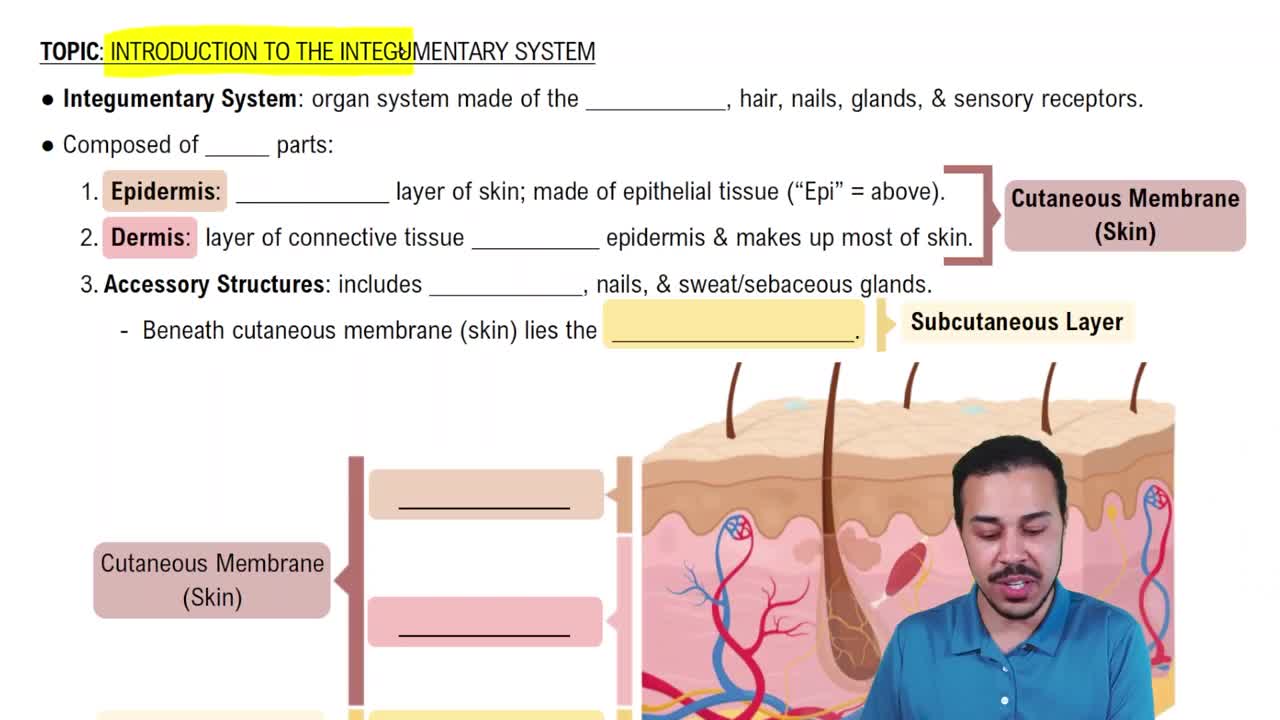
 06:54
06:54