Skip to main content
Anatomy & Physiology
My Course
Learn
Exam Prep
AI Tutor
Study Guides
Textbook Solutions
Flashcards
Explore
Try the app
My Course
Learn
Exam Prep
AI Tutor
Study Guides
Textbook Solutions
Flashcards
Explore
Try the app
Back
Integumentary System - Anatomy & Physiology
You can tap to flip the card.
What are the main components of the integumentary system?
You can tap to flip the card.
👆
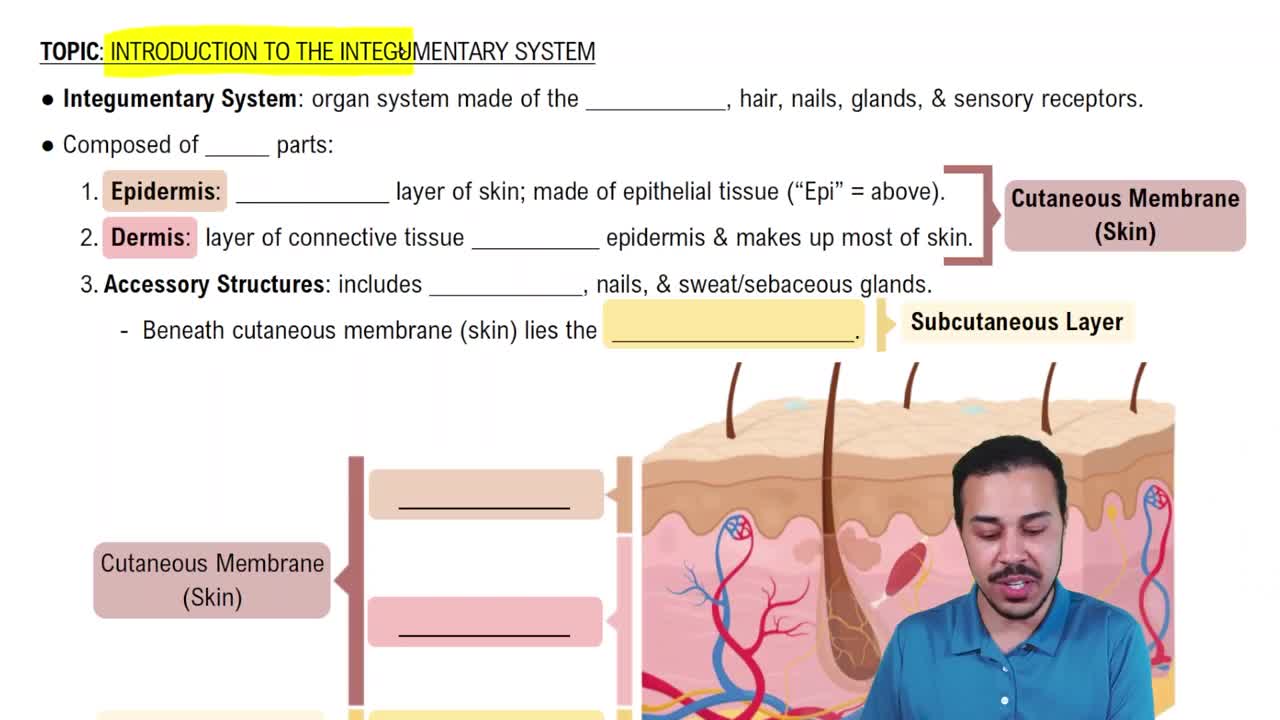
What are the main components of the integumentary system?
Skin
,
hair
,
nails
,
sweat (sudoriferous) glands
,
oil (sebaceous) glands
, and
subcutaneous tissue (hypodermis)
.
Track progress
Control buttons has been changed to "navigation" mode.
1/28
Recommended videos
Guided course
06:54
Introduction to the Integumentary System
24081
views
820
rank
3
comments
Guided course
03:40
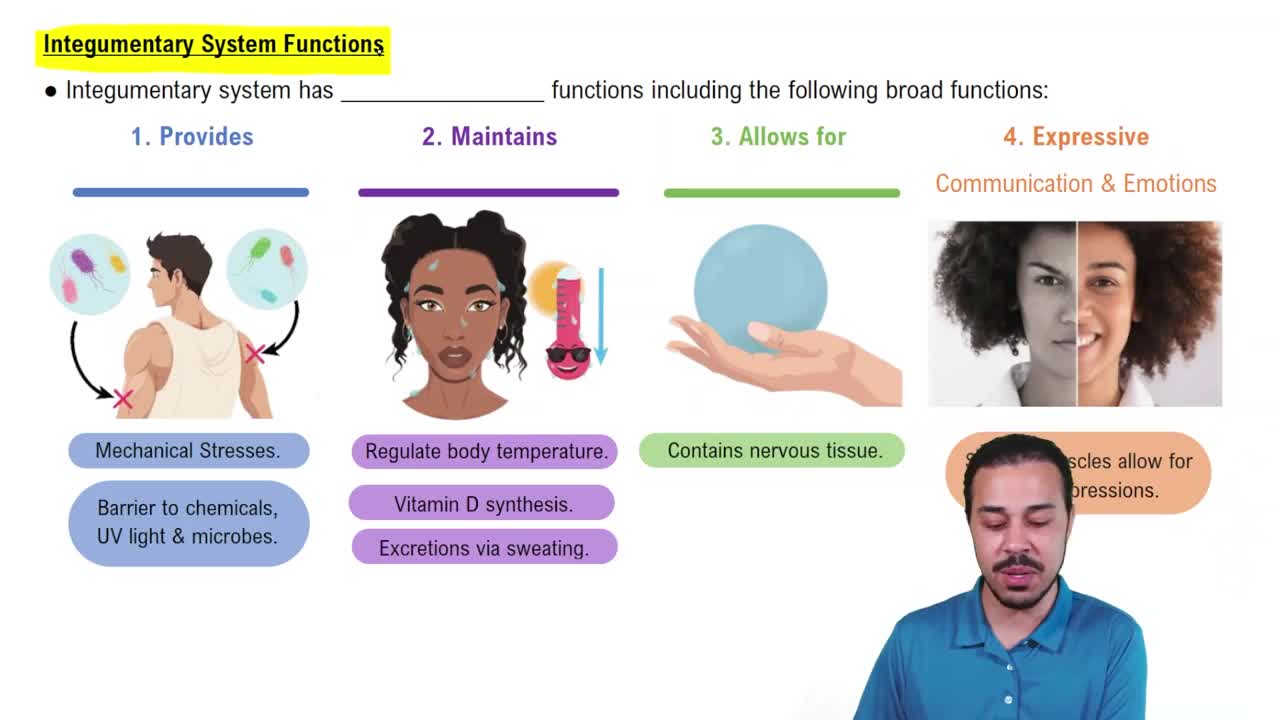
Integumentary System Functions
15633
views
394
rank
1
comments
Guided course
02:47
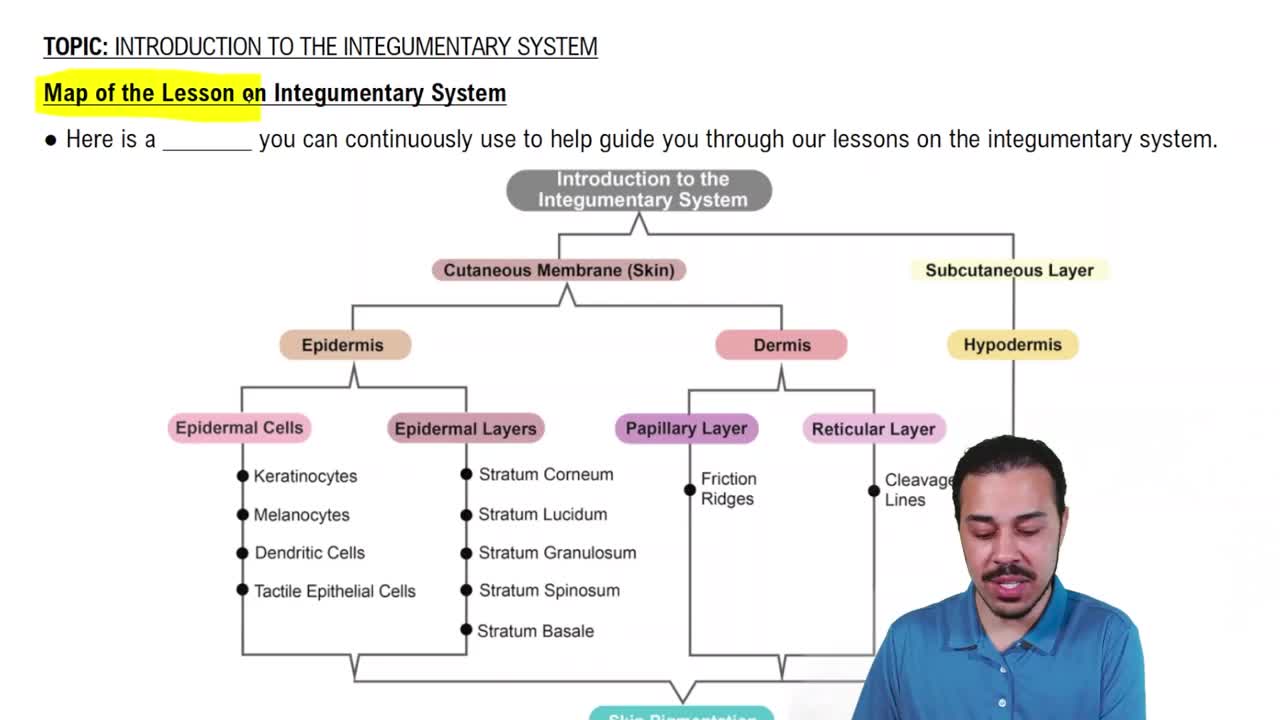
Map of the Lesson on Integumentary System
13780
views
649
rank
6
comments
Terms in this set (28)
Hide definitions
What are the main components of the integumentary system?
Skin
,
hair
,
nails
,
sweat (sudoriferous) glands
,
oil (sebaceous) glands
, and
subcutaneous tissue (hypodermis)
.
What are the primary functions of the skin?
Protection, temperature regulation, sensory perception, metabolic functions (Vitamin D production), blood reservoir, and excretion of wastes.
Name the three barriers of the skin that provide protection.
Chemical barriers
,
physical barriers
, and
biological barriers
.
What is the acid mantle and its function?
A low pH layer on the skin surface that retards bacterial multiplication, acting as a
chemical barrier
.
Describe the physical barrier function of the skin.
The
stratum corneum
consists of flat, dead, keratinized cells surrounded by glycolipids that block most water and water-soluble substances.
What role do dendritic cells and macrophages play in the skin?
They act as
biological barriers
by engulfing foreign antigens and activating the immune response.
How does the skin contribute to thermoregulation?
By regulating sweat gland activity and dilation/constriction of blood vessels to control heat loss or retention.
What metabolic functions does the skin perform?
Synthesizes Vitamin D, disarms some carcinogens, activates hormones, and produces collagenase to prevent wrinkles.
What is the blood reservoir function of the skin?
The dermis holds about 5% of the body's blood volume and can constrict vessels to redirect blood flow.
What are the two main layers of the skin?
Epidermis
(outer protective layer) and
dermis
(bulk of skin with connective tissue).
What is the hypodermis and its function?
A layer beneath the dermis made mostly of adipose tissue; anchors skin to muscles, provides shock absorption and insulation.
What types of cells are found in the epidermis?
Keratinocytes, melanocytes, dendritic (Langerhans) cells, and tactile (Merkel) cells.
List the five layers of thick skin epidermis from superficial to deep.
Stratum corneum, stratum lucidum, stratum granulosum, stratum spinosum, stratum basale.
What is the function of keratinocytes?
Produce fibrous keratin that protects skin and repels water; major cell type in epidermis.
What is the role of melanocytes?
Produce melanin pigment to protect keratinocyte DNA from UV damage.
Describe the papillary layer of the dermis.
Upper dermis layer with loose connective tissue, blood vessels, dermal papillae, and sensory receptors like Meissner's corpuscles.
Describe the reticular layer of the dermis.
Thick, dense irregular connective tissue with collagen and elastic fibers providing strength, hydration, and elasticity.
What causes stretch marks (striae)?
Extreme stretching of skin causing dermal tears and silvery white scars.
Name the three pigments that contribute to skin color.
Melanin, carotene, and hemoglobin.
What are the two main types of sweat glands?
Eccrine (merocrine) glands and apocrine glands.
Where are eccrine sweat glands most abundant and what is their function?
Palms, soles, and forehead; function in thermoregulation by secreting watery sweat.
Where are apocrine sweat glands located and what is their function?
Axillary and anogenital areas; secrete viscous sweat that bacteria break down causing body odor.
What are sebaceous glands and their function?
Oil glands that secrete sebum to soften hair and skin and have bactericidal properties.
What are the main parts of a hair follicle?
Hair bulb, hair papilla, hair root, hair shaft, and arrector pili muscle.
What are the functions of hair?
Protection from trauma, heat loss, sunlight; sensory detection; filtering particles in nose and eyelashes.
What are the types of hair?
Lanugo (fetal), vellus (fine body hair), and terminal (thicker, coarse hair).
What are nails and their function?
Scale-like modifications of epidermis containing hard keratin; protect distal fingers and toes.
What are cutaneous sensory receptors and their functions?
Exteroreceptors detecting heat, cold, pain, touch, and pressure; include Meissner's corpuscles, Pacinian corpuscles, and free nerve endings.
 BackBack
 06:54