 Back
BackIntegumentary System - Anatomy & Physiology
 06:54
06:54
Terms in this set (30)
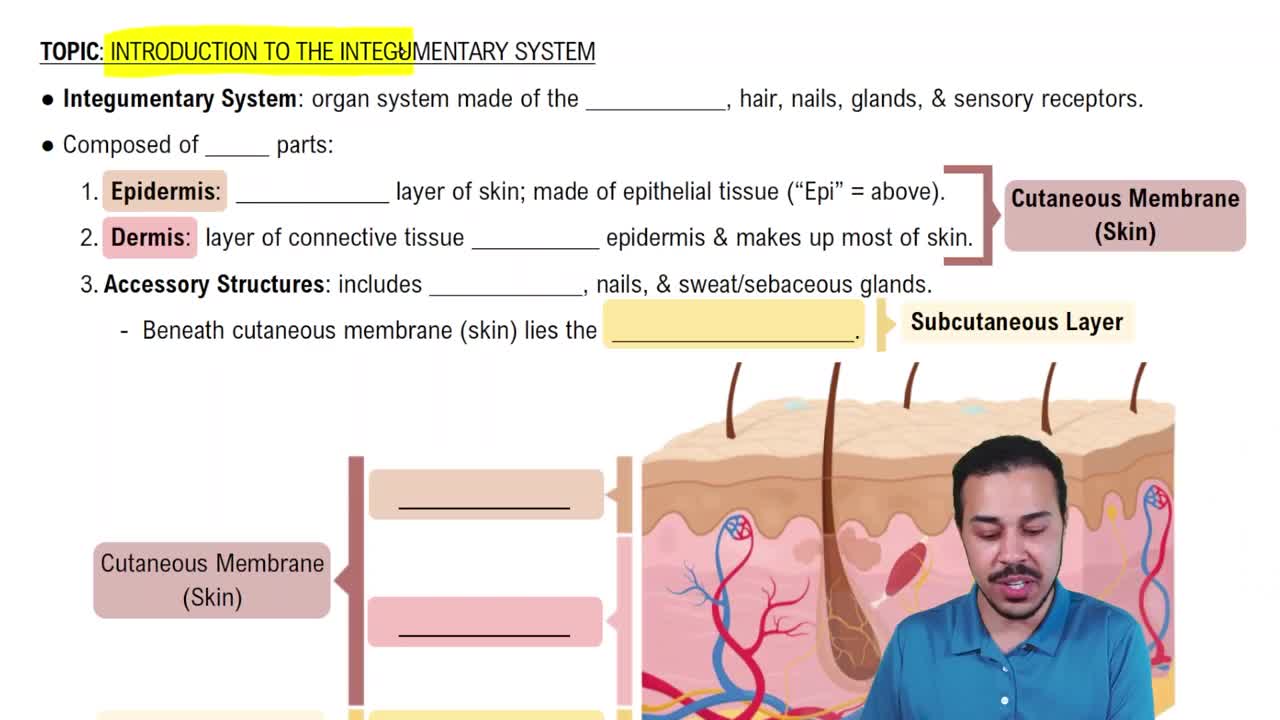
The integumentary system includes skin, hair, nails, sweat glands, sebaceous glands, and mammary glands.
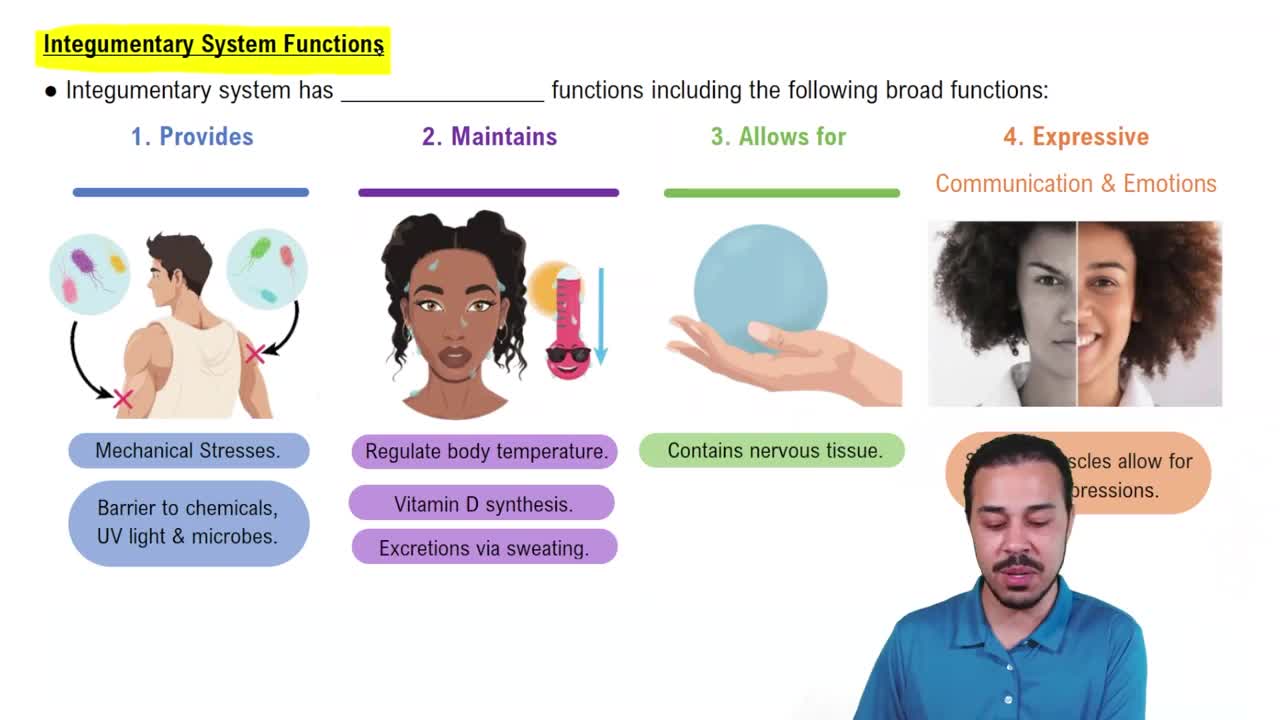
Skin provides protection, temperature regulation, excretion, synthesis and storage of lipids and vitamin D3, immune response coordination, and sensation.
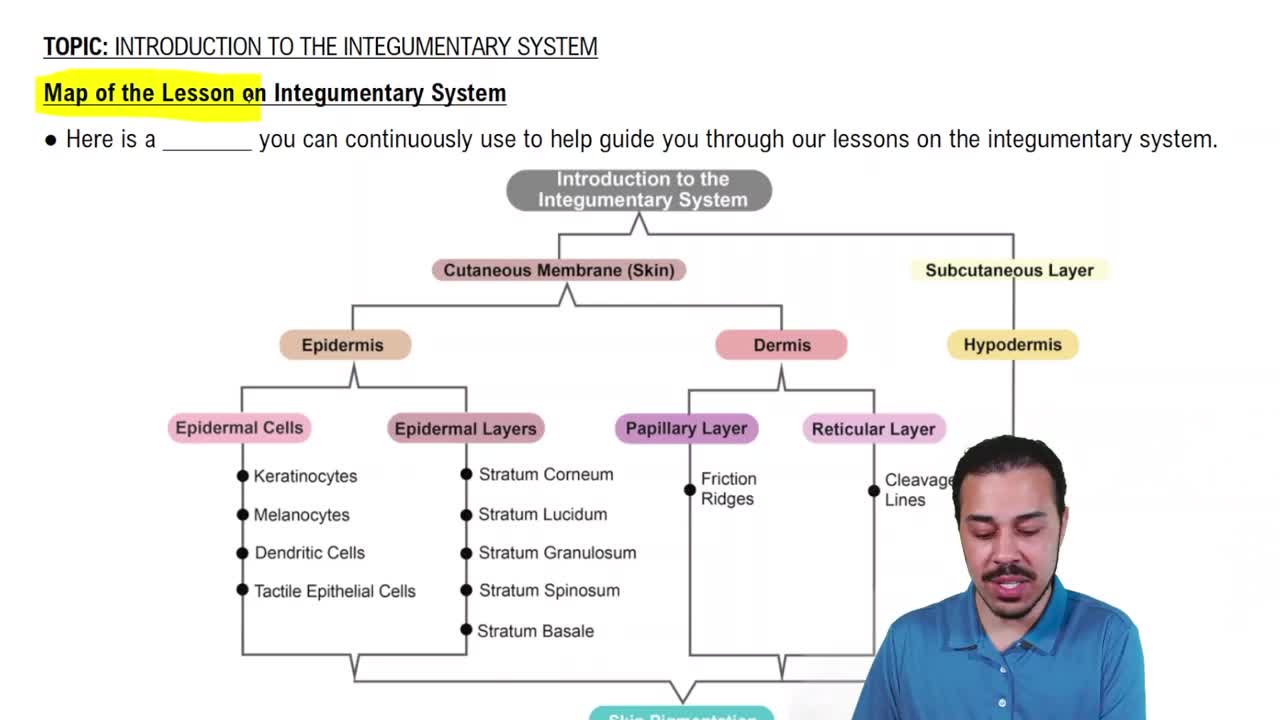
The cutaneous membrane consists of the epidermis (superficial epithelium) and the dermis (underlying connective tissue).
The hypodermis (subcutaneous layer) lies deep to the dermis, contains adipose tissue and blood vessels, and is not normally considered part of the integument.
The epidermis protects the dermis, controls skin permeability, prevents water loss, blocks pathogen entry, synthesizes vitamin D3, and contains sensory receptors.
The papillary layer nourishes and supports the epidermis; the reticular layer restricts pathogen spread, stores lipids, attaches skin to deeper tissues, and contains sensory receptors and blood vessels.
Keratinocytes (produce keratin), melanocytes (produce melanin), Merkel cells (sensory), and Langerhans cells (immune macrophages).
Stratum basale, stratum spinosum, stratum granulosum, stratum lucidum (only in thick skin), and stratum corneum.
It contains basal stem cells for regeneration, melanocytes for pigment, and Merkel cells for touch sensation.
Thick skin has five epidermal layers including stratum lucidum and is found on palms and soles; thin skin lacks stratum lucidum and covers most of the body.
Dermal papillae form ridges in the epidermis called epidermal ridges, creating unique fingerprint patterns.
Skin color depends on dermal blood supply, stratum corneum thickness, and concentrations of carotene and melanin, all under genetic control.
Melanin absorbs UV radiation, protecting skin cells from damage and contributing to natural skin color and tanning.
UV light converts a cholesterol precursor to vitamin D3, which is then activated in the liver and kidneys to regulate calcium metabolism.
The dermis contains the papillary layer (loose connective tissue, capillaries, neurons) and the reticular layer (dense irregular connective tissue, hair follicles, sweat and sebaceous glands).
Wrinkles result from aging, hormone changes, and UV damage; stretch marks occur when reticular fibers break due to excessive stretching.
They are patterns of collagen and elastic fibers aligned parallel in the dermis, guiding surgical incisions to reduce scarring.
Blood vessels form the cutaneous and subpapillary plexuses, aiding in thermoregulation and maintaining blood flow to tissues.
Tactile discs (light touch), Ruffini corpuscles (stretch), and lamellated corpuscles (deep pressure and vibration).
Hair follicles, sebaceous glands, sweat glands, and nails.
Hair is absent on the palms, soles, sides of fingers and toes, lips, and certain genital areas.
Hair papilla, hair bulb, hair matrix (keratinized cells), medulla (soft keratin), cortex (hard keratin), cuticle, hair root, and hair shaft.
Protection from UV light, insulation, guarding entrances (nose, ears), sensory input via root hair plexus, and goosebumps from arrector pili contraction.
Lanugo (embryonic, unpigmented), vellus (fine body hair), and terminal (head, eyebrows, eyelashes).
Hair color depends on melanin production by melanocytes; more melanin means darker hair, less melanin causes gray or white hair.
Active growth phase lasts 2-5 years with ~0.33 mm/day growth; resting phase where hair detaches and becomes a club hair; replacement hair then grows.
Sebaceous glands (sebum), sweat glands (apocrine and eccrine), ceruminous glands (earwax), and mammary glands (milk production).
They secrete oily sebum to lubricate skin and hair, inhibit bacterial growth, and are found everywhere except palms and soles.
Apocrine glands produce odorous secretions in armpits and nipples; eccrine glands produce watery sweat for cooling and are widespread.
Nails protect finger and toe tips; composed of nail body, root, lunula, eponychium, hyponychium, and nail folds.