Skip to main content
Anatomy & Physiology
My Course
Learn
Exam Prep
AI Tutor
Study Guides
Textbook Solutions
Flashcards
Explore
Try the app
My Course
Learn
Exam Prep
AI Tutor
Study Guides
Textbook Solutions
Flashcards
Explore
Try the app
Back
Integumentary System - Anatomy & Physiology
You can tap to flip the card.
What are the two major components of the integumentary system?
You can tap to flip the card.
👆
What are the two major components of the integumentary system?
Cutaneous membrane
and
accessory structures
.
Track progress
Control buttons has been changed to "navigation" mode.
1/31
Recommended videos
Guided course
06:54
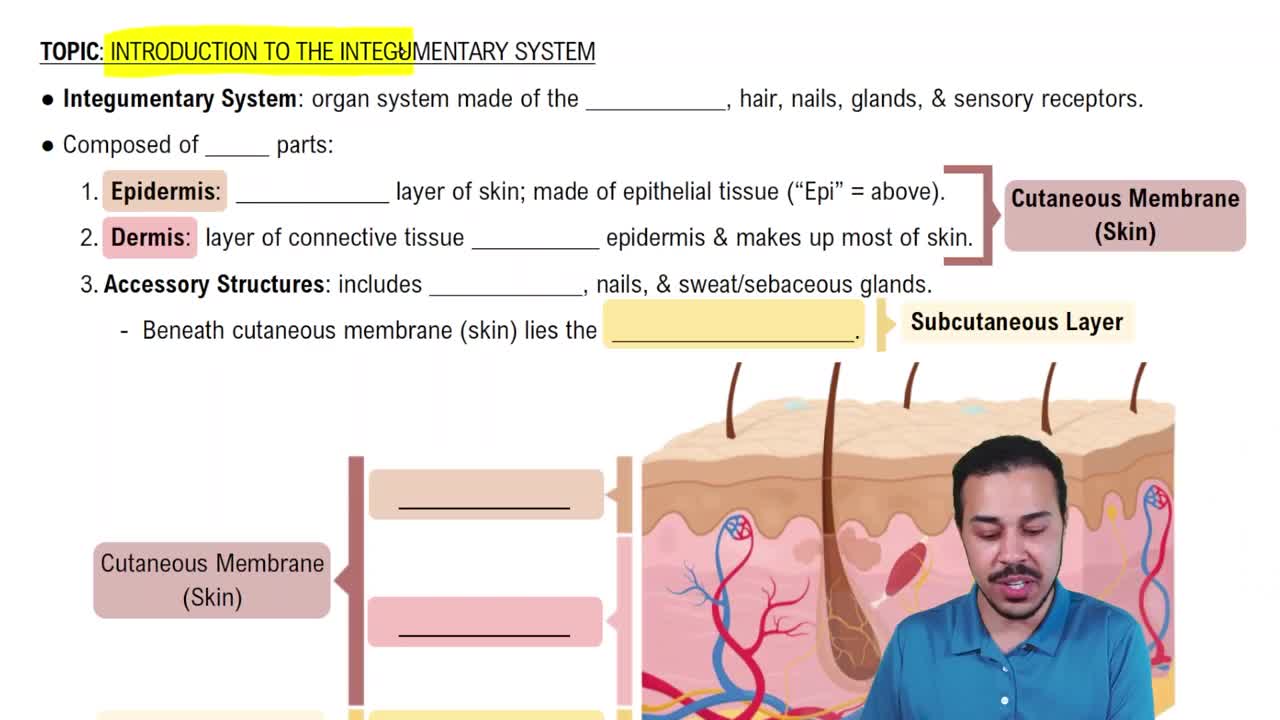
Introduction to the Integumentary System
23838
views
815
rank
3
comments
Guided course
03:40
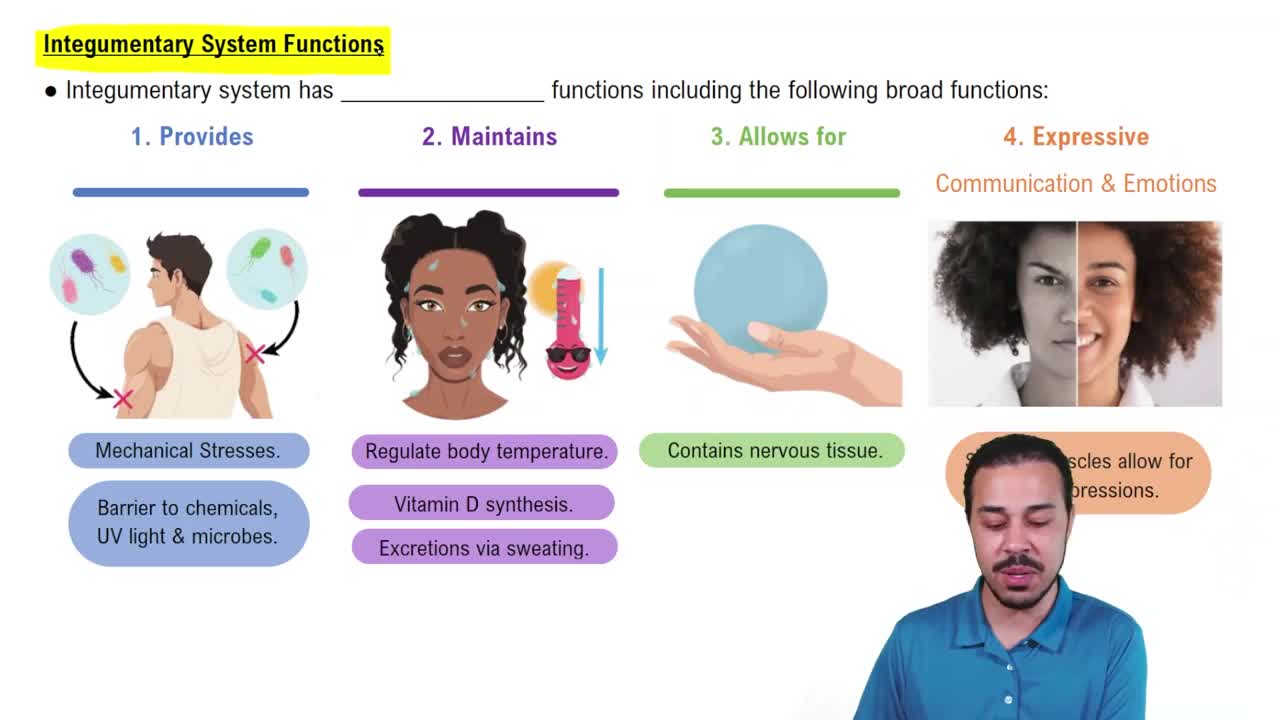
Integumentary System Functions
15496
views
393
rank
1
comments
Guided course
02:47
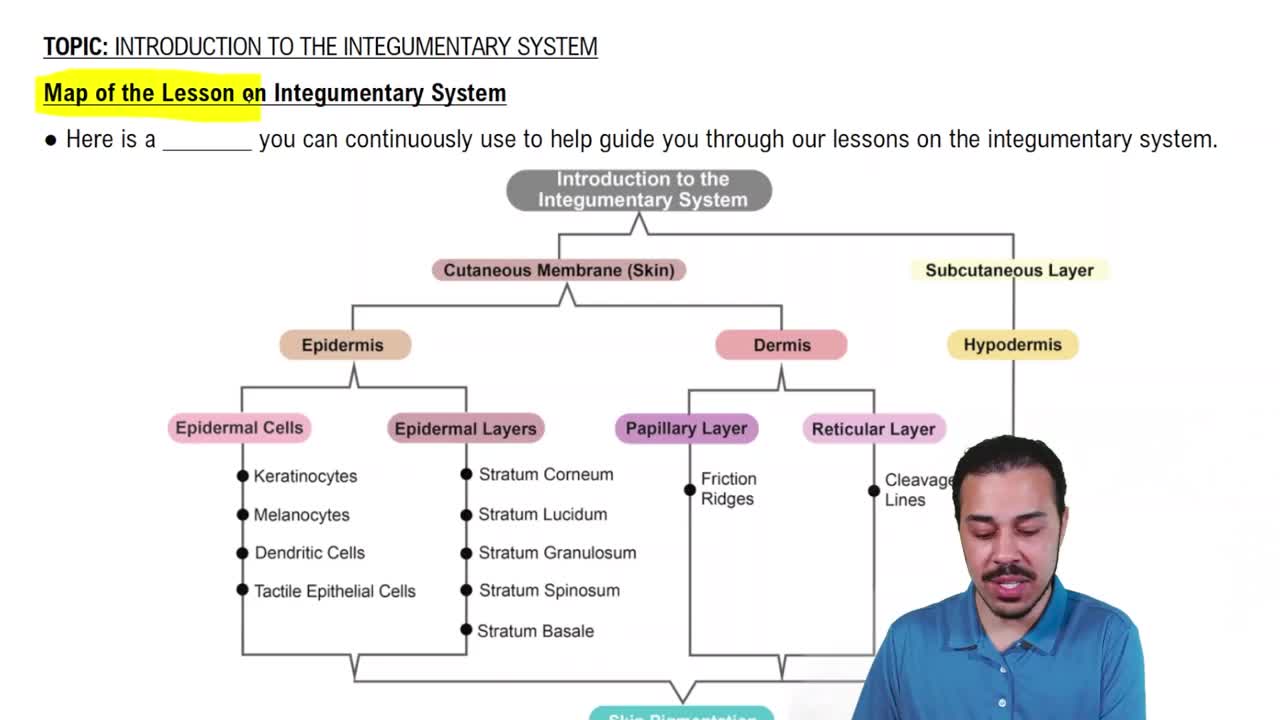
Map of the Lesson on Integumentary System
13635
views
646
rank
6
comments
Terms in this set (31)
Hide definitions
What are the two major components of the integumentary system?
Cutaneous membrane
and
accessory structures
.
What layers compose the cutaneous membrane?
The
epidermis
(stratified squamous epithelium) and the
dermis
(papillary and reticular layers).
Name the accessory structures of the integumentary system.
Hairs, nails, sebaceous glands, sweat glands, sensory receptors, arrector pili muscles, and cutaneous plexus.
What is the subcutaneous layer and is it part of the integument?
The
subcutaneous layer
(hypodermis) separates the integument from deep fascia and is
not
part of the integument.
What is the primary cell type in the epidermis?
Keratinocytes
are the primary cell type in the epidermis.
How many strata are in thick skin and where is it found?
Thick skin has
five strata
and is found on the palms and soles.
What is the function of epidermal ridges?
Epidermal ridges increase surface area for better attachment to the dermis.
Describe the stratum basale.
The deepest epidermal layer attached to the basement membrane; contains basal stem cells and Merkel cells for touch.
What cells are found in the stratum spinosum and their function?
Keratinocytes bound by desmosomes and dendritic (Langerhans) cells that participate in immune defense.
What happens in the stratum granulosum?
Keratinocytes stop dividing, produce keratin and keratohyalin, and their membranes thicken.
Where is the stratum lucidum found and what is its characteristic?
Found only in thick skin; composed of flattened, densely packed dead cells filled with keratin.
What is the stratum corneum and its function?
The outermost layer with 15–30 layers of dead keratinized cells; provides a water-resistant barrier.
What pigments influence skin color?
Carotene (orange-yellow) and melanin (brown to black) primarily influence skin color.
How does blood supply affect skin color?
Increased blood flow makes skin redder; decreased flow and oxygen cause pale or bluish (cyanosis) skin.
What is basal cell carcinoma?
The most common skin cancer originating in the stratum basale, usually caused by UV radiation, with low metastasis.
What distinguishes malignant melanoma?
A dangerous cancer of melanocytes that grows rapidly and metastasizes; early detection greatly improves survival.
What are the two layers of the dermis?
The
papillary layer
(areolar connective tissue) and the
reticular layer
(dense irregular connective tissue).
What is the function of the subcutaneous layer?
Separates skin from deeper tissues and stores energy in adipose tissue.
Name the sensory receptors found in the dermis.
Meissner corpuscles (light touch), Pacinian corpuscles (deep pressure), and Ruffini corpuscles (pressure/stretch).
What are the clinical implications of tension (cleavage) lines in skin?
Surgical cuts parallel to cleavage lines heal better with less scarring; perpendicular cuts tend to scar more.
What are the classifications of burns by depth?
First-degree (epidermis only), second-degree (epidermis and part of dermis), third-degree (full thickness including subcutaneous).
What is the rule of nines?
A method to estimate the percentage of body surface area affected by burns.
What are the types of skin grafts used in burn treatment?
Split-thickness grafts (epidermis and superficial dermis) and full-thickness grafts (epidermis and full dermis).
What are the two types of hair and their characteristics?
Terminal hairs are large, coarse, pigmented; vellus hairs are smaller, shorter, and delicate.
What is the role of the arrector pili muscle?
A smooth muscle that contracts to pull hair erect, causing 'goosebumps.'
What are sebaceous glands and their secretion?
Holocrine glands that secrete sebum, an oily mixture that lubricates hair and skin and has antimicrobial properties.
What are the two types of sweat glands and their functions?
Apocrine glands produce odorous secretions in specific areas; merocrine (eccrine) glands produce watery sweat for thermoregulation.
What is the structure and function of nails?
Nails are thick sheets of keratinized cells that protect finger and toe tips and help limit digit distortion.
How does aging affect the integumentary system?
Fewer melanocytes, drier and thinner epidermis, diminished immune response, thinning dermis, decreased perspiration, slower repair, and altered hair/fat distribution.
How does the skin contribute to vitamin D3 production?
UV radiation converts steroids in epidermal cells to cholecalciferol (vitamin D3), which is then processed to calcitriol for calcium absorption.
What are the four phases of skin regeneration after injury?
Inflammation, migration, proliferation, and scarring phases.
 BackBack
 06:54