Back

Integumentary System - Anatomy & Physiology

Control buttons has been changed to "navigation" mode.
1/28
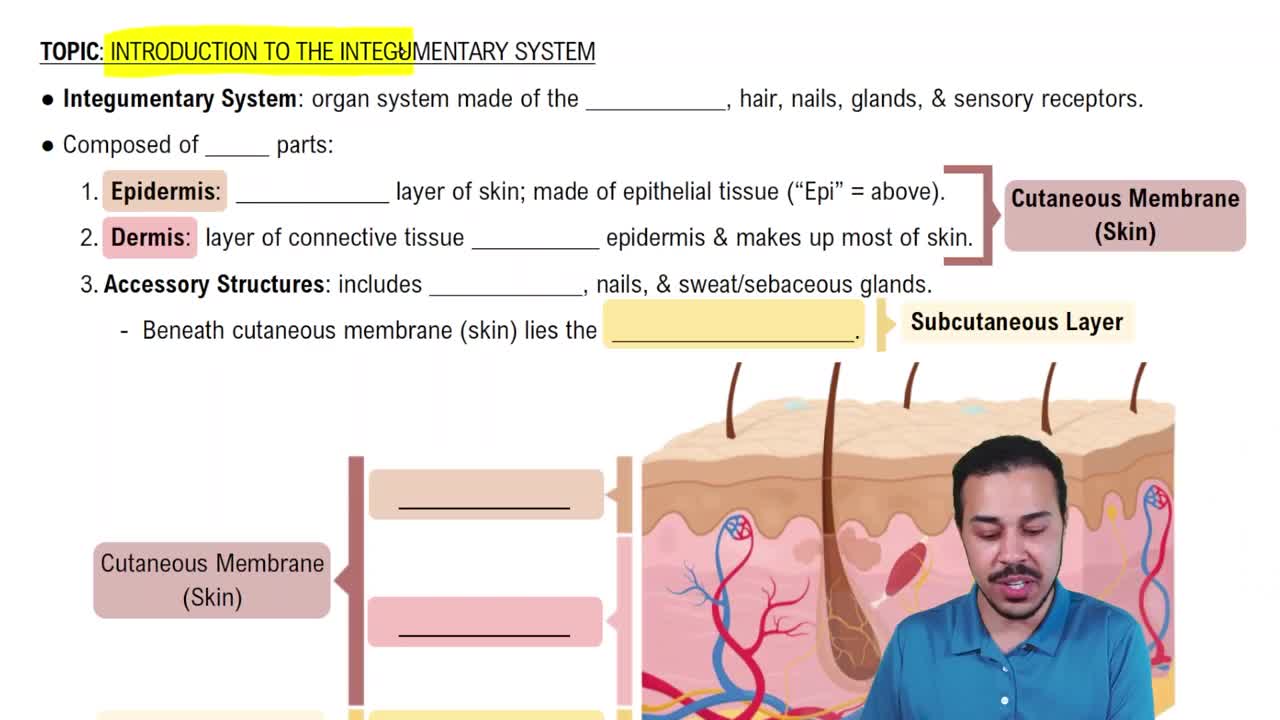
  • What are the main components of the integumentary system?

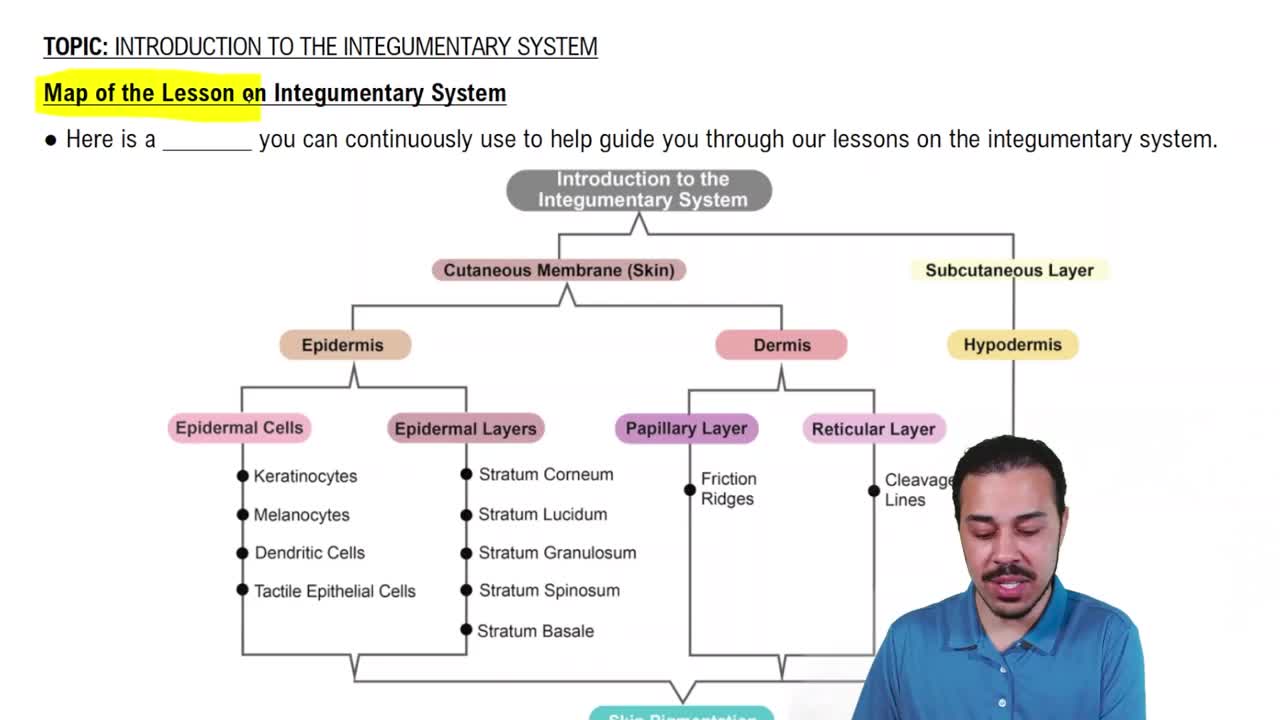
    The integumentary system consists of the skin and its epidermal derivatives, including hair, nails, and glands.
  • What percentage of body weight does the skin approximately account for?

    The skin accounts for approximately 10-15% of body weight.
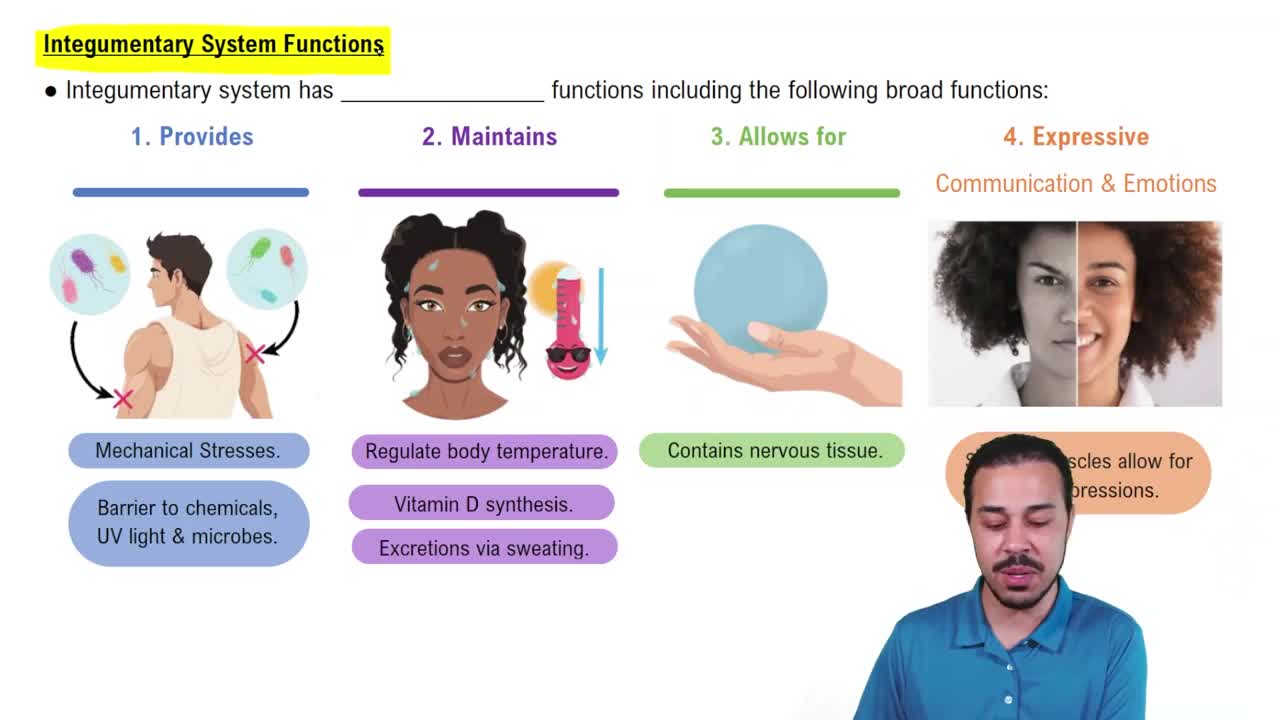
  • List the primary functions of the skin.

    • Barrier protection
    • Immunologic defense
    • Thermoregulation
    • Protection from UV radiation
    • Nerve sensation
    • Injury repair
    • Excretion and vitamin D synthesis
    • Appearance and quality of life
  • What composes the physical barrier of the skin?

    The stratum corneum, made of dead keratinized cells and glycolipids, prevents entry of harmful substances and minimizes water loss.
  • How does the skin chemically protect against bacteria?

    Through the acid mantle and secretions that inhibit bacterial growth.
  • Name the immune cells involved in the skin's biological barrier.

    Dendritic cells and macrophages detect and destroy pathogens.
  • What role do dendritic cells play in skin immunity?

    They patrol beneath the skin’s surface, capturing foreign invaders.
  • Describe the negative feedback loop in thermoregulation by the skin.

    Temperature-sensitive cells detect change, the control center processes it, and sweat glands activate to cool the body.
  • How does melanin protect the skin?

    Melanin shields DNA from ultraviolet (UV) radiation.
  • What are the three types of sensory receptors in the skin?

    • Mechanoreceptors (touch, pressure, vibration)
    • Thermoreceptors (heat, cold)
    • Nociceptors (pain)
  • What wastes are excreted through sweat?

    Sweat eliminates lactic acid, urea, toxins, and metals.
  • Outline the phases of wound healing in the skin.

    1. Coagulation: clot formation
    2. Inflammatory: heat, redness, swelling
    3. Proliferation-Migratory: new capillaries, collagen production
    4. Remodeling: wound contraction, scar formation
  • What clinical condition is indicated by yellow skin coloration?

    Jaundice, often due to liver dysfunction and bilirubin buildup.
  • What cell types are found in the epidermis?

    Keratinocytes, dendritic (Langerhans) cells, tactile epithelial (Merkel) cells, and melanocytes.
  • What distinguishes thick skin from thin skin?

    Thick skin has five layers, no hair follicles, and many sweat glands; thin skin has four layers, hair follicles, sweat, and sebaceous glands.
  • Name the five layers of the epidermis in thick skin.

    Stratum basale, stratum spinosum, stratum granulosum, stratum lucidum, stratum corneum.
  • How long does keratinocyte migration from basal layer to shedding take?

    Approximately 40-50 days.
  • What is the epidermal-dermal junction (EDJ)?

    The basement membrane interface connecting epidermis and dermis; weakest structural point prone to blistering.
  • What are the two main layers of the dermis and their functions?

    • Papillary layer: areolar connective tissue, blood supply, sensory receptors
    • Reticular layer: dense irregular connective tissue, strength, elasticity, glands, hair follicles
  • What is the hypodermis composed of and its function?

    Loose connective tissue and adipocytes; provides cushioning, insulation, and energy storage.
  • Describe the Rule of Nines in burn assessment.

    Estimates total body surface area affected by burns by assigning percentages to body regions (e.g., head 9%, each leg 18%).
  • What are the four types of sweat glands?

    • Eccrine: most common, secrete water and electrolytes
    • Apocrine: specific locations, active after puberty
    • Ceruminous: produce ear wax
    • Mammary: produce milk
  • What is the function of sebaceous glands?

    Produce sebum, an oily secretion that lubricates hair and skin; influenced by sex hormones.
  • What are the three types of hair and their characteristics?

    • Lanugo: fetal hair, falls out at birth
    • Vellus: short, fine, soft body hair
    • Terminal: long, coarse, thick, dark hair
  • What is psoriasis?

    An immune-mediated skin disorder causing rapid skin cell turnover, resulting in scaly, red, itchy patches.
  • What are the ABCDs of malignant melanoma?

    Asymmetry, Border irregularity, Color variation, Diameter greater than 6 mm.
  • What is vitiligo?

    An autoimmune disease causing loss of melanocytes and depigmentation of the skin.
  • How is vitamin D synthesized in the skin?

    UV radiation converts 7-dehydrocholesterol to cholecalciferol, then liver and kidneys convert it to active vitamin D (calcitriol).