Skip to main content
Anatomy & Physiology
My Course
Learn
Exam Prep
AI Tutor
Study Guides
Textbook Solutions
Flashcards
Explore
Try the app
My Course
Learn
Exam Prep
AI Tutor
Study Guides
Textbook Solutions
Flashcards
Explore
Try the app
Back
Integumentary System - Medical Terminology Unit2 Chapter 5
You can tap to flip the card.
What is the integumentary system?
You can tap to flip the card.
👆
What is the integumentary system?
The integumentary system includes the
skin, hair, and nails
and is the body's largest organ system.
Track progress
Control buttons has been changed to "navigation" mode.
1/30
Recommended videos
Guided course
06:54
Introduction to the Integumentary System
24075
views
820
rank
3
comments
Guided course
03:40
Integumentary System Functions
15632
views
394
rank
1
comments
Guided course
02:47
Map of the Lesson on Integumentary System
13779
views
649
rank
6
comments
Terms in this set (30)
Hide definitions
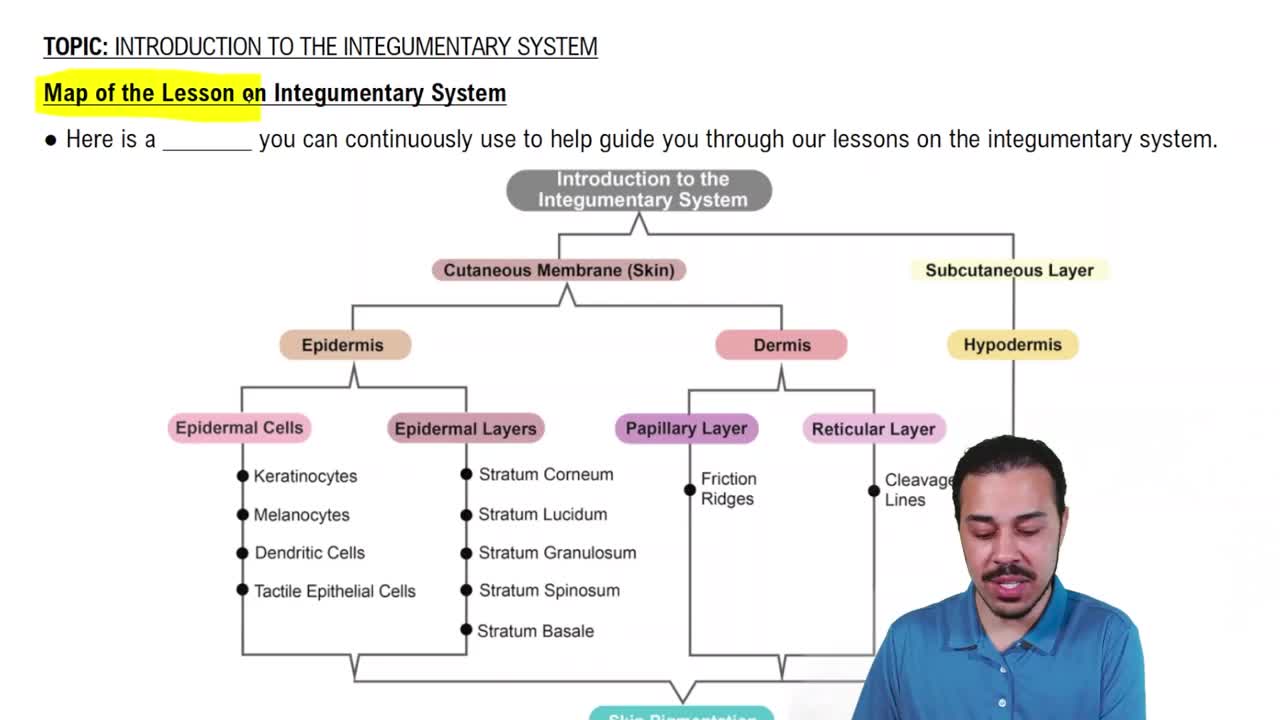
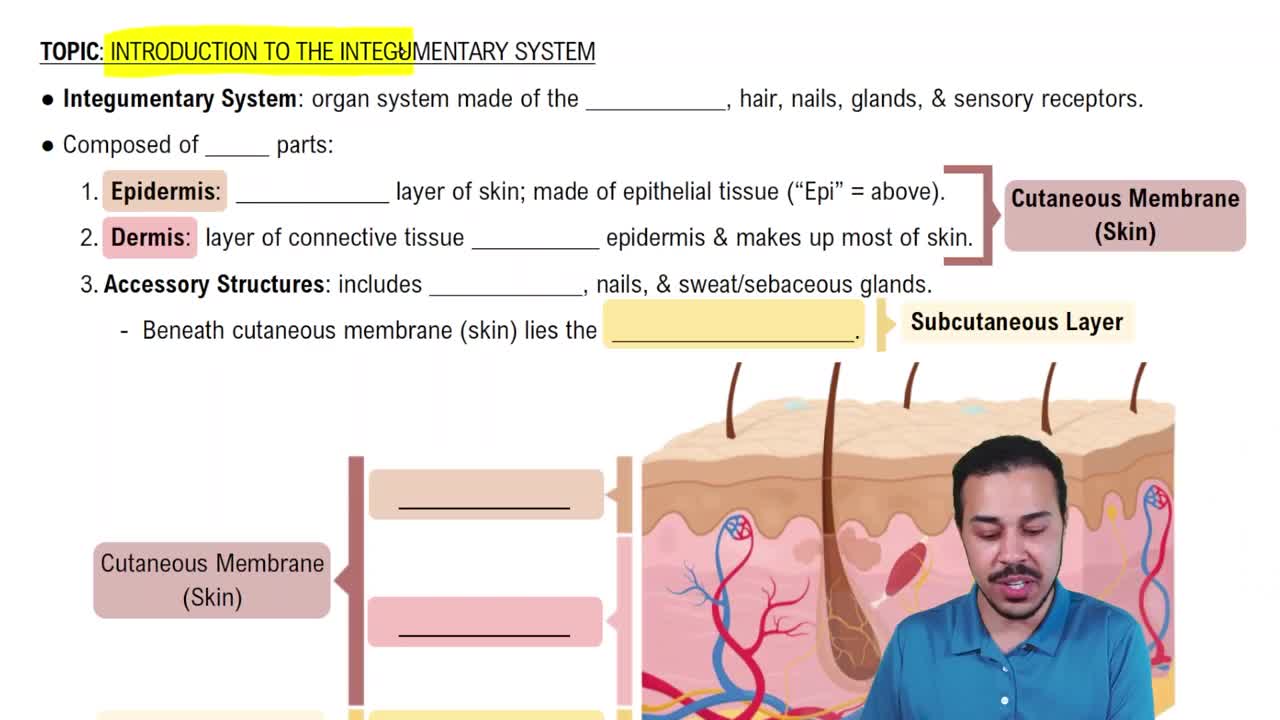
What is the integumentary system?
The integumentary system includes the
skin, hair, and nails
and is the body's largest organ system.
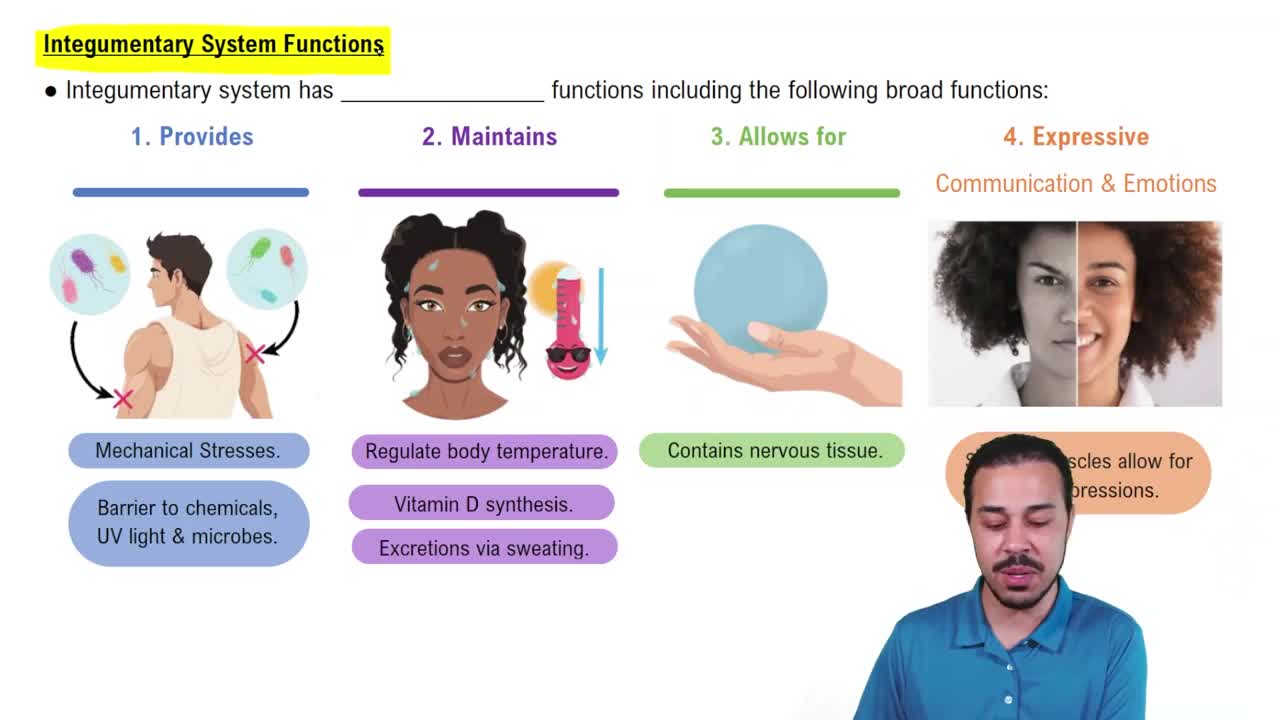
What are the main functions of the integumentary system?
Protection, temperature regulation, sensation, and waste disposal
.
How does the skin regulate body temperature when too hot?
Evaporation of sweat and dilation of blood vessels in the skin help
cool the body
.
How does the skin conserve heat when the body is too cold?
Constriction of blood vessels and the fatty subcutaneous layer serve as
insulation
to conserve heat.
What are sensory receptors in the skin responsible for?
They send information about
touch, pressure, temperature, and pain
to the brain.
Define the root word 'derm/' or 'cutane/'.
Both mean
skin
.
What does the suffix '-oma' mean?
It means
tumor
.
What does the prefix 'epi-' mean?
It means
above
.
What is a lipoma?
A
fatty tumor
formed by combining lip- (fat) and -oma (tumor).
What is an abrasion?
A
skin injury
that scrapes away the surface of the skin, causing redness and pain.
What is an abscess?
A
collection of pus
in the skin, often with redness, elevation, and pain.
What is acne?
Inflammation of the
sebaceous glands and hair follicles
.
Define alopecia.
The
absence or loss of hair
, especially on the head.
What is ecchymosis?
A
black-and-blue bruise
caused by blood collecting under the skin after trauma.
What is erythema?
Redness of the skin
.
What is eczema?
A skin condition with
erythema, vesicles, itching, and crusting
of unknown cause.
What is malignant melanoma?
A
skin cancer
originating in melanocytes, with changes in moles or new growths.
Define necrosis.
The
death of tissue
, usually due to lack of oxygen.
What is pruritus?
Severe itching
caused by an allergen.
What causes shingles?
Infection of nerve root by
varicella-zoster virus
, causing painful skin blisters along nerves.
Describe a first-degree burn.
Mild burn damaging only the
epidermis
, causing redness but no blisters or scarring.
Describe a second-degree burn.
Burn extending through epidermis into dermis, causing
blisters
and possible scarring.
Describe a third-degree burn.
Burn damaging full thickness of skin and underlying tissues, requiring
skin grafts
and causing scarring.
What is a biopsy?
Surgical removal of tissue to examine under a microscope for diagnosis.
What is cryosurgery?
Use of
extreme cold
to freeze and destroy abnormal tissue.
Name three types of dermatological medications.
Corticosteroids, antibiotics, and antifungals
.
What does the abbreviation 'ID' stand for?
Intradermal
(injection into the skin).
What does the abbreviation 'SubQ' or 'Subcut' mean?
Subcutaneous
(under the skin).
What does the abbreviation 'IM' stand for?
Intramuscular
(injection into muscle).
What does the abbreviation 'IV' mean?
Intravenous
(injection into a vein).
 BackBack
 06:54