 Back
BackIntroduction to Chemistry
 02:13
02:13
Terms in this set (20)
A pure substance that cannot be broken down further and contains only one type of atom.
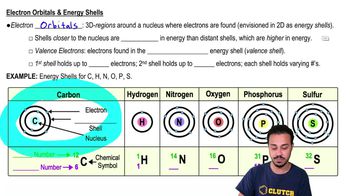
An atom consists of a nucleus containing protons (+ charge) and neutrons (neutral), surrounded by electrons (- charge) orbiting in shells.
The number of protons in the nucleus of an atom.
An atom is electrically neutral, while an ion is charged due to loss or gain of electrons.
Cation: positively charged ion (lost electrons).
Anion: negatively charged ion (gained electrons).
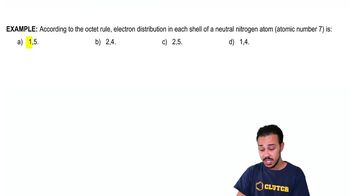
Electrons orbit in electron shells with specific capacities: 1st shell = 2, 2nd shell = 8, 3rd shell = 8 electrons.
The outermost electron shell of an atom, which determines chemical reactivity.
Atoms with filled valence shells are inert; those with unfilled valence shells are reactive.
A chemical bond formed by the transfer of electrons from one atom to another, creating oppositely charged ions that attract.
A chemical bond formed when atoms share one or more pairs of electrons to fill their valence shells.
By covalent bonds between one oxygen atom and two hydrogen atoms sharing electrons.
Because oxygen is more electronegative than hydrogen, it attracts shared electrons more strongly, creating partial charges.
The attraction an atom has for shared electrons in a covalent bond.
An attraction between the slightly positive hydrogen pole of one polar molecule and the slightly negative pole of another.
Hydrogen bonds are weaker intermolecular attractions, not bonds formed by electron transfer or sharing.
They help hold large molecules like proteins and DNA together by stabilizing their structure.
Chemical bonds hold atoms together to form molecules, achieving stability in valence electron shells.
Atoms combine to form molecules, which build cells; similar cells form tissues, and tissues combine to form organs.
Protons and neutrons each have a mass of about 1 amu, electrons have negligible mass (~0 amu).
By filling their valence electron shells through sharing (covalent) or transferring (ionic) electrons.