Back

Introduction to the Skeletal System - Anatomy & Physiology

Control buttons has been changed to "navigation" mode.
1/28
  • Functions of the skeletal system

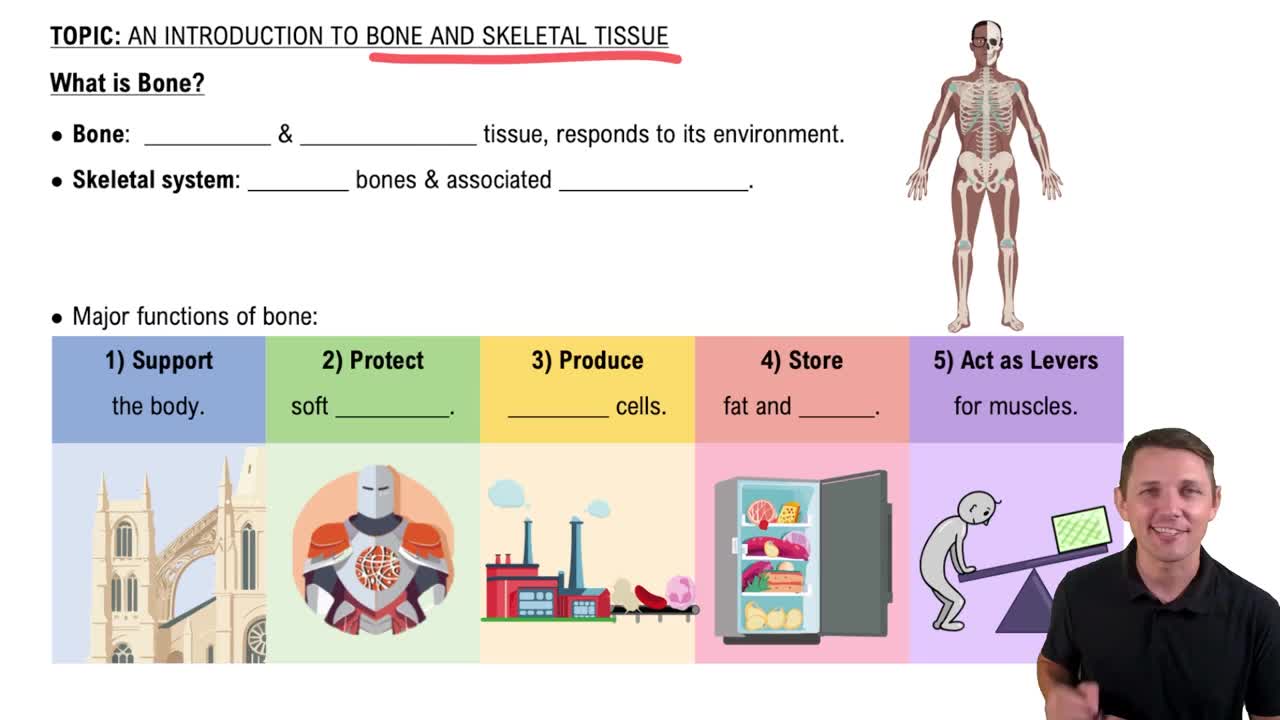
    • Protection of vital organs
    • Support for body shape and organ placement
    • Mineral storage mainly calcium phosphate
    • Lipid storage in yellow bone marrow
    • Blood cell production in red bone marrow
    • Leverage for movement
  • Hyaline cartilage characteristics and function

    Firm but flexible connective tissue that allows strong connections with some flexibility, e.g., sternum to ribs for chest expansion.
  • Fibrocartilage characteristics and function

    Stronger and tougher cartilage that absorbs shock and provides strength, found in intervertebral discs.
  • Ligaments function

    Dense regular connective tissue that anchors bone to bone and stabilizes joints.
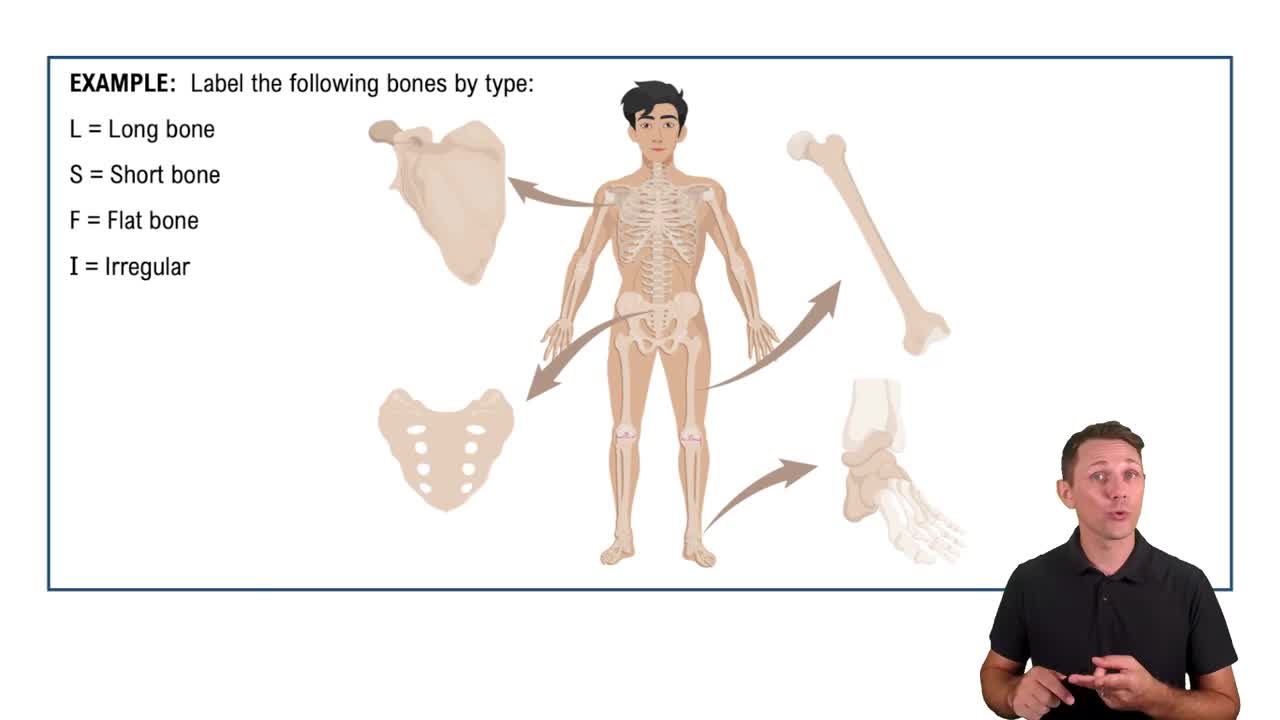
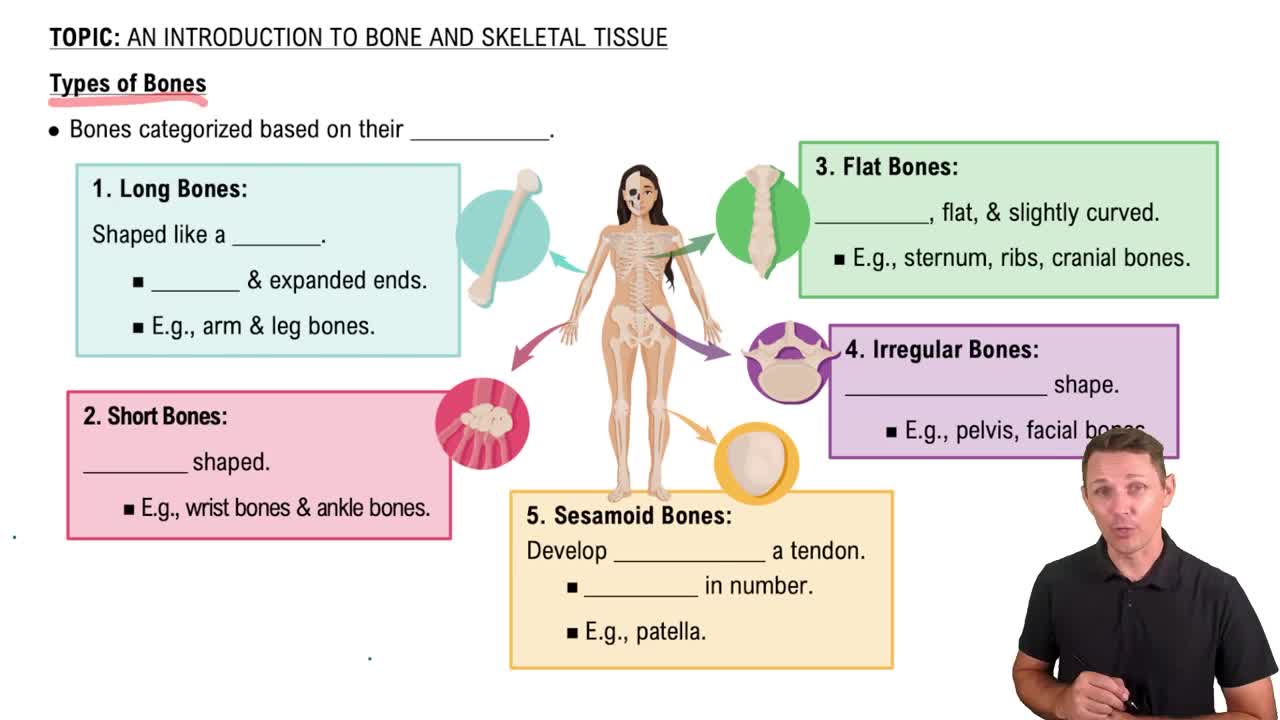
  • Classification of flat bones

    Thin, flat bones containing red marrow, e.g., skull, sternum, ribs.
  • Long bones definition and examples

    Bones longer than wide with a shaft and rounded ends, mostly in extremities, e.g., femur, humerus, finger bones.
  • Short bones characteristics and examples

    Small, round, pebble-like bones such as carpals (wrist) and tarsals (ankle).
  • Sesamoid bones and function

    Specialized short bones embedded in tendons, e.g., patella, that improve tendon movement and muscle mechanics.
  • Red marrow location and function

    Found mainly in flat bones; responsible for blood cell production.
  • Yellow marrow location and function

    Found mainly in other bone types; functions as fat storage.
  • Foramen and canal function

    Holes or tunnels in bone that serve as passageways for nerves and blood vessels.
  • Condyle vs Epicondyle

    Condyle: smooth, rounded projection for articulation.
    Epicondyle: rough, jagged projection for muscle attachment.
  • Long bone anatomy: Diaphysis

    The shaft or middle section of a long bone containing the medullary cavity with yellow marrow.
  • Long bone anatomy: Epiphysis

    Rounded ends of long bones that form joints (articulations).
  • Growth plate (metaphysis) characteristics

    Hyaline cartilage in children allowing bone lengthening; replaced by bone in adults.
  • Articular cartilage function

    Covers epiphyses at joints to prevent bone-on-bone friction and allow smooth movement.
  • Compact bone vs Spongy bone

    Compact bone: dense outer layer with osteons and central canals.
    Spongy bone: porous inner layer with trabeculae, no osteons.
  • Osteoblasts function

    Bone-building cells that produce osteoid and build bone tissue.
  • Osteoclasts function

    Bone-destroying cells that break down bone and release calcium; modified macrophages.
  • Bone homeostasis balance

    Balance between osteoblasts (build bone) and osteoclasts (break down bone) controls bone density.
  • Effect of weight-bearing exercise on bones

    Stimulates osteoblast activity, promoting bone formation and increased density.
  • Role of Vitamin D in bone health

    Needed to absorb calcium; converted in kidneys to calcitriol which signals intestines to absorb calcium.
  • Calcitonin vs Parathyroid Hormone (PTH)

    Calcitonin: lowers blood calcium by stopping osteoclasts.
    PTH: raises blood calcium by stimulating osteoclasts and increasing absorption.
  • Stages of osteogenesis (bone formation)

    1) Bone formation during fetal development
    2) Postnatal bone growth
    3) Bone remodeling and repair throughout life.
  • Types of bone growth

    Interstitial growth: lengthening at growth plates.
    Appositional growth: increase in bone thickness.
  • Fracture repair methods

    Closed reduction: manual realignment without surgery.
    Open reduction: surgical realignment with pins, screws, or rods.
  • Osteoporosis characteristics

    Severe bone loss causing fragile bones and fractures; lost bone cannot be fully rebuilt.
  • Difference between osteopenia and osteoporosis

    Osteopenia is mild bone loss; osteoporosis is severe bone loss with increased fracture risk.