Back

Joints and Movements Unit 2 Chapter 8

Control buttons has been changed to "navigation" mode.
1/39
  • What is an articulation (joint)?

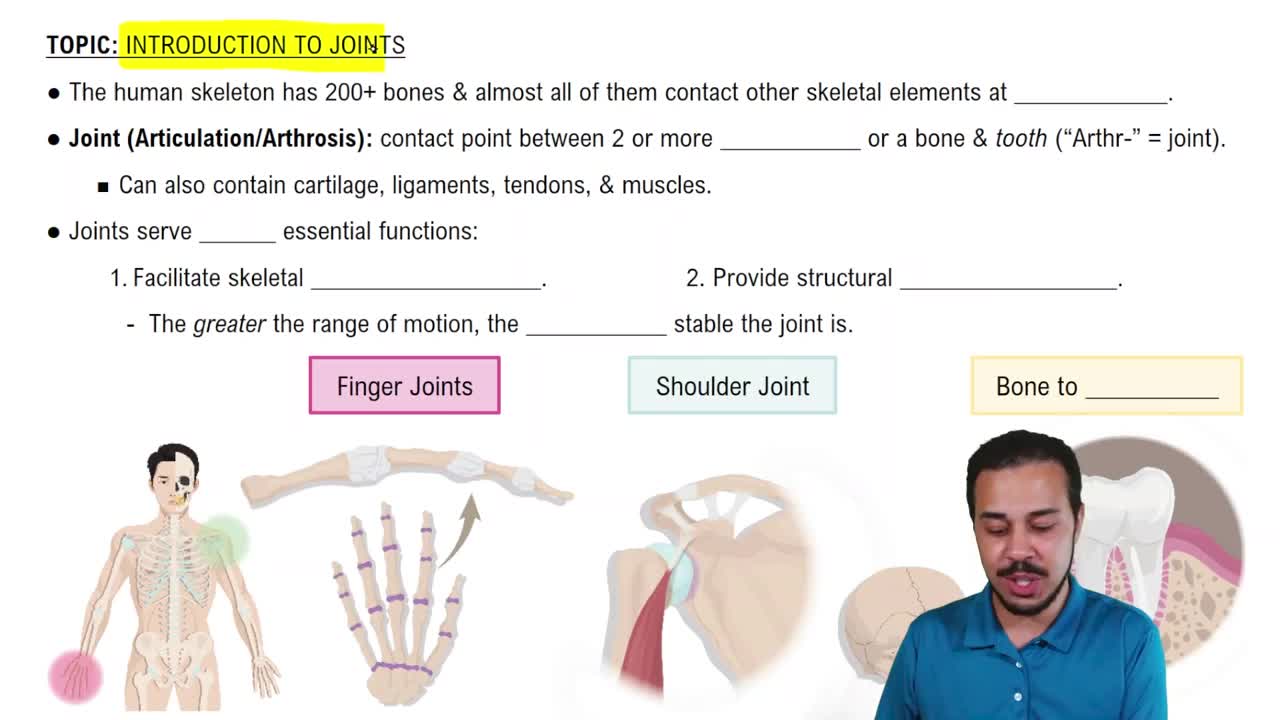
    A site where two or more bones meet, allowing skeleton mobility and holding the skeleton together.
  • What are the three functional classifications of joints?

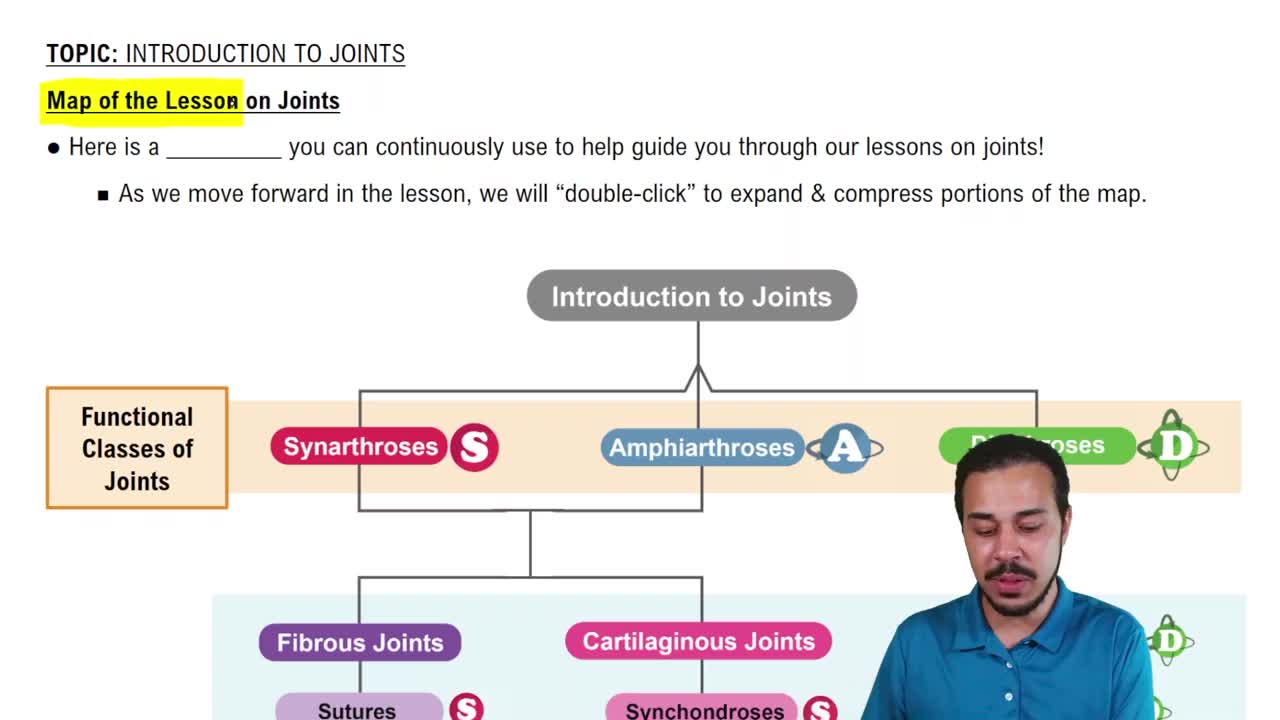
    Synarthroses (immovable), Amphiarthroses (slightly movable), and Diarthroses (freely movable).
  • What are the three structural classifications of joints?

    Based on material binding bones and presence of joint cavity: Fibrous joints, Cartilaginous joints, and Synovial joints.
  • Describe fibrous joints and their types.

    Bones joined by dense fibrous connective tissue with no joint cavity. Types: Sutures, Syndesmoses, and Gomphoses.
  • What are sutures and their characteristics?

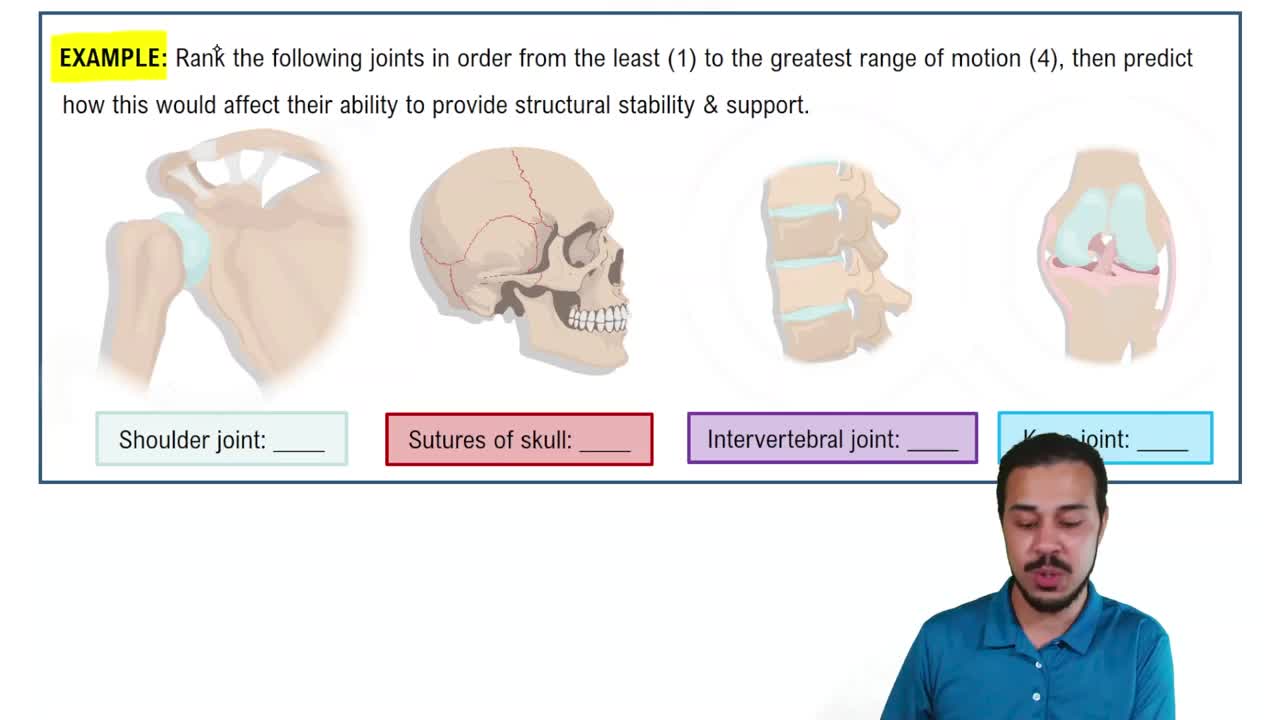
    Rigid, interlocking, immovable joints in the skull with short connective tissue fibers; allow growth in youth and ossify in middle age.
  • What are syndesmoses?

    Bones connected by ligaments with variable fiber length, allowing variable movement, e.g., interosseous membrane between radius and ulna.
  • What is a gomphosis?

    A peg-in-socket fibrous joint where teeth are held in alveolar sockets by the periodontal ligament.
  • Describe cartilaginous joints and their types.

    Bones united by cartilage with no joint cavity; types include Synchondroses (hyaline cartilage) and Symphyses (fibrocartilage).
  • What are synchondroses?

    Bones united by hyaline cartilage, mostly immovable, e.g., epiphyseal plates and first rib-sternum joint.
  • What are symphyses?

    Bones united by fibrocartilage with some hyaline cartilage; strong, flexible, and slightly movable joints like intervertebral discs.
  • What defines synovial joints?

    Bones separated by a fluid-filled joint cavity; all are freely movable (diarthrotic) and include most limb joints.
  • Name the six distinguishing features of synovial joints.

    1. Articular cartilage, 2. Joint cavity, 3. Articular capsule, 4. Synovial fluid, 5. Reinforcing ligaments, 6. Nerves and blood vessels.
  • What is the function of synovial fluid?

    Lubricates and nourishes articular cartilage and contains phagocytic cells to remove microbes and debris.
  • What are bursae and tendon sheaths?

    Bursae are sacs lined with synovial membrane containing fluid to reduce friction; tendon sheaths are elongated bursae around tendons.
  • What are the three stabilizing factors at synovial joints?

    1. Shapes of articular surfaces, 2. Ligament number and location, 3. Muscle tendons crossing the joint (most important).
  • Define origin and insertion in muscle attachment.

    Origin is attachment to immovable bone; insertion is attachment to movable bone; muscle contraction moves insertion toward origin.
  • What are the four types of synovial joint movements based on range of motion?

    Nonaxial (slipping), Uniaxial (one plane), Biaxial (two planes), and Multiaxial (all three planes).
  • What are the three general types of synovial joint movements?

    1. Gliding, 2. Angular movements (flexion, extension, abduction, adduction, circumduction), 3. Rotation (medial and lateral).
  • Describe gliding movements with examples.

    One flat bone surface slips over another; examples include intercarpal and intertarsal joints.
  • What is the difference between flexion, extension, and hyperextension?

    Flexion decreases joint angle, extension increases it, and hyperextension moves beyond anatomical position.
  • Define abduction, adduction, and circumduction.

    Abduction moves limb away from midline, adduction moves it toward midline, circumduction is a circular movement combining flexion, extension, abduction, and adduction.
  • What is rotation in synovial joints?

    Turning of a bone around its own long axis; can be medial (toward midline) or lateral (away from midline).
  • List special movements at synovial joints.

    Supination/pronation, dorsiflexion/plantar flexion, inversion/eversion, protraction/retraction, elevation/depression, and opposition of the thumb.
  • Name the six types of synovial joints based on shape.

    Plane, hinge, pivot, condylar, saddle, and ball-and-socket joints.
  • What are the characteristics of the knee joint?

    Largest, most complex joint; includes femoropatellar and tibiofemoral joints; allows flexion, extension, and some rotation.
  • What ligaments stabilize the knee joint?

    Capsular and extracapsular ligaments (fibular and tibial collateral, oblique and arcuate popliteal) and intracapsular ligaments (anterior and posterior cruciate).
  • What are common knee joint injuries?

    Injuries often affect collateral ligaments, cruciate ligaments, and cartilages (menisci), especially from lateral blows.
  • Describe the shoulder (glenohumeral) joint.

    A ball-and-socket joint between humerus head and glenoid cavity; most freely moving but less stable.
  • What structures reinforce the shoulder joint?

    Coracohumeral and glenohumeral ligaments, tendon of long head of biceps brachii, and four rotator cuff tendons.
  • Describe the elbow joint and its ligaments.

    Hinge joint between humerus and ulna; stabilized by anular ligament and collateral ligaments restricting side-to-side movement.
  • Describe the hip (coxal) joint and its stability.

    Ball-and-socket joint between femur head and acetabulum; deep socket with acetabular labrum enhances stability.
  • What ligaments reinforce the hip joint?

    Iliofemoral, pubofemoral, ischiofemoral ligaments, and ligamentum teres.
  • What is the temporomandibular joint (TMJ) and its movements?

    Joint between mandibular condyle and temporal bone; allows hinge (elevation/depression) and gliding (side-to-side) movements.
  • What are common joint injuries?

    Cartilage tears, sprains, dislocations (luxations), and inflammatory conditions like bursitis and tendonitis.
  • What is osteoarthritis?

    Common degenerative arthritis caused by cartilage breakdown, leading to bone spurs and restricted movement.
  • What is rheumatoid arthritis?

    Chronic autoimmune inflammatory disease causing joint pain, swelling, and tissue destruction.
  • What is gouty arthritis?

    Inflammation caused by uric acid crystal deposits in joints, often affecting the great toe.
  • What is Lyme disease in relation to joints?

    Bacterial infection from tick bites causing joint pain and arthritis; treated with antibiotics.
  • How do joints develop and change with age?

    Synovial joints form by embryonic week 8; size and flexibility change with use; aging weakens ligaments and tendons, increasing arthritis risk.