Skip to main content
Anatomy & Physiology
My Course
Learn
Exam Prep
AI Tutor
Study Guides
Textbook Solutions
Flashcards
Explore
Try the app
My Course
Learn
Exam Prep
AI Tutor
Study Guides
Textbook Solutions
Flashcards
Explore
Try the app
Back
Joints of the Body - Anatomy & Physiology
You can tap to flip the card.
What is a joint (articulation)?
You can tap to flip the card.
👆
What is a joint (articulation)?
A
joint
or
articulation
is a place where two or more bones come together and touch, usually covered by cartilage.
Track progress
Control buttons has been changed to "navigation" mode.
1/28
Recommended videos
Guided course
04:06
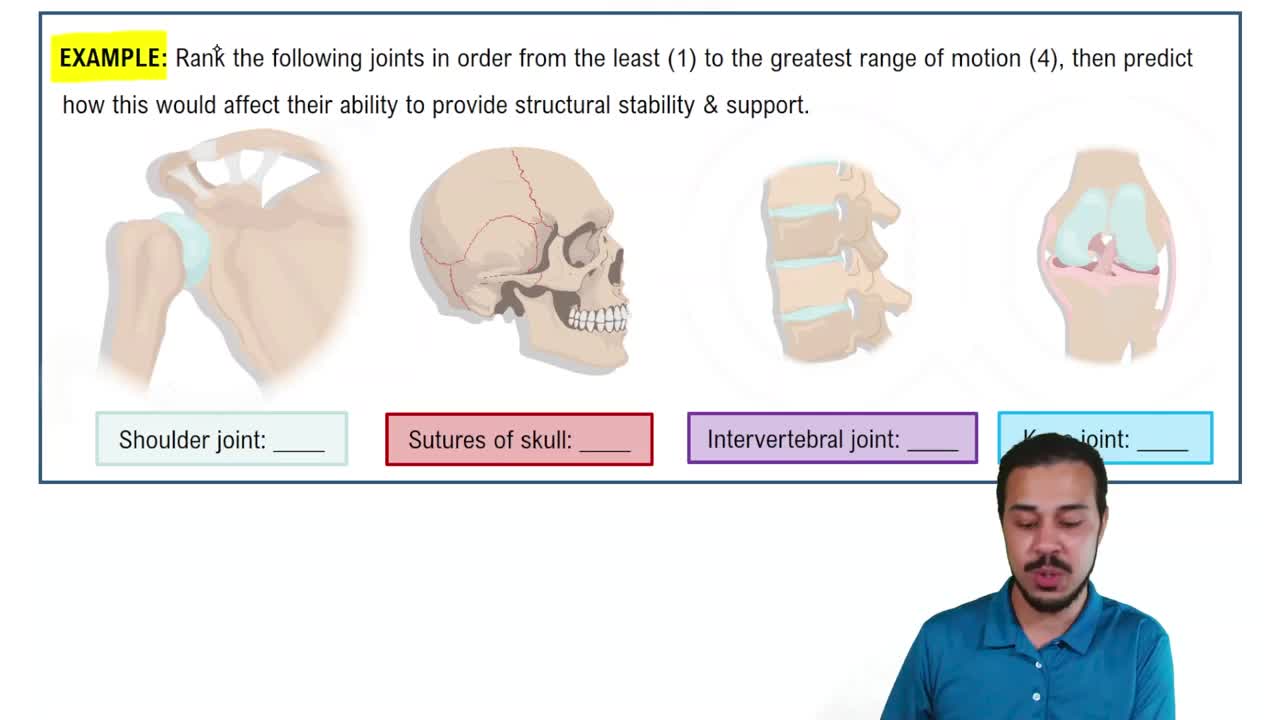
Introduction to Joints Example 1
11986
views
269
rank
Guided course
05:29
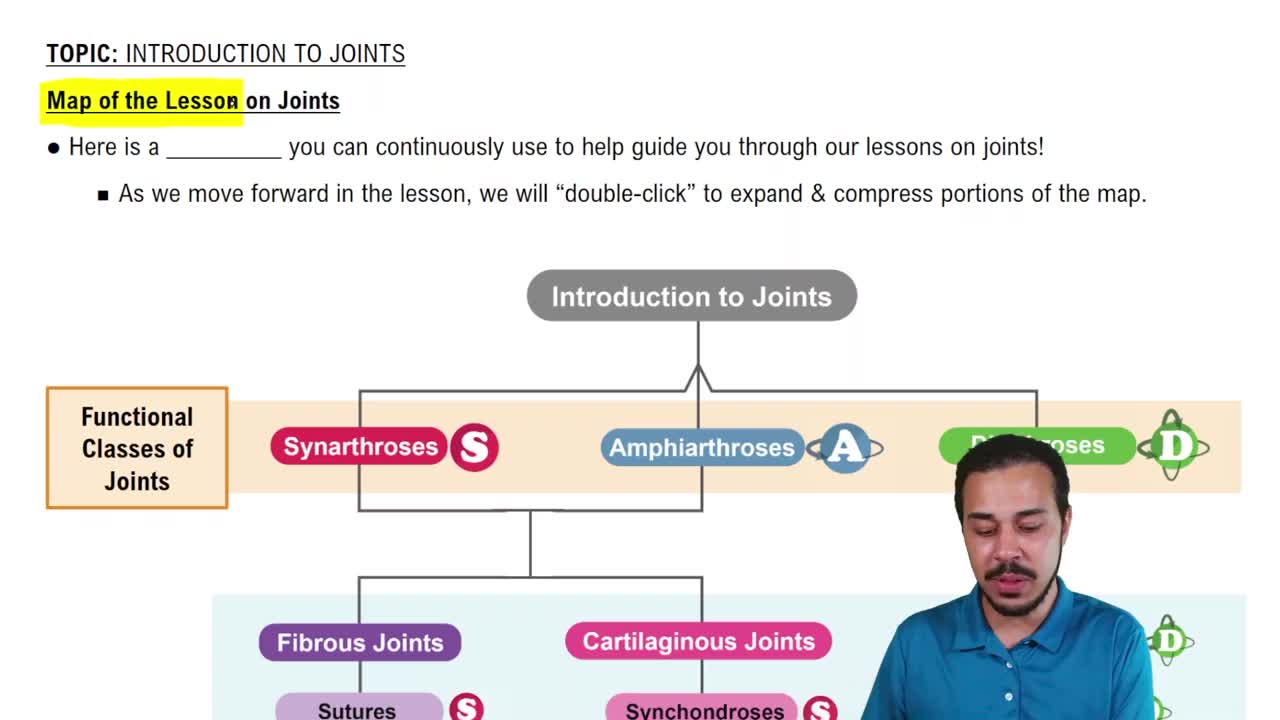
Map of the Lesson on Joints
12513
views
264
rank
1
comments
Guided course
05:39
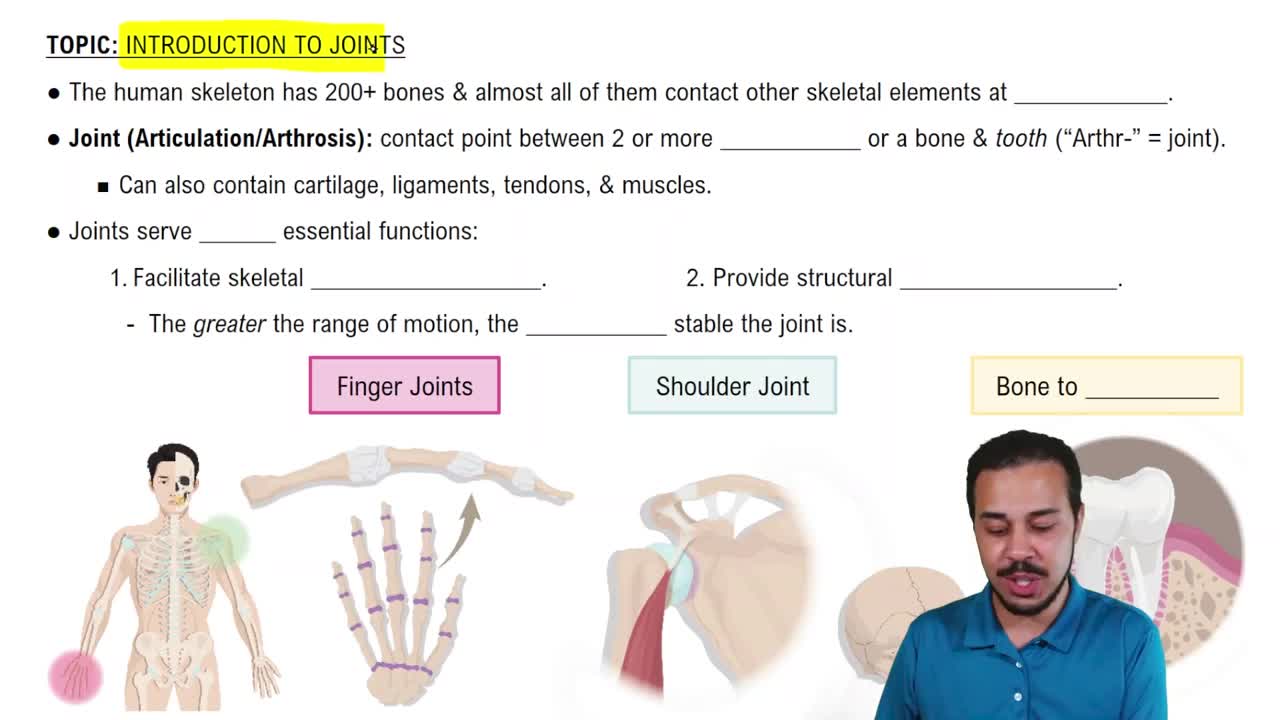
Introduction to Joints
16793
views
431
rank
Terms in this set (28)
Hide definitions
What is a joint (articulation)?
A
joint
or
articulation
is a place where two or more bones come together and touch, usually covered by cartilage.
What are the three structural classifications of joints?
Joints are classified structurally as
fibrous
,
cartilaginous
, or
synovial
based on the tissues connecting the bones.
Characteristics of fibrous joints
Fibrous joints connect bones with fibrous connective tissue, are very strong, and allow
no or very little movement
.
Types of fibrous joints
The three types are
sutures
(skull),
syndesmosis
(e.g., tibia-fibula), and
gomphosis
(tooth in jaw).
Characteristics of cartilaginous joints
Cartilaginous joints connect bones with cartilage, allowing
limited movement
and include synchondrosis and symphysis types.
What is a synchondrosis joint?
A synchondrosis is a cartilaginous joint where bones are joined by
hyaline cartilage
, such as epiphyseal growth plates in growing bones.
Where are symphysis joints found and their features?
Symphysis joints are found in the
midline
of the body, contain a
fibrocartilaginous disc
, and allow slight movement (e.g., pubic symphysis).
What defines a synovial joint?
Synovial joints have a
fluid-filled cavity
, articular cartilage, an articular capsule with fibrous and synovial membrane layers, and ligaments.
Five key features of synovial joints
They include
articular cartilage
,
synovial cavity
,
articular capsule
(fibrous outer layer and synovial membrane),
synovial fluid
, and
ligaments
.
Types of synovial joints based on movement axes
Synovial joints are classified as
non-axial (planar)
,
mono-axial (hinge, pivot)
,
bi-axial (condyloid, saddle)
, and
multi-axial (ball and socket)
.
Example and movement of planar (non-axial) joints
Planar joints have flat surfaces allowing small gliding movements in multiple directions, e.g., intercarpal joints in the wrist.
Characteristics of hinge joints
Hinge joints are mono-axial, allowing movement in one plane such as
flexion and extension
, e.g., the elbow joint.
Function of pivot joints
Pivot joints are mono-axial and allow rotational movement around a single axis, e.g., the proximal radioulnar joint enabling pronation and supination.
Movements allowed by condyloid joints
Condyloid joints are bi-axial, allowing
flexion-extension
and
abduction-adduction
, e.g., the wrist joint.
Where are saddle joints found and their movement?
Saddle joints are bi-axial, allowing flexion-extension and abduction-adduction, found at the base of the thumb.
Movements allowed by ball and socket joints
Ball and socket joints are multi-axial, allowing
flexion-extension
,
abduction-adduction
,
rotation
, and
circumduction
, e.g., shoulder and hip joints.
What is the glenoid labrum and its function?
The glenoid labrum is a fibrocartilaginous rim around the glenoid cavity that
deepens the socket
to improve shoulder joint stability.
Why does the shoulder joint have a redundant capsule?
The loose or redundant capsule allows the shoulder to achieve its large range of motion, especially during abduction up to 180 degrees.
Main source of shoulder joint stability
Most shoulder stability comes from the
rotator cuff muscles
, as the bony and ligamentous support is relatively weak.
What ligaments stabilize the knee joint?
The knee is stabilized by
collateral ligaments
(fibular and tibial) on the sides and
cruciate ligaments
(anterior and posterior) inside the joint.
Function of the anterior cruciate ligament (ACL)
The ACL prevents
anterior translation
of the tibia relative to the femur.
Function of the posterior cruciate ligament (PCL)
The PCL prevents
posterior translation
of the tibia relative to the femur.
What are menisci and their role in the knee?
Menisci are fibrocartilaginous discs that provide
shock absorption
and improve joint congruency in the knee.
Why do medial collateral ligament (MCL) injuries often involve the medial meniscus?
The MCL (tibial collateral ligament) is attached to the medial meniscus, so injuries often damage both structures together.
What type of joint is the ankle (talocrural) joint and its movements?
The ankle is a
hinge joint
allowing only
plantarflexion
and
dorsiflexion
; inversion and eversion occur at other foot joints.
What is the function of the annular ligament at the elbow?
The annular ligament holds the head of the radius in place, allowing it to pivot during pronation and supination.
What type of joint is the temporomandibular joint (TMJ) and its movements?
The TMJ is a
biaxial condyloid synovial joint
allowing elevation-depression and protraction-retraction of the jaw.
What is the sacroiliac joint and its classification?
The sacroiliac joint is a
planar synovial joint
between the auricular surfaces of the sacrum and ilium, allowing very limited movement.
 BackBack
 04:06