 Back
BackMuscle Anatomy & Physiology High-Yield Flashcards
 6:31
6:31
Terms in this set (45)
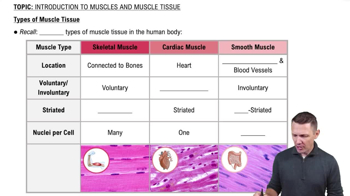
Skeletal, cardiac, and smooth muscle.
Skeletal muscles.
Movement, posture, support, temperature regulation, and guarding openings.
Connective tissue that surrounds the entire muscle.
Connective tissue that surrounds fascicles (bundles of muscle fibers).
Connective tissue that surrounds individual muscle fibers.
A bundle of muscle fibers.
A muscle cell.
The cell membrane of a muscle fiber.
The cytoplasm of a muscle fiber.
Myofilaments (thin and thick filaments).
Actin filaments.
Myosin filaments.
Sarcomere.
Z lines define the boundaries of a sarcomere.
Region containing thick filaments (myosin).
Region containing thin filaments (actin) only.
Region with thick filaments only, no overlap.
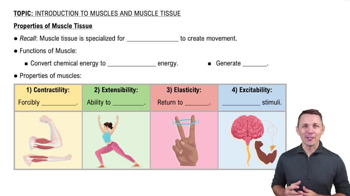
Thin filaments slide over thick filaments, shortening the sarcomere.
No, the A band remains the same length.
The I band and H zone shorten.
Sarcoplasmic reticulum releases Ca²⁺.
Troponin.
Tropomyosin blocks binding sites.
Powers contraction by enabling myosin head movement and detachment.
Muscle stays contracted, causing rigor mortis.
Actin (thin filament).
Myosin pulls actin toward the center of the sarcomere.
ATP causes myosin detachment from actin.
Acetylcholine (ACh).
Na⁺ enters muscle fiber, triggering an action potential.
Acetylcholinesterase.
When Ca²⁺ levels decrease in the sarcoplasm.
Provides a quick source of ATP during muscle contraction.
Aerobic respiration.
Fast ATP and lactic acid.
Low ATP and lactic acid buildup.
Red, slow contraction, and high endurance.
White, fast contraction, and fatigue quickly.
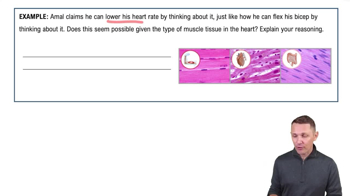
Found in the heart.
Intercalated discs that connect cells.
Contracts as one unit to pump blood.
No, smooth muscle is non-striated.
Found in organs like intestines and blood vessels.
Involuntary control.