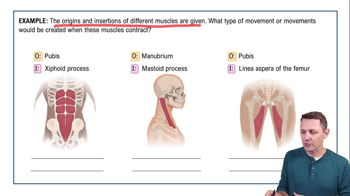
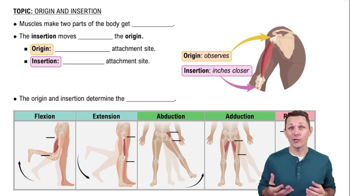
The relatively fixed end of a muscle; usually the proximal attachment.
Define the Insertion of a muscle.
The movable end of a muscle; usually the distal attachment.
What is the Action of a muscle?
The movement produced when a muscle contracts.
Buccinator muscle OIA and action
Origin: Alveolar processes of maxilla and mandible. Insertion: Lips (blends with orbicularis oris). Action: Compresses cheeks; keeps food between teeth.
Orbicularis oris muscle OIA and action
Origin: Maxilla and mandible indirectly. Insertion: Lips. Action: Compresses and purses lips.
Risorius muscle OIA and action
Origin: Connective tissue covering the cheek. Insertion: Angle of mouth. Action: Draws corners of mouth laterally.
Zygomaticus major muscle OIA and action
Origin: Zygomatic bone. Insertion: Angle of mouth. Action: Elevates and retracts corner of mouth.
Origin: Orbital margin. Insertion: Eyelid. Action: Closes eyelid.
Frontalis muscle OIA and action
Origin: Epicranial aponeurosis. Insertion: Skin of eyebrows and forehead. Action: Elevates eyebrows and wrinkles forehead.
Occipitalis muscle OIA and action
Origin: Occipital bone and mastoid process of temporal bone. Insertion: Epicranial aponeurosis. Action: Tenses and retracts scalp.
Platysma muscle OIA and action
Origin: Between 2nd costal cartilage and acromion region. Insertion: Mandible and skin of cheek/lower face. Action: Depresses mandible and lower lip; tenses skin of neck.
Superior rectus muscle OIA and action
Origin: Common tendinous ring around optic canal/superior orbital fissure. Insertion: Superior surface of eyeball. Action: Elevates the eye (looks up).
Inferior rectus muscle OIA and action
Origin: Common tendinous ring around optic canal/superior orbital fissure. Insertion: Inferior surface of eyeball. Action: Depresses the eye (looks down).
Lateral rectus muscle OIA and action
Origin: Common tendinous ring around optic canal/superior orbital fissure. Insertion: Lateral surface of eyeball. Action: Abducts the eye (looks laterally).
Medial rectus muscle OIA and action
Origin: Common tendinous ring around optic canal/superior orbital fissure. Insertion: Medial surface of eyeball. Action: Adducts the eye (looks medially).
Superior oblique muscle OIA and action
Origin: Common tendinous ring around optic canal/superior orbital fissure. Insertion: Posterior to superior rectus on eyeball. Action: Depresses and abducts eye; rotates it medially.
Inferior oblique muscle OIA and action
Origin: Floor of orbit on maxilla. Insertion: Posterior, lateral surface of eyeball. Action: Elevates and abducts eye; rotates it laterally.
General OIA for extrinsic eye muscles
Origin: Around optic canal and superior orbital fissure; inferior oblique originates on maxilla. Insertion: Surface of eyeball. Action: Position and move the eye.
Masseter muscle OIA and action
Origin: Zygomatic arch. Insertion: Lateral surface of mandibular ramus. Action: Elevates mandible and closes jaw.
Temporalis muscle OIA and action
Origin: Temporal lines/temporal fossa. Insertion: Coronoid process and lateral surface of mandibular ramus. Action: Elevates and retracts mandible.
Medial pterygoid muscle OIA and action
Origin: Medial surface of lateral pterygoid plate. Insertion: Medial surface of mandibular ramus. Action: Elevates mandible and helps move it side-to-side.
Lateral pterygoid muscle OIA and action
Origin: Superior head: greater wing of sphenoid; inferior head: lateral surface of lateral pterygoid plate. Insertion: Mandible at condylar process. Action: Opens jaw and moves mandible side-to-side.
Sternocleidomastoid (SCM) muscle OIA and action
Origin: Manubrium of sternum and medial clavicle. Insertion: Mastoid process of temporal bone. Action: Both sides contract: flex neck; one side contracts: rotates head opposite side and tilts head same side.
Scalenes muscle OIA and action
Origin: Transverse processes of cervical vertebrae. Insertion: Superior surfaces of ribs 1 and 2. Action: Flex neck bilaterally; laterally flex neck unilaterally; elevate ribs during inhalation.
Iliocostalis muscle OIA and action
Origin: Iliac crest, sacral crest, lumbar spinous processes. Insertion: Transverse processes of middle/inferior cervical vertebrae and ribs. Action: Extends spine bilaterally; laterally flexes spine same side unilaterally.
Longissimus muscle OIA and action
Origin: Transverse processes of lower thoracic and upper lumbar vertebrae. Insertion: Along spine and mastoid process. Action: Extends spine; helps extend head and neck.
Spinalis muscle OIA and action
Origin: Spinous processes of inferior thoracic and superior lumbar vertebrae. Insertion: Spinous process of axis (C2) and other upper vertebrae. Action: Extends the spine.
What are the three muscles of the erector spinae group?
Iliocostalis (lateral), longissimus (middle), and spinalis (medial). Main action: extending the spine.
Quadratus lumborum muscle OIA and action
Origin: Iliac crest. Insertion: Inferior margin of rib 12 and transverse processes of lumbar vertebrae L1–L4. Action: Depresses ribs bilaterally; laterally flexes spine same side unilaterally.
 Back
 5:39