 Back
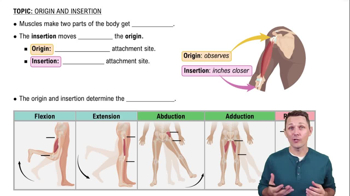
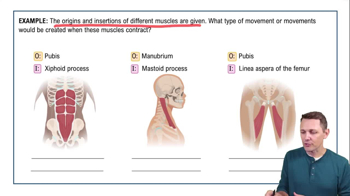
BackMuscle origin and insertions
 5:39
5:39
Terms in this set (29)
External intercostals
O: inferior rib
I: superior rib
F: contracts to bring air in
Internal intercostals
O: superior rib
I: inferior rib
F: contract to push air out
Diaphragm
O: costal cartilage/rib, xiphoid process, L vertebrae
I: central tendon
F: contracts to bring air in and relaxes to push air out
Pectoralis major
O: Clavicle, sternum, costal cartilage of ribs 1-7
I: sulcus of humerus
F: Adducts and medially rotates arm
Pectoralis minor
O: Sternal ends of ribs 3-5
I: scapula
F: pulls scapula forward and downward, raises ribs
Serratus anterior
O: Lateral surface of ribs
I: scapula
F: pulls scapula anteriorly
External Oblique
O: ribs 5-12
I: Iliac crest, pubis of hip bone, covering connective tissues
F: Trunk rotation and flexation
Rectus Abdominis
O: pubic symphysis, pubis of hip bone
I: Xiphoid process and costal cartilage of ribs 5-7
F: bending forward, compression of abdomen
Trapezius
O: occipital bone, C7 and upper T vertebrae
I: Clavicle, spine, acromion of scapula
F: contracts to rotate and move scapula
Latissimus dorsi
O: Spinous process of L vertebrae, Iliac crest, lower ribs
I: Sulcus of humorous
F: extend adduct and rotate arm
Deltoid
O: Scapula and clavicle
I: Tuberosity of humerus
F: Prime mover of arm abduction when all its fibers contract simultaneously
Rhomboid minor
O: Spinous process of C7 and T1
I: scapula
F: retracts and elevates scapula
Rhomboid major
O: Spinous process of T2-T5
I: scapula
F: retracts and elevates scapula
Erector spinae
O: Sacrum, iliac crest, spinous process of all L vertebrae and T11-12
I: rib angles, spinous process of upper T, L and C vertebrae, mastoid process
F: Extension of the vertebral column
Serratus posterior inferior
O: T11-L2
I: ribs 9-12
F: Rotation and extension of the trunk
Sternocleidomastoid
O: Manubrium, clavicle
I: temporal bone
F: flexing neck, rotating head
Semispinalis capitis (deeper) and Splenius capitis (more superficial)
O: process of lower C and upper T vertebrae
I: Occipital bone (splenius capitis also inserts mastoid process)
F: extends and rotates head
Suprahyoid muscles
O: VARIOUS most at mandible, and mastoid process
I: HYOID BONE
F: (open mouth, depress mandible, elevate and retract hyoid)
Infrahyoid muscles
O: VARIOUS can span across mandible to manubrium
I: HYOID BONE
F: (depresses hyoid)
Zygomaticus
F: smiling
Orbicularis Oculi
F: closing eye
Orbicularis Oris
F: purse lips, close lips
Frontalis
F: elevating eyebrows
Depressor Anguli Oris
F: open mouth, frown
Buccinator
F: compresses cheek (as in whistling and sucking);
holds food between teeth during chewing
Masseter
O: zygomatic arch and zygomatic bone
I: angle and ramus of mandible
F: Prime mover of jaw closure; elevates mandible
Temporalis
O: temporal fossa
I: coronoid process of mandible via a tendon that passes deep to zygomatic arch
F: Closes jaw; elevates and retracts mandible; maintains position of the mandible at rest; deep anterior part may help protract mandible
Lateral Pterygoid
O: greater wing and lateral pterygoid plate of sphenoid bone
I: condylar process of mandible and capsule of temporomandibular joint
F: Provides side-to-side grinding movements and protracts mandible
Medial Pterygoid
O: medial surface of lateral pterygoid plate of sphenoid bone, maxilla, and palatine bone
I: medial surface of mandible near its angle
F: Acts with the lateral pterygoid muscle to protract (pull anteriorly) the mandible and promote side-to-side grinding movements