 Back
Nervous System Anatomy & Physiology Flashcards
 1:06

Terms in this set (30)
Sensory input: gathering information from sensory receptors.
Integration: interpreting and processing sensory input.
Motor output: activating effector organs like muscles and glands.
Includes the brain and spinal cord; main integration and command center of the nervous system.
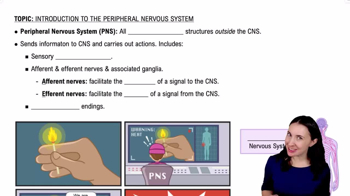
Consists of nerves and ganglia outside the CNS; divided into afferent (sensory) and efferent (motor) subdivisions.
Afferent: carries sensory info to CNS.
Efferent: carries motor commands from CNS to effectors.
Somatic: voluntary control of skeletal muscles.
Autonomic: involuntary control of organs, divided into sympathetic and parasympathetic systems.
Fight or flight system; increases heart rate, respiration, and awareness while inhibiting digestion.
Rest and repose system; slows heart rate and respiration, increases digestive activity.
Contains nucleus and Nissl bodies; clusters called ganglia in PNS and nuclei in CNS.
Dendrites receive signals; axons conduct impulses away from the cell body.
Axon hillock is origin of axon; terminals have synaptic knobs for neurotransmitter release.
Neurofibrils transport materials anterograde (to terminals) and retrograde (to cell body).
Multipolar: many dendrites, one axon; most common.
Bipolar: one dendrite, one axon; found in retina.
Pseudounipolar: single process splits into two; sensory neurons.
Support neurons; include Schwann cells, oligodendrocytes, astrocytes, microglia, ependymal cells, and satellite cells.
Form myelin sheath in PNS; insulate axons, speed impulse conduction, and aid in axon regeneration.
Form myelin sheaths in CNS; can myelinate multiple axons.
Most abundant CNS glia; form blood-brain barrier and support neurons.
Phagocytic CNS cells that remove debris and pathogens.
Line brain ventricles and spinal canal; produce cerebrospinal fluid.
Negative inside cell due to Na+/K+ pump and higher K+ permeability.
Depolarization: Na+ influx.
Repolarization: K+ efflux.
Hyperpolarization: brief overshoot of negativity.
Absolute: no new AP possible.
Relative: new AP possible with strong stimulus.
AP jumps between Nodes of Ranvier in myelinated axons, speeding conduction.
Presynaptic neuron releases neurotransmitter into synaptic cleft; binds postsynaptic receptors to open ion channels.
EPSP: depolarize postsynaptic cell, promote AP.
IPSP: hyperpolarize cell, inhibit AP.
Temporal summation: repeated stimuli from one neuron.
Spatial summation: simultaneous stimuli from multiple neurons.
Excitatory neurotransmitter at neuromuscular junction and autonomic nervous system.
Include serotonin and catecholamines (dopamine, norepinephrine, epinephrine); involved in mood, arousal, and autonomic functions.
Short proteins like endorphins and substance P; involved in pain modulation and synaptic plasticity.
Include glutamate and aspartate (excitatory), GABA and glycine (inhibitory); important in CNS signaling.
Include ATP, nitric oxide (NO), and carbon monoxide (CO); have unique signaling roles in nervous system.