Skip to main content
Anatomy & Physiology
My Course
Learn
Exam Prep
AI Tutor
Study Guides
Textbook Solutions
Flashcards
Explore
Try the app
My Course
Learn
Exam Prep
AI Tutor
Study Guides
Textbook Solutions
Flashcards
Explore
Try the app
Back
Neurons and Action Potentials - Anatomy & Physiology
You can tap to flip the card.
Resting membrane potential (RMP)
You can tap to flip the card.
👆
Resting membrane potential (RMP)
The resting electrical charge of a neuron, about \(-70\,\mathrm{mV}\).
Track progress
Control buttons has been changed to "navigation" mode.
1/31
Recommended videos
03:35
Standard Sodium and Potassium Concentrations
12982
views
265
rank
1
comments
03:40
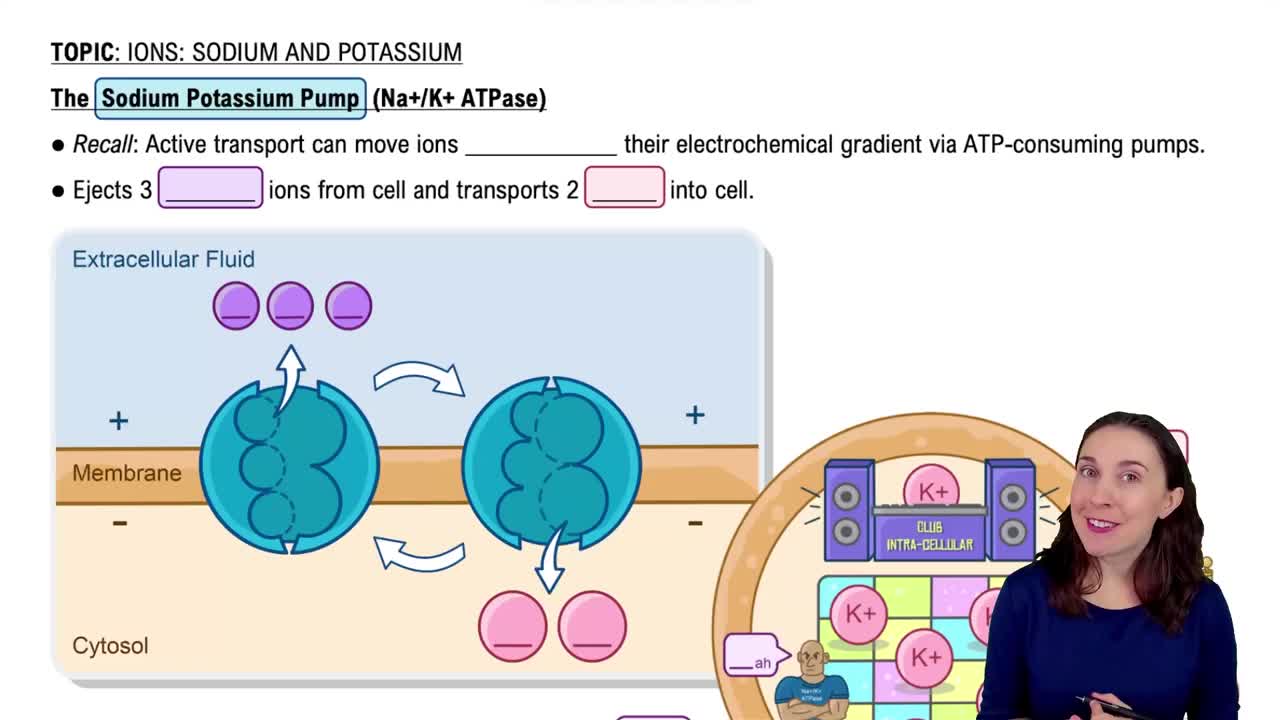
The Sodium Potassium Pump
11405
views
354
rank
3
comments
01:55
Ions - Sodium and Potassium Example 3
9275
views
207
rank
Terms in this set (31)
Hide definitions
Resting membrane potential (RMP)
The resting electrical charge of a neuron, about \(-70\,\mathrm{mV}\).
Why is the inside of a resting neuron negative?
More
K⁺
leaks out than
Na⁺
leaks in.
K⁺ leak channels
Always-open channels allowing
K⁺
to diffuse out without ATP.
Effect of adding Na⁺ leak channels
The resting membrane potential becomes less negative.
Increased membrane permeability to Na⁺ causes
Membrane depolarization (inside becomes more positive).
Function of the Na⁺/K⁺ pump
Uses ATP to pump 3
Na⁺
out and 2
K⁺
in.
Memory trick for Na⁺/K⁺ pump
"3 out, 2 in, ATP to win."
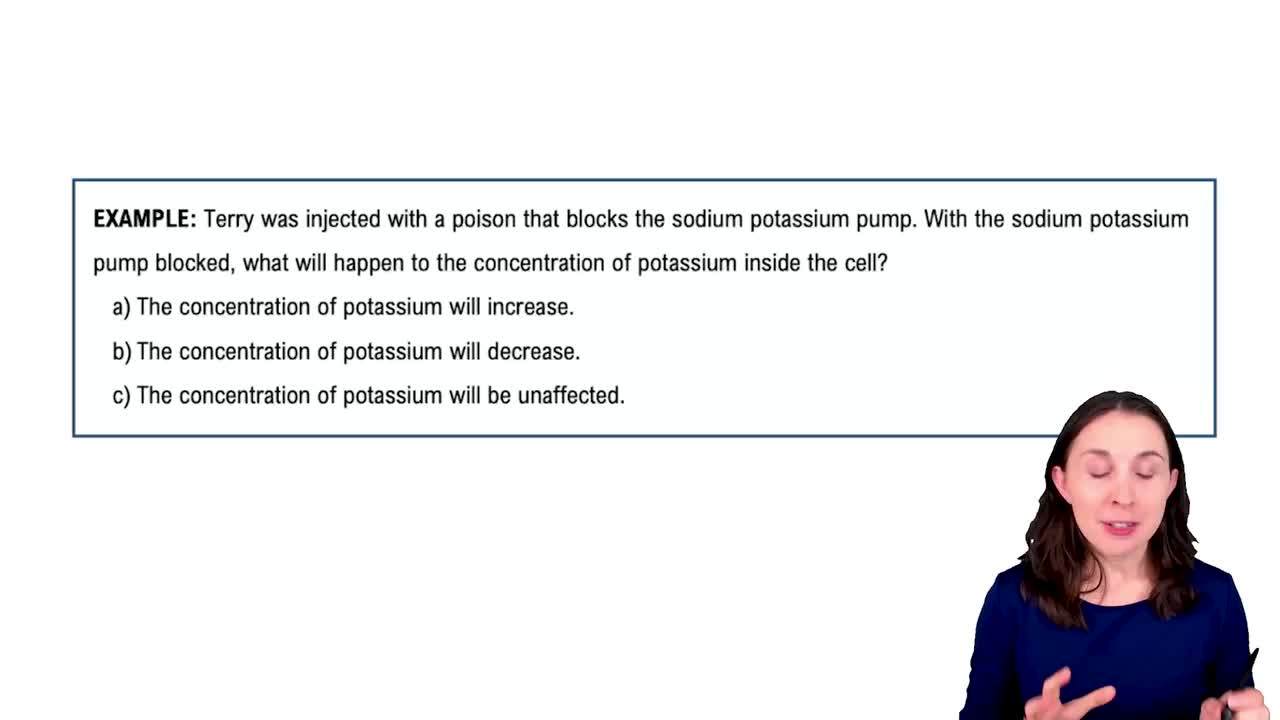
If the Na⁺/K⁺ pump stops working
Resting membrane potential gradually moves toward 0 mV.
Opening Cl⁻ channels causes
Hyperpolarization of the neuron.
What maintains the resting membrane potential?
Leak channels and the Na⁺/K⁺ pump.
Graded potential
A local membrane potential with variable amplitude that fades with distance.
Depolarization means
The inside of the membrane becomes less negative.
Channels needed for an action potential
Voltage-gated
Na⁺
and
K⁺
channels.
Order of events in an action potential
Rest → Threshold → Na⁺ in → K⁺ out → Hyperpolarization → Rest.
Unmyelinated axon conduction type
Continuous conduction.
Why is an action potential self-regenerating?
Na⁺ influx triggers the next segment to depolarize.
Why do action potentials travel in only one direction?
Na⁺ channels behind the impulse are inactivated.
Function of myelin
Speeds nerve impulse conduction via saltatory conduction.
Peak of action potential
Na⁺ channels inactivate; K⁺ channels open causing repolarization.
Fastest axons
Large-diameter myelinated axons.
Threshold for starting an action potential
Approximately \(-55\,\mathrm{mV}\).
Factors affecting conduction speed
Myelination and axon diameter.
Relative refractory period
K⁺ channels remain open; a stronger stimulus is required to fire.
Synaptic cleft
The gap between neurons at a synapse.
Neurotransmitter
Chemical messenger that crosses the synapse.
Role of Ca²⁺ at the synapse
Triggers vesicle fusion and neurotransmitter release.
Effect of neurotransmitter binding
Opens chemically gated ion channels on the postsynaptic neuron.
More negative postsynaptic cell means
Less likely to fire an action potential.
Na⁺ through chemically gated channels causes
Excitatory postsynaptic potential (EPSP).
Opening K⁺ or Cl⁻ channels causes
Inhibitory postsynaptic potential (IPSP).
Neurotransmitter at skeletal muscle
Acetylcholine (ACh).
 BackBack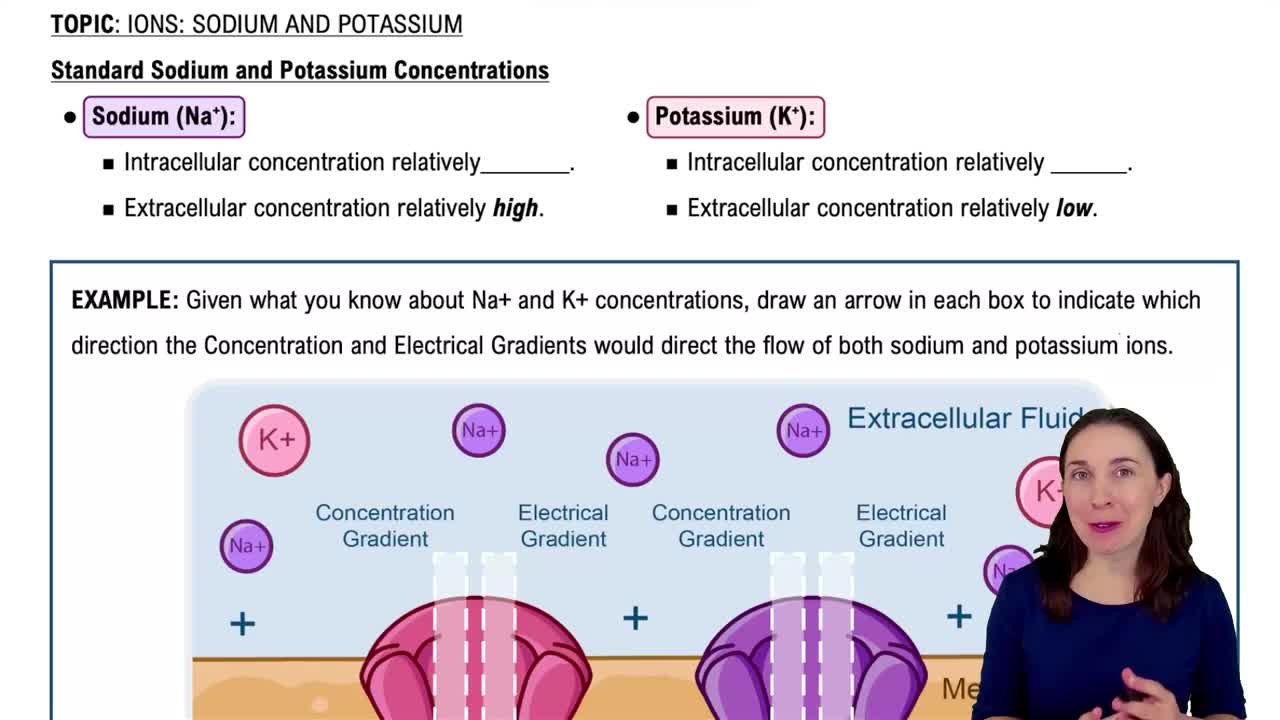
 03:35
03:35