 Back
BackOrgans, Systems, and Organization of the Body - Anatomy & Physiology
 05:04
05:04
Terms in this set (22)
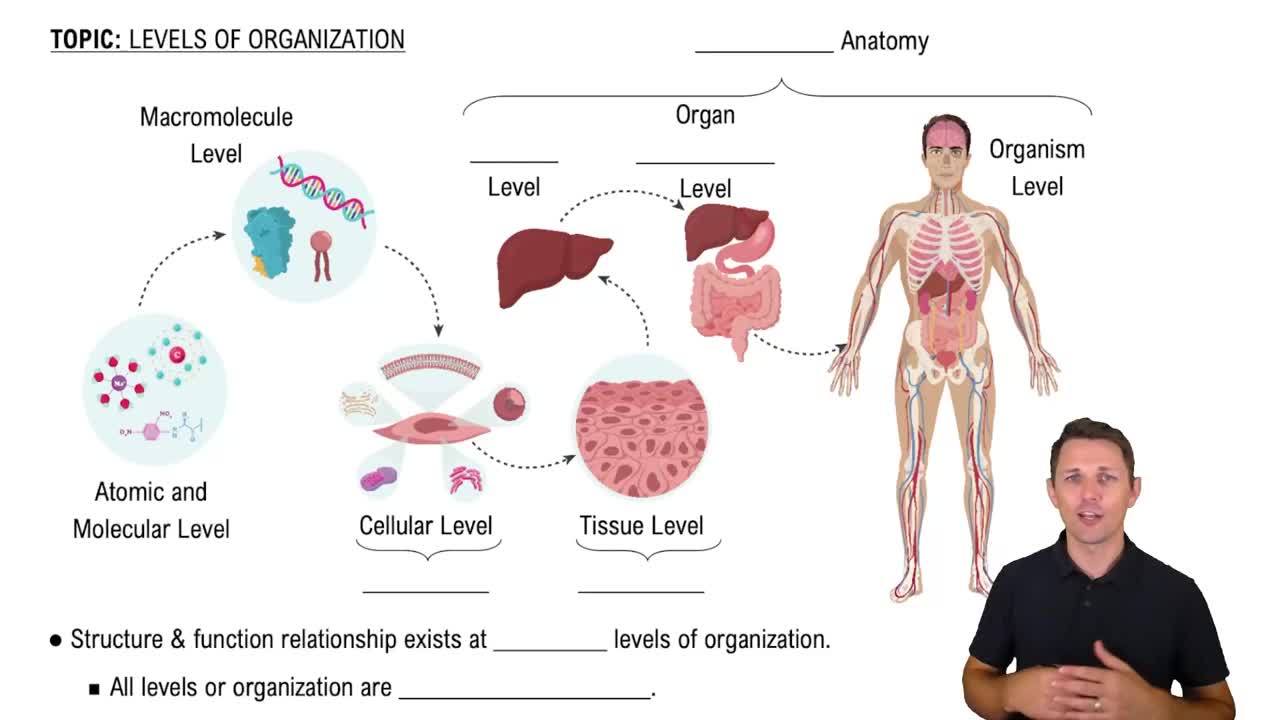
Human Anatomy is the scientific study of the structure of the body.
Gross Anatomy involves examining structures visible to the naked eye.
Regional Anatomy is the study of particular areas of the body, such as the head, leg, or abdomen.
Systemic Anatomy is the study of organ systems like the skeletal, nervous, or reproductive systems.
Atom, Molecule, Macromolecule, Organelle, Cell, Tissue, Organ, Organ System, Organism.
Respiratory, Urinary, Nervous, Muscular, Reproductive, Skeletal, Lymphatic, Integumentary, Digestive, Endocrine, Circulatory.
Body erect, face forward, palms forward, feet together. Directional terms refer to this pose.
Superior means above or toward the head.
Inferior means below or toward the feet.
Superficial means toward or on the surface; Deep means away from the surface, more internal.
Anterior (ventral) means front; Posterior (dorsal) means back.
Medial means toward the midline; Lateral means away from the midline.
Proximal means closer to the origin of a body part; Distal means farther from the origin.
Transverse (divides into superior and inferior), Coronal/Frontal (anterior and posterior), Sagittal (left and right sides).
A Midsagittal plane divides the body into equal right and left sides.
A body cavity is an enclosed space within the body that houses organs.
Cranial cavity and vertebral canal.
Thoracic cavity, mediastinum, pericardial cavity, pleural cavity, abdominal cavity, pelvic cavity.
Serous membranes protect organs by lining body cavities and producing fluid to reduce friction.
Visceral layer covers the organ surface; Parietal layer lines the body wall.
Right hypochondriac, epigastric, left hypochondriac, right lumbar, umbilical, left lumbar, right iliac, hypogastric, left iliac.
Right upper quadrant (RUQ), left upper quadrant (LUQ), right lower quadrant (RLQ), left lower quadrant (LLQ).