 Back
BackReproductive System Anatomy & Physiology
 2:08
2:08
Terms in this set (20)
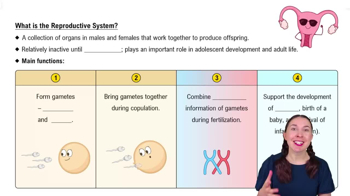
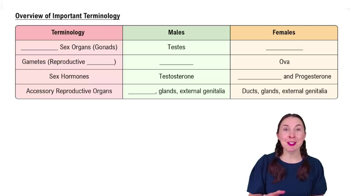
The testes are the primary male gonads responsible for producing sperm and secreting testosterone.
The male duct system includes the epididymis, ductus deferens, ejaculatory duct, and urethra.
The epididymis stores sperm and facilitates their maturation.
The urethra has three parts: prostatic, membranous, and spongy.
Accessory glands include seminal vesicles (fructose, prostaglandins), prostate gland (citrate, PSA), and bulbourethral glands (mucus secretion).
A sperm has an acrosome (enzyme cap), head (nucleus), midpiece (mitochondria), and tail (flagellum).
Spermatogenesis is the process of sperm production occurring in the seminiferous tubules of the testes.
Stages: spermatogonia (stem cells), primary spermatocytes (meiosis I), secondary spermatocytes (meiosis II), spermatids, and spermatozoa after spermiogenesis.
Sustentacular cells support developing sperm by providing nutrients and hormonal regulation.
Puberty begins around 12-14 years, with testosterone causing secondary sex characteristics like hair growth, voice deepening, and muscle growth.
The ovaries produce oocytes and secrete female sex hormones like estrogen and progesterone.
Before birth, oogonia become primary oocytes arrested in prophase I. At puberty, meiosis I completes for some, producing a secondary oocyte arrested in metaphase II.
Spermatogenesis starts at puberty producing millions of sperm continuously; oogenesis begins before birth, producing one ovum per month with polar bodies.
Phases: Follicular phase (follicle development), ovulation (release of oocyte), and luteal phase (corpus luteum activity).
FSH stimulates follicle growth; LH triggers ovulation and corpus luteum formation; estrogen and progesterone regulate feedback.
The uterus has the stratum functionalis (shed during menstruation) and the stratum basalis (regenerates the functionalis).
Phases: Menstrual (shedding), proliferative (endometrium rebuilds), and secretory (endometrium prepares for implantation).
Estrogen rises during proliferative phase; progesterone rises during secretory phase; FSH and LH peak to trigger ovulation.
Estrogen causes secondary sex characteristics like increased bone and muscle growth and widening of the pelvis.
Menopause is the cessation of menstruation, marked by a drop in estrogen levels, typically occurring in late 40s to 50s.