 Back
Skeletal System Basics - Anatomy & Physiology
 3:56

Terms in this set (20)
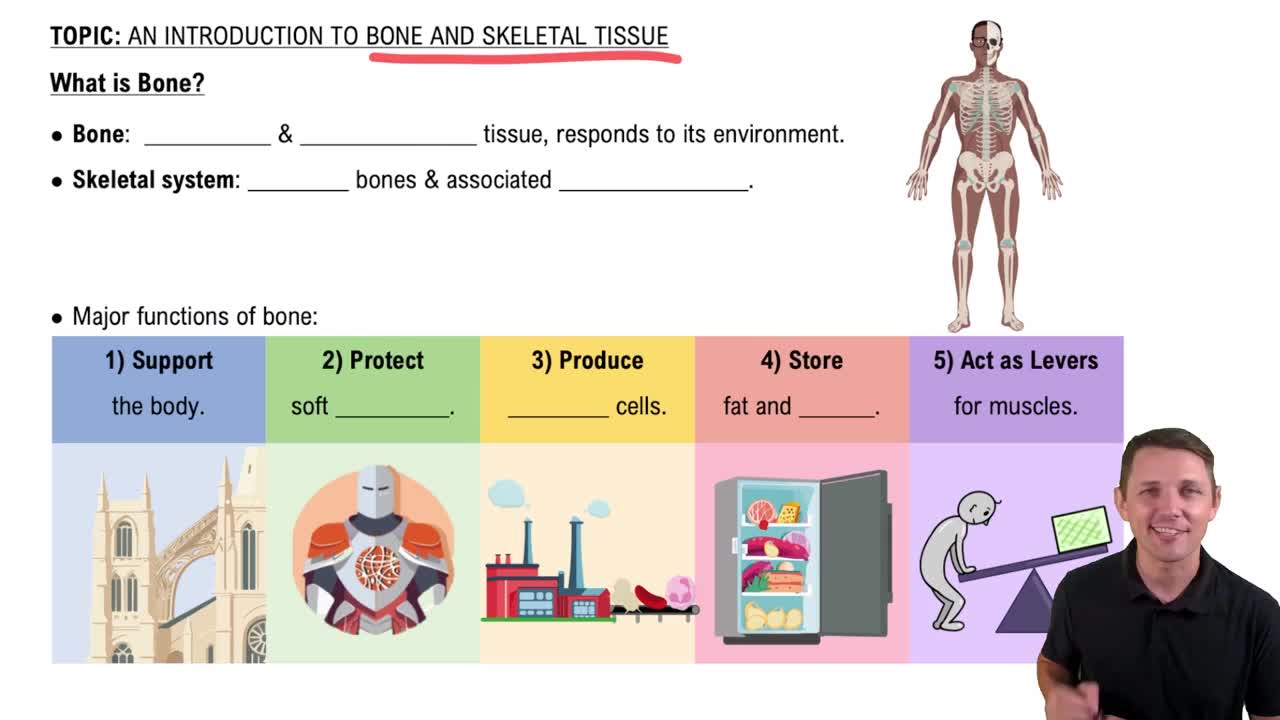
Support, protection, movement, mineral storage, blood cell production, and energy storage.
The outer fibrous layer provides protection and attachment for tendons and ligaments; the inner cellular layer contains osteogenic cells for bone growth and repair.
Cartilage is a flexible connective tissue with a firm, gel-like matrix; it is avascular and provides support and cushioning in joints.
Hyaline cartilage: ends of long bones, nose, trachea; Elastic cartilage: ear, epiglottis; Fibrocartilage: intervertebral discs, pubic symphysis.
Osteoblasts are bone-forming cells that secrete the bone matrix and initiate calcification.
Osteocytes are mature bone cells that maintain the bone matrix and communicate with other bone cells.
Osteoclasts are large cells that resorb and break down bone tissue during growth and healing.
Includes the diaphysis (shaft), epiphyses (ends), medullary cavity (marrow space), periosteum, and articular cartilage.
Compact bone is dense and forms the outer layer; spongy bone is porous and found inside bones, especially in epiphyses.
Compact bone forms the outer shell of the diaphysis and covers the spongy bone in the epiphyses.
Spongy bone is found primarily in the epiphyses and inside flat bones, containing red marrow.
Compact bone is made of osteons (Haversian systems) with concentric lamellae surrounding a central canal.
Spongy bone consists of a network of trabeculae with spaces filled by marrow.
The periosteum protects bone, anchors blood vessels and nerves, and contains cells for growth and repair.
Articular cartilage covers bone ends at joints, reducing friction and absorbing shock.
The diaphysis is the long, tubular shaft of a long bone.
The epiphysis is the rounded end of a long bone, usually covered with articular cartilage.
The medullary cavity contains yellow bone marrow in adults, which stores fat.
Osteoclasts break down bone matrix during remodeling and calcium release.
Osteocytes maintain the mineral concentration of the matrix.