Back

Spinal Cord and Reflexes - Anatomy & Physiology
Control buttons has been changed to "navigation" mode.
1/83
  • What are spinal reflexes?

    Rapid, automatic nerve responses controlled by the spinal cord only, not the brain.

  • What are the dimensions of the spinal cord?

    Approximately 18 inches long and ½ inch wide.

  • Where does the spinal cord end?

    At the L1–L2 vertebral level.

  • What is the symmetry of the spinal cord?

    The spinal cord is bilaterally symmetrical.

  • What is the posterior groove of the spinal cord called?

    Posterior median sulcus.

  • What is the anterior groove of the spinal cord called?

    Anterior median fissure, which is deeper than the posterior sulcus.

  • Which enlargement controls upper limbs?

    Cervical enlargement.

  • Which enlargement controls lower limbs?

    Lumbar enlargement.

  • What is the tapered end of the spinal cord called?

    Conus medullaris.

  • What are the nerve roots below the spinal cord called?

    Cauda equina (horse tail nerves).

  • What anchors the spinal cord?

    Filum terminale.

  • How many spinal cord segments are there?

    31 spinal cord segments.

  • Where are sensory neuron cell bodies located?

    In the dorsal root ganglion.

  • Which root carries sensory information?

    Dorsal roots carry sensory information.

  • Which root carries motor information?

    Ventral roots carry motor information.

  • What type of nerves are spinal nerves?

    Mixed nerves containing both sensory and motor fibers.

  • How are spinal nerves formed?

    By the fusion of dorsal (sensory) and ventral (motor) roots.

  • What is the function of meninges?

    Protect the spinal cord and carry blood supply.

  • What is meningitis?

    Inflammation of the meninges.

  • What are the three meningeal layers?

    Dura mater (outer), arachnoid mater (middle), and pia mater (inner).

  • What is dura mater made of?

    Dense connective tissue.

  • What is found in the epidural space?

    Fat and blood vessels.

  • Where are epidural injections given?

    In the epidural space.

  • What space is below the arachnoid mater?

    Subarachnoid space.

  • What is in the subarachnoid space?

    Cerebrospinal fluid (CSF).

  • What is the function of CSF?

    Shock absorber and provides nutrients.

  • What is pia mater?

    The innermost meningeal layer attached directly to the spinal cord.

  • What prevents side-to-side movement of the spinal cord?

    Denticulate ligaments.

  • What is white matter in the spinal cord?

    Axons, located superficially.

  • What is gray matter in the spinal cord?

    Neuron cell bodies.

  • What does the posterior horn of gray matter do?

    Processes sensory information.

  • What does the anterior horn of gray matter do?

    Controls motor neurons.

  • What does the lateral horn of gray matter do?

    Controls autonomic neurons.

  • What do ascending tracts in white matter do?

    Carry sensory information to the brain.

  • What do descending tracts in white matter do?

    Carry motor commands from the brain.

  • What is the outer layer of a spinal nerve?

    Epineurium.

  • What surrounds fascicles in a nerve?

    Perineurium.

  • What surrounds individual axons in a nerve?

    Endoneurium.

  • What does the dorsal ramus innervate?

    Back muscles and skin.

  • What does the ventral ramus innervate?

    Limbs and body wall.

  • What is a dermatome?

    An area of skin supplied by one spinal nerve.

  • Why are dermatomes important?

    Used to locate nerve damage.

  • What causes shingles?

    Varicella-zoster virus.

  • What happens in shingles?

    Affects sensory nerves causing a painful rash.

  • Which rami form plexuses?

    Only ventral rami form plexuses.

  • What spinal levels form the cervical plexus?

    C1–C5.

  • What nerve controls breathing?

    Phrenic nerve from the cervical plexus.

  • What spinal levels form the brachial plexus?

    C5–T1.

  • What does the brachial plexus control?

    Motor and sensory control of the upper limb.

  • Which nerve is affected in carpal tunnel syndrome?

    Median nerve.

  • What does the radial nerve do?

    Controls extensor muscles of the arm and forearm.

  • What does the ulnar nerve do?

    Controls many hand muscles.

  • What spinal levels form the lumbar plexus?

    T12–L4.

  • What is the major nerve of the lumbar plexus?

    Femoral nerve.

  • What spinal levels form the sacral plexus?

    L4–S4.

  • What is the largest nerve in the body?

    Sciatic nerve, from the sacral plexus.

  • What carries sensory input to the CNS?

    Afferent fibers.

  • What carries motor output from the CNS?

    Efferent fibers.

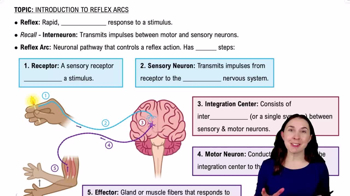
  • What is the first step of the reflex arc?

    Receptor activation.

  • What is the second step of the reflex arc?

    Sensory neuron activation.

  • What is the third step of the reflex arc?

    Interneuron processing in CNS.

  • What is the fourth step of the reflex arc?

    Motor neuron activation.

  • What is the final step of the reflex arc?

    Effector response (muscle or gland action).

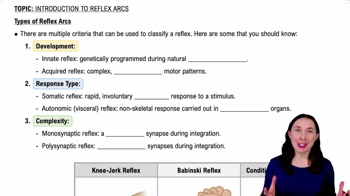
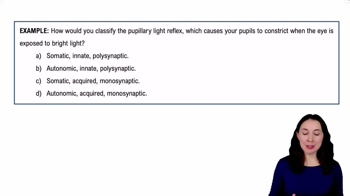
  • What are innate reflexes?

    Reflexes that are present at birth.

  • What are acquired reflexes?

    Reflexes that are learned through experience.

  • What do somatic reflexes control?

    Skeletal muscle responses.

  • What do visceral reflexes control?

    Organ functions.

  • What is a monosynaptic reflex?

    A reflex with one synapse, the fastest type.

  • What is a polysynaptic reflex?

    A reflex with multiple synapses.

  • Where are spinal reflexes processed?

    In the spinal cord.

  • Where are cranial reflexes processed?

    In the brain.

  • What is the function of the stretch reflex?

    Maintains posture by responding to muscle stretch.

  • What detects stretch in the stretch reflex?

    Muscle spindle.

  • What is the function of the Golgi tendon reflex?

    Prevents muscle damage by inhibiting excessive tension.

  • What does the withdrawal reflex do?

    Pulls a body part away from painful stimuli.

  • What is reciprocal inhibition?

    Flexors contract while extensors relax during a reflex.

  • What does the crossed extensor reflex do?

    The opposite leg stabilizes the body during withdrawal reflex.

  • What does ipsilateral mean?

    Occurs on the same side of the body.

  • What does contralateral mean?

    Occurs on the opposite side of the body.

  • Can the brain control reflexes?

    Yes, the brain can enhance or inhibit reflexes.

  • What is facilitation in reflexes?

    Increases the strength of a reflex.

  • What is inhibition in reflexes?

    Decreases the strength of a reflex.

  • What is the Babinski reflex?

    Normal in infants but abnormal in adults, indicates CNS damage if present.