 Back
Water Properties and pH Scale in Anatomy & Physiology
 05:03

Terms in this set (21)
Water is essential because cells evolved in it, all living organisms require it, and it stabilizes the environment necessary for life.
Water molecules have polar covalent bonds due to oxygen's higher electronegativity attracting electrons more strongly than hydrogen.
Water is polar because oxygen has a partial negative charge and hydrogens have partial positive charges, creating an uneven charge distribution.
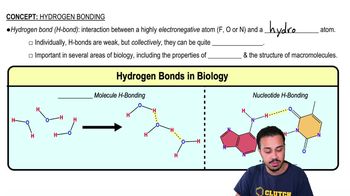
A hydrogen bond is an electrical attraction between opposite partial charges on separate water molecules.
Water can moderate temperature, act as a solvent, and exhibit cohesion.
Water absorbs or releases heat by breaking or forming hydrogen bonds, which slows temperature changes and stabilizes environments.
Ice is less dense because hydrogen bonds arrange water molecules further apart in a solid, causing ice to float and insulate liquid water below.
Water molecules expand as they freeze due to hydrogen bonding, which can cause containers or pipes to break.
A solution is a liquid mixture; the liquid is the solvent and the dissolved substance is the solute.
Water dissolves many solutes because its partial charges allow hydrogen bonding with polar or charged molecules.
Hydrophilic substances have an affinity for water and usually contain polar covalent bonds allowing interaction with water.
Hydrophobic substances repel water and are usually nonpolar molecules with no partial charges to interact with water.
Nonpolar molecules share electrons equally, have no partial charges, and thus cannot attract water's partial charges for hydrogen bonding.
Cohesion is water molecules sticking together due to hydrogen bonding, contributing to surface tension and plant water transport.
Surface tension arises from cohesive hydrogen bonds at the water surface forming a 'net' that resists external force.
pH measures the acidity of a solution, specifically the concentration of hydrogen ions (H+).
The pH scale ranges from 0 to 14; lower values are acidic, 7 is neutral, and higher values are basic (alkaline).
Each pH unit change represents a tenfold change in hydrogen ion concentration.
Acids increase hydrogen ions, lowering pH; bases decrease hydrogen ions, raising pH.
A buffer is a chemical system that resists pH changes by absorbing or donating hydrogen ions, maintaining stable pH in cells and blood.
Hydrogen bonds between water molecules must be broken for evaporation; polar covalent bonds within molecules remain intact.