Skip to main content
Beginning Algebra
My Course
Learn
Exam Prep
AI Tutor
Study Guides
Flashcards
Try the app
My Course
Learn
Exam Prep
AI Tutor
Study Guides
Flashcards
Try the app
Back
Factoring Special Products definitions
You can tap to flip the card.
Difference of Squares
You can tap to flip the card.
👆
Difference of Squares
A binomial with two perfect square terms separated by subtraction, factored as the product of conjugates.
Track progress
Control buttons has been changed to "navigation" mode.
1/15
Related flashcards
Related practice
Recommended videos
Factoring Special Products quiz
Factoring Special Products
15 Terms
Factoring Special Products
7. Factoring
5 problems
Topic
ErnestBlazevic
Quadratic Equations & Applications
7. Factoring
5 problems
Topic
ErnestBlazevic
7. Factoring - Part 1 of 2
4 topics
12 problems
Chapter
JustinRaimundo
7. Factoring - Part 2 of 2
1 topic
3 problems
Chapter
ErnestBlazevic
Guided course
01:15
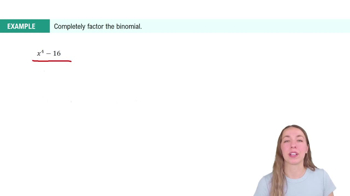
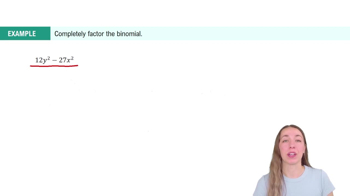
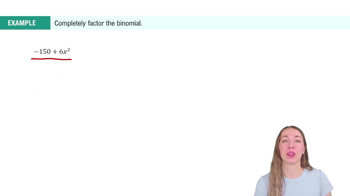
Difference of Squares Example 2
60
views
Guided course
00:38
Difference of Squares Example 1
80
views
Guided course
01:17
Difference of Squares Example 3
58
views
Terms in this set (15)
Hide definitions
Difference of Squares
A binomial with two perfect square terms separated by subtraction, factored as the product of conjugates.
Perfect Square Trinomial
A trinomial where the first and last terms are perfect squares and the middle term equals twice their product.
Sum of Cubes
An expression with two perfect cubes added together, factored using a specific binomial and trinomial pattern.
Difference of Cubes
An expression with two perfect cubes subtracted, factored using a binomial and trinomial with SOAP sign rules.
Conjugates
Two binomials with identical terms but opposite signs, whose product yields a difference of squares.
SOAP Rule
A sign pattern acronym: Same, Opposite, Always Positive, used when factoring sums or differences of cubes.
Perfect Square
A term that results from squaring a single expression, such as x² or 25.
Perfect Cube
A term that results from cubing a single expression, such as x³ or 8.
Binomial
A polynomial with exactly two terms, often used in special product patterns.
Trinomial
A polynomial with exactly three terms, commonly seen in perfect square and cube factoring.
Factored Form
A polynomial written as a product of simpler polynomials, revealing its roots or structure.
Sign Value
The positive or negative nature of a term, crucial for applying correct factoring formulas.
Coefficient
A numerical factor multiplying a variable in a term, important for identifying patterns in factoring.
Exponent
A number indicating how many times a base is used as a factor, key for recognizing squares and cubes.
Base
The expression or number being raised to a power in a term, essential for identifying perfect squares or cubes.
 BackBack

 01:15
01:15