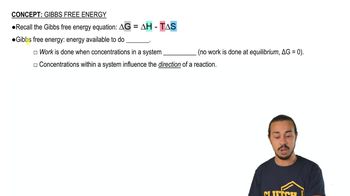
What does it mean when the Gibbs free energy change (ΔG) of a reaction is zero, and how does this relate to equilibrium?
When ΔG is zero, the reaction is at equilibrium, meaning there is no net change in the concentrations of reactants and products, and no work can be done by the system.
How can the direction of a chemical reaction be predicted using the reaction quotient (Q) and the equilibrium constant (K)?
If Q < K, the reaction proceeds forward to form more products; if Q > K, the reaction proceeds in reverse to form more reactants; if Q = K, the reaction is at equilibrium.
What does it mean when the Gibbs free energy change (ΔG) of a reaction is zero?
When ΔG is zero, the reaction is at equilibrium, meaning there is no net change in the concentrations of reactants and products, and no work can be done by the system.
How can the direction of a chemical reaction be predicted using the reaction quotient (Q) and the equilibrium constant (K)?
If Q < K, the reaction proceeds forward to form more products; if Q > K, the reaction proceeds in reverse to form more reactants; if Q = K, the reaction is at equilibrium.
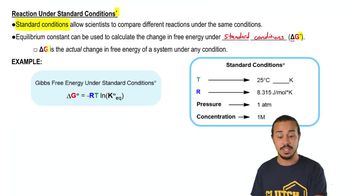
What is the standard Gibbs free energy equation under standard conditions?
The standard Gibbs free energy change (ΔG°) is calculated as ΔG° = −R·T·ln(K), where R is the gas constant, T is temperature in Kelvin, and K is the equilibrium constant.
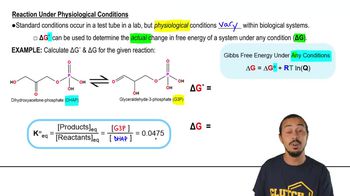
How do standard conditions differ from physiological conditions in the context of Gibbs free energy?
Standard conditions are defined as 25°C (298 K), 1 atm pressure, and 1 M concentrations, while physiological conditions can vary and often do not match these values.
Why are most cellular reactions not at equilibrium?
Cellular reactions are rarely at equilibrium because reactants and products are constantly being added or removed, and conditions within cells are always changing.
How is the actual Gibbs free energy change (ΔG) under physiological conditions calculated?
The actual ΔG is calculated using the equation ΔG = ΔG° + R·T·ln(Q), where Q is the reaction quotient reflecting current concentrations.
What does a positive value of ΔG under standard conditions indicate about a reaction?
A positive ΔG under standard conditions means the reaction is endergonic and non-spontaneous under those conditions.
How can a reaction that is non-spontaneous under standard conditions become spontaneous in a cell?
A reaction can become spontaneous in a cell if the actual concentrations of reactants and products (Q) make ΔG negative, even if ΔG° is positive.
What does ATP lose when it is hydrolyzed?
ATP loses a phosphate group when it is hydrolyzed.
How can metabolism be defined in biochemistry?
Metabolism is the sum of all chemical reactions that occur within a living organism to maintain life.
What molecules does ATP become after it is hydrolyzed?
After hydrolysis, ATP becomes ADP (adenosine diphosphate) and an inorganic phosphate (Pi).
What function does ATP carry out in living things?
ATP functions as the primary energy carrier in living cells, providing energy for cellular activities.
How do ATP molecules provide energy for cellular activities?
ATP provides energy for cellular activities by hydrolyzing and releasing a phosphate group, which releases energy.
What three components make up an ATP molecule?
An ATP molecule is composed of adenine, ribose (a sugar), and three phosphate groups.
What are the components of an ATP molecule?
The components of ATP are adenine, ribose, and three phosphate groups.
What are the three parts of an ATP molecule?
The three parts of ATP are adenine, ribose, and three phosphate groups.
What is released when ATP loses a phosphate group?
Energy is released when ATP loses a phosphate group.
Which bond is broken in ATP to release energy?
The bond broken in ATP to release energy is the bond between the terminal (last) phosphate group and the rest of the molecule.
What is the function of ATP in living things?
ATP serves as the universal energy currency, powering cellular processes.
How many high-energy bonds does ATP contain?
ATP contains two high-energy phosphate bonds.
How many phosphates does ATP have?
ATP has three phosphate groups.
How are ATP and ADP related?
ATP and ADP are related by the transfer of a phosphate group; ATP loses a phosphate to become ADP, and ADP can gain a phosphate to become ATP.
How many phosphate groups are in ATP?
ATP contains three phosphate groups.
How many phosphates does ATP have?
ATP has three phosphate groups.
How many phosphates are in ATP?
ATP contains three phosphate groups.
How is energy released from ATP?
Energy is released from ATP when the terminal phosphate bond is broken during hydrolysis.
When is energy released from ATP?
Energy is released from ATP when it is hydrolyzed and a phosphate group is removed.
What is the cycle called in which ATP is converted to ADP and then back to ATP?
The cycle is called the ATP-ADP cycle.
ATP is used for ________ in all cells.
ATP is used for energy in all cells.
When ATP loses a phosphate group, what is released?
When ATP loses a phosphate group, energy is released.
What is released when ATP loses a phosphate?
Energy is released when ATP loses a phosphate.
What happens when a phosphate group is removed from ATP?
When a phosphate group is removed from ATP, it becomes ADP and energy is released.
How does ATP become ADP?
ATP becomes ADP by losing one of its three phosphate groups through hydrolysis.
Where is most of the energy in ATP stored?
Most of the energy in ATP is stored in the bonds between its phosphate groups, especially the terminal phosphate bond.
How many phosphate groups does ATP possess?
ATP possesses three phosphate groups.
What term best summarizes ATP hydrolysis?
ATP hydrolysis is best summarized as an exergonic reaction.
When is the energy stored in ATP released?
The energy stored in ATP is released when ATP is hydrolyzed and a phosphate group is removed.