What type of bonding maintains the secondary structure of a protein, specifically in an alpha helix?
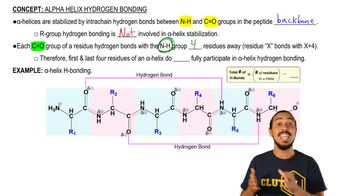
The secondary structure of a protein in an alpha helix is maintained by hydrogen bonds formed between the carbonyl group of one amino acid and the amino group of another amino acid that is four residues away within the same polypeptide chain.
Which groups in the peptide backbone are directly involved in alpha helix hydrogen bonding?
The amino and carbonyl groups in the peptide backbone are directly involved in alpha helix hydrogen bonding. The R groups of amino acids are not involved in this bonding.
How does the hydrogen bonding pattern in an alpha helix affect the participation of the first and last four residues?
The first and last four residues of an alpha helix do not fully participate in hydrogen bonding. This is because the hydrogen bonds form between residues that are four positions apart.
In a hexapeptide forming an alpha helix, how many hydrogen bonds are present and why?
There are two hydrogen bonds present in a hexapeptide alpha helix. This is calculated by subtracting four from the total number of residues.
What is the directionality of hydrogen bonding between carbonyl and amino groups in an alpha helix?
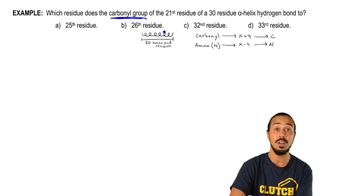
The carbonyl group of residue x hydrogen bonds to the amino group of residue x+4 towards the C-terminus. Conversely, the amino group of residue x hydrogen bonds to the carbonyl group of residue x-4 towards the N-terminus.
Why do alpha helices exhibit a net dipole, and what is its orientation?
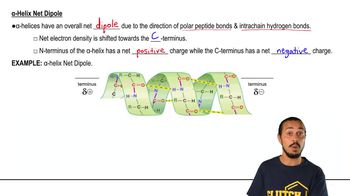
Alpha helices exhibit a net dipole because all polar peptide bonds are oriented in the same direction due to hydrogen bonding. The net dipole points towards the C-terminus, resulting in a net negative charge at the C-terminus and a net positive charge at the N-terminus.
How does the net dipole of an alpha helix differ from that of beta sheets?
Alpha helices have a unique net dipole due to the orientation of their peptide bonds. This net dipole is not observed in beta sheets.
What mnemonic can help distinguish the directionality of hydrogen bonding for amino and carbonyl groups in alpha helices?
The N in the amino group can remind you of the negative sign in x-4, indicating hydrogen bonding towards the N-terminus. The carbonyl group bonds towards x+4, which is towards the C-terminus.
What is the effect of hydrogen bonding on the electron density within an alpha helix?
Hydrogen bonding in alpha helices shifts electron density towards the carboxyl terminus. This contributes to the net negative charge at the C-terminus.
Why are the R groups of amino acids not involved in alpha helix hydrogen bonding?
Alpha helix hydrogen bonding occurs exclusively between backbone amino and carbonyl groups. The R groups do not participate in these stabilizing interactions.