Pearson+ LogoPearson+ Logo

Amino Acid Oxidation 1 quiz #1 Flashcards

Back
Amino Acid Oxidation 1 quiz #1
Control buttons has been changed to "navigation" mode.
1/10
  • What is a byproduct of amino acid catabolism in the liver?

    A byproduct of amino acid catabolism in the liver is urea, which is produced via the urea cycle to safely remove nitrogen from the body.
  • Urea is a byproduct of the metabolism of which type of biomolecule?

    Urea is a byproduct of the metabolism of amino acids, specifically from the removal of nitrogen during amino acid catabolism.
  • Which B vitamin is required for amino acid metabolism?

    Vitamin B6 (pyridoxine) is required for amino acid metabolism, as it is a cofactor for enzymes involved in amino acid transamination and other reactions.
  • Why can't cells simply release ammonia after removing nitrogen from amino acids?

    Cells can't release ammonia because it is toxic and can disrupt cellular pH. Instead, ammonia is converted to urea for safe excretion.
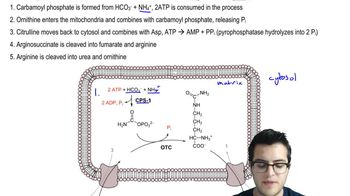
  • How many ATP molecules are consumed during the formation of carbamoyl phosphate in the urea cycle?

    Two ATP molecules are consumed during the formation of carbamoyl phosphate. This step occurs in the mitochondrial matrix.
  • Which molecule combines with carbamoyl phosphate to form citrulline in the urea cycle?

    Ornithine combines with carbamoyl phosphate to form citrulline. This reaction takes place inside the mitochondria.
  • What happens to citrulline after it is formed in the mitochondria during the urea cycle?

    Citrulline exits the mitochondria and enters the cytosol. There, it reacts with aspartate to continue the cycle.
  • What is the role of AMP in the reaction between citrulline and aspartate in the urea cycle?

    AMP is temporarily attached to the enzymatic intermediate during the reaction. It is released when aspartate is added to citrulline.
  • Which two products are formed when argininosuccinate is cleaved in the urea cycle?

    Argininosuccinate is cleaved into fumarate and arginine. This is a key step in the cytosolic portion of the cycle.
  • What happens to ornithine after urea is released from arginine in the urea cycle?

    Ornithine is regenerated and reenters the mitochondria to combine with carbamoyl phosphate. This allows the urea cycle to repeat.