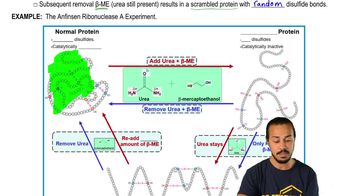
What determines the shape and function of a protein according to the Anfinsen experiment?
The primary structure (amino acid sequence) of a protein determines its shape (tertiary structure) and function, as demonstrated by the Anfinsen experiment, which showed that protein folding is spontaneous and dictated by the primary sequence.
What protein did Anfinsen use in his experiments to study protein folding?
Anfinsen used ribonuclease A (RNase A) in his experiments. This protein was chosen to demonstrate the principles of protein folding and structure.
Which two reagents did Anfinsen use to denature ribonuclease A?
Anfinsen used urea and beta-mercaptoethanol to denature ribonuclease A. Urea disrupts non-covalent bonds, while beta-mercaptoethanol breaks disulfide bonds.
What happens to the catalytic activity of ribonuclease A when it is denatured by urea and beta-mercaptoethanol?
The catalytic activity of ribonuclease A is lost when it is denatured by these reagents. The protein becomes catalytically inactive and cannot perform its function.
How did Anfinsen demonstrate that protein folding is spontaneous and exergonic?
He showed that removing the denaturing agents allowed the protein to refold into its native, active state. This indicated that folding occurs spontaneously and is thermodynamically favorable.
What is the effect of removing only beta-mercaptoethanol while keeping urea present during the refolding process?
Removing only beta-mercaptoethanol allows disulfide bonds to reform, but they form randomly due to disrupted non-covalent interactions. This results in a scrambled, mostly inactive protein.
Why are non-covalent interactions important for proper disulfide bond formation in proteins?
Non-covalent interactions help guide the correct pairing of cysteine residues to form proper disulfide bonds. Without them, disulfide bonds form randomly, leading to inactive or misfolded proteins.
What technique did Anfinsen use to remove urea and beta-mercaptoethanol from the denatured protein?
Anfinsen used dialysis to remove urea and beta-mercaptoethanol from the denatured protein. This allowed the protein to renature and regain its activity.
What does the native conformation of a protein represent in terms of stability and energy?
The native conformation is the most stable state of a protein and has the lowest energy. Proteins spontaneously fold into this state because it is thermodynamically favorable.
How did Anfinsen restore the activity of a scrambled protein with incorrect disulfide bonds?
He removed urea and added a small amount of beta-mercaptoethanol, allowing disulfide bonds to break and reform correctly over time. This process restored the protein's native structure and activity.