Skip to main content
Biochemistry
My Course
Learn
Exam Prep
AI Tutor
Study Guides
Flashcards
Explore
Try the app
My Course
Learn
Exam Prep
AI Tutor
Study Guides
Flashcards
Explore
Try the app
Back
Aromatic Amino Acids definitions
You can tap to flip the card.
Aromatic Amino Acids
You can tap to flip the card.
👆
Aromatic Amino Acids
Group with large benzene ring R groups, including phenylalanine, tyrosine, and tryptophan, influencing protein structure and function.
Track progress
Control buttons has been changed to "navigation" mode.
1/15
Related flashcards
Related practice
Recommended videos
Aromatic Amino Acids quiz
Aromatic Amino Acids
15 Terms
Aromatic Amino Acids
3. Amino Acids
7 problems
Topic
Polar Amino Acids
3. Amino Acids
7 problems
Topic
3. Amino Acids - Part 1 of 3
5 topics
15 problems
Chapter
3. Amino Acids - Part 2 of 3
5 topics
14 problems
Chapter
3. Amino Acids - Part 3 of 3
7 topics
16 problems
Chapter
Guided course
10:45
Aromatic Amino Acids
2156
views
28
rank
3
comments
Terms in this set (15)
Hide definitions
Aromatic Amino Acids
Group with large benzene ring R groups, including phenylalanine, tyrosine, and tryptophan, influencing protein structure and function.
Phenylalanine
Nonpolar amino acid with a phenyl group branching from alanine, represented by the letter F and three-letter code Phe.
Tyrosine
Amino acid with a polar hydroxyl group attached to a phenyl group, derived from phenylalanine, represented by the letter Y.
Tryptophan
Amino acid with a unique indole ring system, consisting of a five-membered ring joined to a benzene ring, represented by the letter W.
Benzene Ring
Six-membered carbon ring with conjugated double bonds, forming the core of aromatic amino acid R groups.
Phenyl Group
Branching benzene ring attached to alanine, forming the R group of phenylalanine.
Hydroxyl Group
Polar functional group consisting of an oxygen and hydrogen, attached to the benzene ring in tyrosine.
Indole Ring
Structure with a five-membered ring containing nitrogen fused to a benzene ring, found in tryptophan.
R Group
Side chain attached to the central carbon of amino acids, determining their chemical properties and classification.
Hydrophobicity
Tendency of aromatic amino acids to avoid water, influenced by their large ring structures.
Protein Conformation
Three-dimensional shape of proteins affected by aromatic amino acid interactions.
Amino Acid Analysis
Process of identifying and classifying amino acids, aided by recognizing aromatic residues.
Residue
Individual amino acid unit within a protein, often referring to aromatic side chains.
Alanine
Simple amino acid serving as the structural base for phenylalanine and tryptophan.
Double Bond
Bond involving two shared pairs of electrons, present in the conjugated system of benzene rings.
 BackBack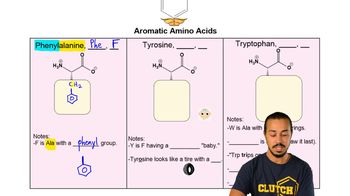
 10:45
10:45