Proteins quiz #2 Flashcards

Proteins quiz #2
1 student found this helpful
Control buttons has been changed to "navigation" mode.
1/40
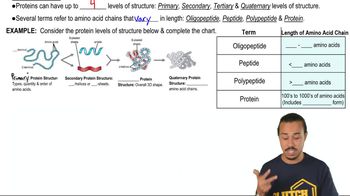
  • What is the typical size range of proteins in terms of amino acids?
    Proteins typically range from 100 to several thousand amino acids.
  • What is the main difference between a polypeptide and a protein?
    A polypeptide is a single amino acid chain, while a protein is a functional molecule that may consist of one or more polypeptides.
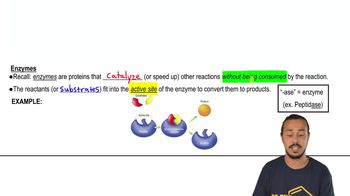
  • What is the function of enzymes in biological systems?
    Enzymes catalyze and speed up chemical reactions necessary for life.
  • How do substrates interact with enzymes?
    Substrates fit into the enzyme's active site, forming an enzyme-substrate complex.
  • What happens to substrates during an enzyme-catalyzed reaction?
    Enzymes convert substrates into products during the reaction.
  • Can enzymes be used repeatedly?
    Yes, enzymes can be reused for multiple reactions because they are not consumed.
  • Why are enzymes essential for life?
    Enzymes are essential because they catalyze nearly all cellular reactions at rates necessary for life.
  • What is the significance of the '-ase' suffix in biochemistry?
    The '-ase' suffix indicates that a molecule is an enzyme.
  • What is a peptidase?
    A peptidase is an enzyme that breaks down peptides into smaller fragments.
  • What is the relationship between protein structure and function?
    A protein's structure determines its specific function in the cell.
  • What is the role of the R group in amino acids?
    The R group gives each amino acid its unique properties and influences protein structure.
  • How are proteins classified based on their structure?
    Proteins are classified by their primary, secondary, tertiary, and quaternary structures.
  • What is the importance of the primary structure of a protein?
    The primary structure determines the protein's final shape and function.
  • What types of bonds stabilize secondary protein structures?
    Hydrogen bonds stabilize secondary structures like alpha helices and beta sheets.
  • What types of interactions stabilize tertiary protein structure?
    Tertiary structure is stabilized by interactions such as hydrogen bonds, ionic bonds, disulfide bridges, and hydrophobic interactions.
  • What is a protein subunit?
    A protein subunit is a single polypeptide chain that can associate with others to form a functional protein.
  • What is a functional protein?
    A functional protein is a polypeptide or group of polypeptides folded into a specific three-dimensional shape that performs a biological function.
  • What is the difference between a substrate and a product in enzyme reactions?
    A substrate is the molecule acted upon by an enzyme, while a product is the molecule produced by the reaction.
  • What is the significance of the enzyme-substrate complex?
    The enzyme-substrate complex allows the enzyme to catalyze the conversion of substrate to product efficiently.
  • What is the role of hydrogen bonding in protein structure?
    Hydrogen bonding helps stabilize secondary and tertiary structures in proteins.
  • What is the role of disulfide bridges in proteins?
    Disulfide bridges are covalent bonds that help stabilize the tertiary and quaternary structures of proteins.
  • What is the role of hydrophobic interactions in protein folding?
    Hydrophobic interactions help drive the folding of proteins by causing nonpolar side chains to cluster away from water.
  • What is the role of ionic bonds in protein structure?
    Ionic bonds between charged side chains help stabilize tertiary and quaternary protein structures.
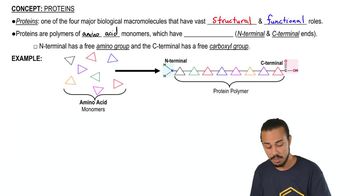
  • What is the difference between a monomer and a polymer in the context of proteins?
    A monomer is a single amino acid, while a polymer is a chain of amino acids (a polypeptide or protein).
  • What is the general function of structural proteins?
    Structural proteins provide support and shape to cells and tissues.
  • What is the general function of regulatory proteins?
    Regulatory proteins control cellular processes and gene expression.
  • What is the general function of transport proteins?
    Transport proteins move molecules across cell membranes or within the body.
  • What is the general function of signaling proteins?
    Signaling proteins transmit signals to coordinate biological processes.
  • What is the general function of defensive proteins?
    Defensive proteins protect the body from pathogens, such as antibodies.
  • What is the general function of storage proteins?
    Storage proteins store amino acids or other substances for later use.
  • What is the general function of motor proteins?
    Motor proteins generate movement within cells and tissues.
  • What is the general function of receptor proteins?
    Receptor proteins receive and respond to chemical signals.
  • What is the general function of enzymatic proteins?
    Enzymatic proteins catalyze biochemical reactions.
  • What is the relationship between protein denaturation and function?
    Denaturation disrupts protein structure, leading to loss of function.
  • What can cause protein denaturation?
    Protein denaturation can be caused by heat, pH changes, or chemicals.
  • What is the significance of protein folding?
    Proper protein folding is essential for correct function.
  • What is a chaperone protein?
    A chaperone protein assists in the proper folding of other proteins.
  • What is the difference between fibrous and globular proteins?
    Fibrous proteins are long and structural, while globular proteins are compact and functional.
  • What is a prosthetic group in a protein?
    A prosthetic group is a non-protein component required for protein function.
  • What is a holoenzyme?
    A holoenzyme is a complete, active enzyme with its necessary cofactors or prosthetic groups.