Back

Biosignaling 4 definitions

Control buttons has been changed to "navigation" mode.
1/15
  • Crosstalk

    Interaction between multiple signaling pathways within a cell, modifying cellular responses and increasing complexity.
  • Insulin Pathway

    A signaling route that regulates cellular metabolism and interacts with other pathways, such as epinephrine, for integrated responses.
  • Epinephrine Pathway

    A hormone-driven signaling cascade affecting cellular responses, often involved in crosstalk with insulin signaling.
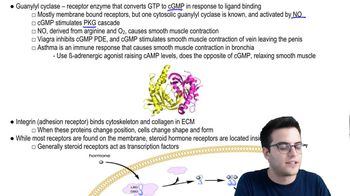
  • Guanylyl Cyclase

    An enzyme receptor converting GTP to cyclic GMP upon ligand binding, initiating downstream signaling events.
  • Cyclic GMP

    A second messenger produced from GTP, activating protein kinase G and influencing smooth muscle contraction.
  • Protein Kinase G

    A kinase activated by cyclic GMP, triggering phosphorylation cascades that affect muscle contraction and other cellular functions.
  • Nitric Oxide

    A signaling molecule derived from arginine and oxygen, activating cytosolic guanylyl cyclase and modulating smooth muscle tone.
  • Phosphodiesterase

    An enzyme that degrades cyclic nucleotides like cyclic GMP or cyclic AMP, regulating signal duration and intensity.
  • Beta-Adrenergic Agonist

    A compound that elevates cyclic AMP levels, relaxing bronchial smooth muscle and alleviating asthma symptoms.
  • Cyclic AMP

    A second messenger generated from ATP, mediating relaxation of smooth muscle and other cellular effects.
  • Integrin

    A membrane protein linking the cytoskeleton to the extracellular matrix, enabling changes in cell shape and structure.
  • Cytoskeleton

    A network of protein filaments inside cells, providing structural support and interacting with integrins for shape modulation.
  • Extracellular Matrix

    A complex network outside cells, composed of proteins like collagen, interacting with integrins to influence cell behavior.
  • Steroid Hormone

    A lipid-soluble molecule that diffuses through membranes, binding intracellular receptors to regulate gene expression.
  • Transcription Factor

    A protein, often activated by steroid hormone receptors, that binds DNA to control gene expression and cellular function.