What type of molecule does the enzyme amylase digest?
Amylase digests carbohydrates, specifically polysaccharides such as starch.
Which protein source is likely to contain lactose?
Protein sources derived from milk, such as whey and casein, are likely to contain lactose, since lactose is a carbohydrate found in milk.
Amylase is a digestive enzyme that breaks down which class of biomolecules?
Amylase is a digestive enzyme that breaks down carbohydrates, particularly polysaccharides like starch.
What is the substrate that amylase acts upon during digestion?
Amylase acts upon polysaccharides, such as starch, breaking them down into smaller carbohydrate units.
Amylase is an enzyme that is only able to digest which type of biological molecule?
Amylase is only able to digest carbohydrates, specifically polysaccharides.
Which type of nutrient requires the enzyme amylase for digestion?
Carbohydrates, especially polysaccharides like starch, require the enzyme amylase for digestion.
What is the general chemical formula for simple carbohydrates as originally defined in the 1800s?
The general formula is Cn(H2O)n, where n is greater than or equal to 3. This formula reflects that for each carbon atom, there is a corresponding water molecule.
How do complex carbohydrates differ from simple carbohydrates in terms of their chemical composition?
Complex carbohydrates may deviate from the Cn(H2O)n formula and can include additional atoms such as phosphorus, nitrogen, or sulfur. They are often derivatives of simple carbohydrates.
What type of bond links monosaccharides together in carbohydrates?
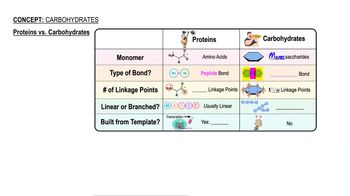
Monosaccharides are linked together by glycosidic bonds. This is distinct from the peptide bonds that link amino acids in proteins.
Why can carbohydrates form both linear and branched structures, unlike proteins?
Carbohydrates have multiple linkage points, allowing for both linear and branched structures. In contrast, proteins generally have only two linkage points, resulting in linear structures.