Back

Catalysis definitions

Control buttons has been changed to "navigation" mode.
1/15
  • Enzyme

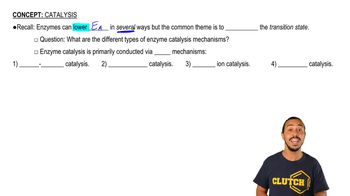
    Biological molecule that accelerates reactions by lowering activation energy through multiple mechanisms.
  • Activation Energy

    Energy barrier that must be overcome for a reaction to proceed; reduced by enzyme action.
  • Transition State

    High-energy, unstable configuration during a reaction, stabilized by enzyme mechanisms.
  • Substrate

    Molecule upon which an enzyme acts, often brought closer and oriented for efficient reaction.
  • Hydration Shell

    Layer of water molecules surrounding a substrate, potentially interfering with reaction progress.
  • Acid-Base Catalysis

    Mechanism where proton transfers facilitate reaction, stabilizing charged intermediates.
  • Electrostatic Catalysis

    Enzyme mechanism involving stabilization of charged intermediates through electrostatic interactions.
  • Metal Ion Catalysis

    Catalytic process where metal ions assist in substrate binding or charge stabilization.
  • Covalent Catalysis

    Mechanism where enzyme forms temporary covalent bonds with substrate to facilitate reaction.
  • Charged Intermediate

    Unstable molecule formed during a reaction, often stabilized by proton transfer or enzyme action.
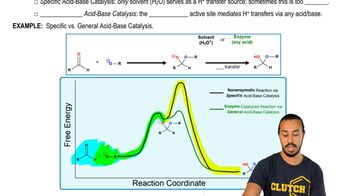
  • Specific Acid-Base Catalysis

    Type of catalysis where only the solvent, typically water, acts as the proton transfer source.
  • General Acid-Base Catalysis

    Catalysis involving any acid or base, with the enzyme's active site mediating proton transfer.
  • Active Site

    Region of an enzyme where substrate binding and catalysis occur, often mediating proton transfers.
  • Hydronium Ion

    Protonated water molecule (H3O+), often serving as a proton donor in specific acid-base catalysis.
  • Free Energy Diagram

    Graphical representation showing energy changes during a reaction, highlighting activation energy and intermediates.