Pearson+ LogoPearson+ Logo

Citric Acid Cycle 1 quiz #2 Flashcards

Back
Citric Acid Cycle 1 quiz #2
Control buttons has been changed to "navigation" mode.
1/10
  • Where does the Krebs cycle occur in eukaryotic cells?

    It occurs in the mitochondrial matrix.
  • Why is the Krebs cycle called a cycle?

    It is called a cycle because the final product, oxaloacetate, is regenerated and used to start the next turn.
  • Where do the TCA cycle reactions take place within the cell?

    They take place in the mitochondrial matrix.
  • How many NADH molecules are produced per turn of the citric acid cycle for each acetyl CoA input?

    Three NADH molecules are produced per turn of the cycle for each acetyl CoA. These NADH molecules are later used in the electron transport chain.
  • What is the significance of succinate's symmetry in the citric acid cycle?

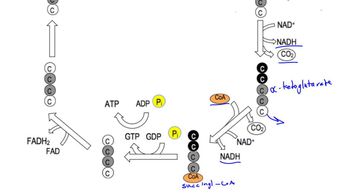
    Succinate's symmetry causes its carbons to have a random orientation in the enzyme's active site. This affects how labeled carbons are tracked through subsequent cycles.
  • Which steps of the citric acid cycle are considered the major drivers due to their negative delta G values?

    Steps 1, 3, and 4 are the major drivers of the citric acid cycle because they have negative delta G values. These steps push the cycle forward consistently.
  • What happens to the labeled carbons from acetyl CoA as they progress through the citric acid cycle?

    Only half of the labeled carbons from acetyl CoA come off as CO2 in the first turn due to succinate's random orientation. In subsequent turns, the fraction released continues to decrease.
  • How is GTP or ATP generated during the citric acid cycle?

    GTP or ATP is generated by substrate-level phosphorylation when succinyl CoA is converted to succinate. The specific nucleotide triphosphate produced depends on the cell type.
  • Which reaction in the citric acid cycle produces FADH2?

    FADH2 is produced when succinate is converted to fumarate. This is the only step in the cycle that generates FADH2 per turn.
  • Why are reactions 5, 6, 7, and 8 of the citric acid cycle considered reversible?

    Reactions 5, 6, 7, and 8 are considered reversible because their delta G values are close to zero. This allows these steps to easily proceed in either direction under cellular conditions.