Back

Citric Acid Cycle 3 definitions

Control buttons has been changed to "navigation" mode.
1/15
  • Alpha Ketoglutarate Dehydrogenase Complex

    Multienzyme system converting alpha ketoglutarate to succinyl-CoA, utilizing several cofactors and driving the citric acid cycle forward.
  • FAD

    Redox cofactor involved in electron transfer, essential for dehydrogenase reactions within the citric acid cycle.
  • Lipoate

    Cofactor facilitating acyl group transfer and oxidation-reduction reactions in multienzyme complexes.
  • TPP

    Vitamin B1-derived cofactor crucial for decarboxylation steps in metabolic enzyme complexes.
  • CoA

    Carrier molecule for acyl groups, enabling their transfer and activation in metabolic pathways.
  • NAD+

    Electron acceptor reduced to NADH during oxidative reactions, vital for cellular energy production.
  • NADH

    Reduced form of NAD+, storing high-energy electrons for subsequent ATP generation.
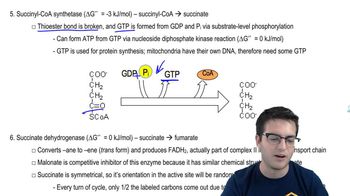
  • Succinyl-CoA Synthetase

    Enzyme catalyzing substrate-level phosphorylation, breaking thioester bonds to generate GTP.
  • Thioester Bond

    High-energy linkage whose cleavage releases energy for GTP synthesis in the citric acid cycle.
  • GTP

    Nucleotide produced via substrate-level phosphorylation, interchangeable with ATP for cellular energy.
  • Substrate-Level Phosphorylation

    Direct transfer of phosphate to a nucleotide, generating GTP or ATP without electron transport.
  • Succinate Dehydrogenase

    Enzyme converting succinate to fumarate, producing FADH2 and forming a trans double bond.
  • FADH2

    Reduced electron carrier generated during succinate oxidation, contributing to mitochondrial ATP synthesis.
  • Malonate

    Succinate analog acting as a competitive inhibitor of succinate dehydrogenase due to structural similarity.
  • Trans Double Bond

    Geometric configuration formed during succinate conversion to fumarate, distinguishing product structure.