Back

Citric Acid Cycle 4 definitions

Control buttons has been changed to "navigation" mode.
1/15
  • Fumarate

    Intermediate in the citric acid cycle converted to L-malate by addition of water, with a near-zero delta G, allowing reversibility.
  • L-malate

    Product formed from fumarate in the citric acid cycle, exists as L or D form, and is further converted to oxaloacetate.
  • Malate dehydrogenase

    Enzyme catalyzing the conversion of malate to oxaloacetate, producing NADH, with a reaction that is easily reversible.
  • Oxaloacetate

    Molecule regenerated at the end of the citric acid cycle, serving as the acceptor for acetyl CoA to restart the cycle.
  • NADH

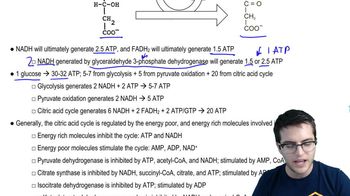
    Electron carrier produced in the citric acid cycle, yielding 2.5 ATP per molecule during oxidative phosphorylation.
  • FADH2

    Electron carrier generated in the citric acid cycle, producing 1.5 ATP per molecule due to its metabolic entry point.
  • ATP

    Primary energy currency of the cell, with a daily turnover of about 50 kilograms, generated through glycolysis, pyruvate oxidation, and the citric acid cycle.
  • Glycolysis

    Metabolic pathway breaking down glucose, contributing 5–7 ATP to the total yield per glucose molecule.
  • Pyruvate oxidation

    Process converting pyruvate to acetyl CoA, generating NADH and contributing 5 ATP per glucose molecule.
  • Acetyl CoA

    Two-carbon molecule entering the citric acid cycle, derived from pyruvate oxidation, essential for ATP production.
  • Citrate synthase

    Enzyme catalyzing the first step of the citric acid cycle, regulated by ATP, NADH, succinyl CoA, and its product citrate.
  • Isocitrate dehydrogenase

    Key enzyme in the citric acid cycle, inhibited by ATP and stimulated by ADP, controlling cycle flux.
  • Alpha-ketoglutarate dehydrogenase

    Enzyme complex in the citric acid cycle, regulated by NADH and succinyl CoA, involved in irreversible steps.
  • Anaplerotic reactions

    Processes replenishing citric acid cycle intermediates, especially oxaloacetate, to maintain cycle function.
  • Succinyl CoA

    Intermediate in the citric acid cycle, production is irreversible and regulated, also acts as a feedback inhibitor.