Pearson+ LogoPearson+ Logo

Competitive Inhibition quiz #1 Flashcards

Back
Competitive Inhibition quiz #1
Control buttons has been changed to "navigation" mode.
1/10
  • How does a competitive inhibitor slow down enzyme catalysis?

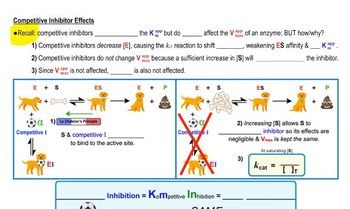
    A competitive inhibitor slows enzyme catalysis by binding to the enzyme's active site, directly competing with the substrate. This prevents the substrate from binding, thereby decreasing the initial reaction velocity. Competitive inhibitors increase the apparent Km (decreasing substrate affinity) but do not affect the Vmax, since increasing substrate concentration can outcompete the inhibitor.
  • What structural feature allows competitive inhibitors to bind to the enzyme's active site?

    Competitive inhibitors are substrate analogs, meaning they are structurally similar to the substrate. This similarity enables them to fit into the enzyme's active site and compete with the substrate.
  • Why do competitive inhibitors only bind to free enzymes and not the enzyme-substrate complex?

    Competitive inhibitors require access to the active site, which is only available in free enzymes. Once the substrate is bound, the active site is occupied and the inhibitor cannot bind.
  • How does increasing the concentration of competitive inhibitor affect the Michaelis-Menten plot?

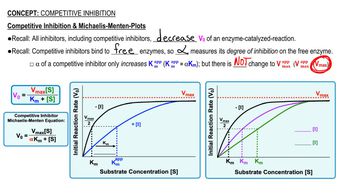
    Increasing competitive inhibitor concentration raises the apparent Km, causing the curve to shift rightward. However, the Vmax remains unchanged regardless of inhibitor concentration.
  • What happens to the initial reaction velocity (vā‚€) in the presence of a competitive inhibitor?

    The initial reaction velocity decreases when a competitive inhibitor is present. This is because the inhibitor competes with the substrate for binding to the enzyme.
  • How does Le Chatelier's principle explain the effect of competitive inhibitors on enzyme affinity?

    When competitive inhibitors decrease free enzyme concentration, the equilibrium shifts to favor dissociation of the enzyme-substrate complex. This results in a weakened apparent affinity for the substrate and an increased Km.
  • What effect do competitive inhibitors have on the slope of a Lineweaver-Burk plot?

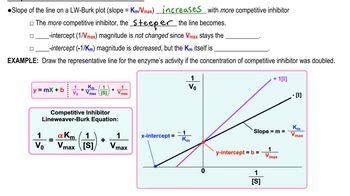
    Competitive inhibitors increase the slope of the Lineweaver-Burk plot because they raise the Km while leaving Vmax unchanged. The more inhibitor added, the steeper the slope becomes.
  • How does the x-intercept of a Lineweaver-Burk plot change in the presence of a competitive inhibitor?

    The x-intercept shifts closer to zero as competitive inhibitors increase Km. This reflects a decrease in the magnitude of the x-intercept, indicating reduced substrate affinity.
  • Why does the catalytic constant (kcat) remain unchanged in the presence of competitive inhibitors?

    Competitive inhibitors do not affect Vmax or total enzyme concentration, so the kcat (Vmax/[E]total) remains the same. This means the enzyme's turnover number is unaffected by competitive inhibition.
  • What unique feature distinguishes competitive inhibitors from other types of reversible inhibitors?

    Competitive inhibitors uniquely compete directly with the substrate for the enzyme's active site. This competitive interaction is not seen with other reversible inhibitor types.