What is denaturation in the context of protein structure?
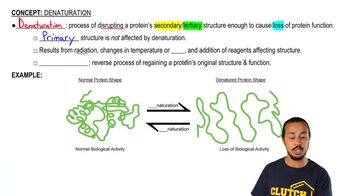
Denaturation is the process that disrupts a protein's secondary and tertiary structures, causing a loss of function while leaving the primary amino acid sequence intact.
Which levels of protein structure are affected by denaturation, and which remain unchanged?
Denaturation affects the secondary and tertiary structures but does not alter the primary structure (the amino acid sequence).
What are some common factors that can cause protein denaturation?
Common factors include changes in temperature, pH, radiation, and the addition of chemical reagents such as urea and beta mercaptoethanol.
How does urea cause protein denaturation?
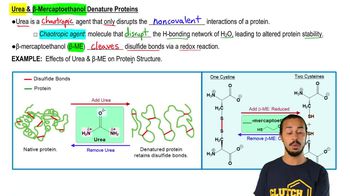
Urea acts as a chaotropic agent that disrupts non-covalent interactions, particularly by interfering with the hydrogen bonding network, leading to the loss of secondary and tertiary structure.
What is the specific effect of beta mercaptoethanol on protein structure?
Beta mercaptoethanol cleaves disulfide bonds (covalent interactions between cysteine residues) through a redox reaction, disrupting the protein's tertiary structure.
Does denaturation affect a protein's primary structure? Explain.
No, denaturation does not affect the primary structure; the amino acid sequence remains unchanged.
What is renaturation, and under what conditions can it occur?
Renaturation is the process by which a denatured protein regains its original structure and function, which can occur if the denaturing agent is removed and conditions are favorable.
Why does a denatured protein lose its biological activity?
A denatured protein loses its biological activity because the disruption of its secondary and tertiary structures prevents it from maintaining the shape necessary for its function.
What is a chaotropic agent, and how does it relate to protein denaturation?
A chaotropic agent, such as urea, disrupts non-covalent interactions in proteins by interfering with the hydrogen bonding network, leading to denaturation.
How can the effects of urea and beta mercaptoethanol on protein structure be reversed?
The effects can be reversed by removing the reagents; urea removal can allow non-covalent interactions to reform, and beta mercaptoethanol removal can allow disulfide bonds to re-form under oxidizing conditions.
What type of chemical bond does beta mercaptoethanol specifically target in proteins?
Beta mercaptoethanol specifically targets and breaks disulfide bonds, which are covalent bonds between cysteine residues.
Describe the difference between the effects of urea and beta mercaptoethanol on protein structure.
Urea disrupts non-covalent interactions, affecting secondary and tertiary structure but leaving disulfide bonds intact, while beta mercaptoethanol breaks disulfide bonds, disrupting covalent interactions.
Can a protein regain its function after denaturation? If so, how?
Yes, a protein can regain its function through renaturation if the denaturing conditions are reversed and the protein refolds correctly.
Why is the primary structure of a protein preserved during denaturation?
The primary structure is preserved because denaturation does not break the peptide bonds between amino acids.
What is the significance of protein conformation in biological activity?
Protein conformation is crucial because the specific three-dimensional structure determines the protein's ability to perform its biological function.
What happens to an enzyme at higher temperatures?
At higher temperatures, an enzyme may denature, losing its secondary and tertiary structure and thus its biological function, while its primary structure remains intact.
How do acids and bases denature a protein?
Acids and bases denature a protein by disrupting non-covalent interactions, such as hydrogen bonds and ionic interactions, which destabilizes the protein's secondary and tertiary structure.
What factors can denature an enzyme?
Enzymes can be denatured by factors such as high temperature, extreme pH, radiation, and chemical reagents like urea and beta mercaptoethanol.
What structural changes occur when a protein is denatured?
When a protein is denatured, its secondary and tertiary structures are disrupted, leading to a loss of biological function, but its primary structure (amino acid sequence) remains unchanged.
What is the role of hydrochloric acid (HCl) in protein digestion?
Hydrochloric acid (HCl) in protein digestion denatures proteins by disrupting their secondary and tertiary structures, making them more accessible to digestive enzymes.
What can cause an enzyme to denature?
An enzyme can be denatured by changes in temperature, pH, or the addition of chemical reagents such as urea (which disrupts non-covalent interactions) and beta mercaptoethanol (which breaks disulfide bonds).
How is an enzyme's shape affected when it becomes denatured?
When an enzyme becomes denatured, it loses its specific secondary and tertiary structure, resulting in a loss of its functional shape and biological activity, while its primary structure remains intact.