Pearson+ LogoPearson+ Logo

Enzymes quiz #8 Flashcards

Back
Enzymes quiz #8
Control buttons has been changed to "navigation" mode.
1/38
  • What does the enzyme amylase break down?

    Amylase breaks down starches into simpler carbohydrates such as sugars.
  • Can an enzyme be reused with a new substrate?

    Yes, enzymes can be reused with new substrates because they are not consumed in the reaction.
  • How many times can an enzyme be used in biochemical reactions?

    An enzyme can be used multiple times, as it is not consumed or permanently changed during reactions.
  • Which liver enzyme is primarily responsible for metabolizing alcohol?

    The liver enzyme primarily responsible for metabolizing alcohol is alcohol dehydrogenase.
  • Which enzyme breaks down starches into simple carbohydrates?

    Amylase is the enzyme that breaks down starches into simple carbohydrates.
  • How many times can an enzyme be used?

    An enzyme can be used repeatedly, as it is not consumed in the reaction.
  • Amylase is an enzyme that digests which type of macromolecule?

    Amylase digests starch, a type of carbohydrate.
  • What is a protein that acts as a biological catalyst called?

    A protein that acts as a biological catalyst is called an enzyme.
  • What is the term for a substance that is changed by an enzyme?

    A substance that is changed by an enzyme is called a substrate.
  • What do you call a protein that speeds up chemical reactions?

    A protein that speeds up chemical reactions is called an enzyme.
  • Can an enzyme be used more than once in chemical reactions?

    Yes, enzymes can be used more than once because they are not consumed during the reaction.
  • Which enzyme is responsible for breaking down carbohydrates?

    Amylase is responsible for breaking down carbohydrates.
  • Which term best describes an enzyme?

    An enzyme is best described as a biological catalyst.
  • Which macromolecule are most enzymes classified as?

    Most enzymes are classified as proteins.
  • Which enzyme degrades acetylcholine?

    Acetylcholinesterase degrades acetylcholine.
  • An enzyme is which type of macromolecule?

    An enzyme is typically a protein.
  • Which macromolecule is an enzyme?

    Enzymes are usually proteins.
  • Which type of macromolecule is an enzyme?

    Enzymes are typically proteins.
  • What enzyme degrades acetylcholine?

    Acetylcholinesterase degrades acetylcholine.
  • What is the function of the enzyme amylase?

    The function of amylase is to catalyze the breakdown of starch into simpler sugars.
  • During an enzymatic reaction, what happens to the enzyme?

    During an enzymatic reaction, the enzyme facilitates the reaction and returns to its original state after the reaction is complete.
  • From what is part of an enzyme's name usually derived?

    Part of an enzyme's name is usually derived from the substrate it acts on or the type of reaction it catalyzes, often ending with the suffix '-ase.'
  • What macromolecule is an enzyme?

    An enzyme is typically a protein.
  • What is the function of the enzyme amylase?

    Amylase catalyzes the hydrolysis of starch into sugars.
  • Amylase is an enzyme that breaks down what?

    Amylase breaks down starch.
  • What kind of macromolecule is an enzyme?

    An enzyme is generally a protein.
  • What macromolecule is the enzyme ATP synthase?

    ATP synthase is a protein.
  • What type of biological molecule is an enzyme?

    An enzyme is typically a protein, though some enzymes (ribozymes) are made of RNA.
  • What enzyme is found in saliva that helps digest carbohydrates?

    Salivary amylase is the enzyme found in saliva that helps digest carbohydrates.
  • What is the function of an enzyme?

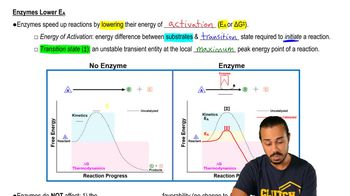
    The function of an enzyme is to catalyze and speed up chemical reactions by lowering the activation energy required.
  • What is the purpose of an enzyme in a cell?

    The purpose of an enzyme is to accelerate biochemical reactions, allowing cellular processes to occur efficiently.
  • What is an enzyme?

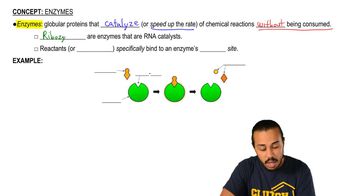
    An enzyme is a biological catalyst, usually a protein, that speeds up chemical reactions without being consumed.
  • What is part of an enzyme's name usually derived from?

    An enzyme's name is usually derived from its substrate or the reaction it catalyzes, with the suffix '-ase.'
  • How does an enzyme influence a chemical reaction?

    An enzyme lowers the activation energy of a chemical reaction, increasing the reaction rate.
  • How does an enzyme affect a reaction?

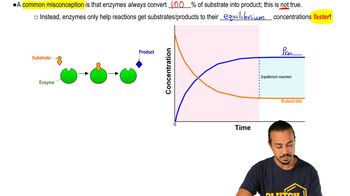
    An enzyme speeds up a reaction by lowering its activation energy, but does not change the reaction's equilibrium or thermodynamic favorability.
  • What happens to an enzyme after a biochemical reaction?

    After a biochemical reaction, the enzyme remains unchanged and can participate in additional reactions.
  • What is a characteristic of an enzyme?

    A characteristic of an enzyme is that it catalyzes reactions without being consumed or permanently altered.
  • Which pancreatic enzyme is responsible for the breakdown of carbohydrates?

    Pancreatic amylase is responsible for the breakdown of carbohydrates in the pancreas.