Pearson+ LogoPearson+ Logo

Fatty Acid Oxidation 1 quiz #1 Flashcards

Back
Fatty Acid Oxidation 1 quiz #1
Control buttons has been changed to "navigation" mode.
1/10
  • How does a resting muscle primarily generate ATP for energy?

    A resting muscle generates most of its ATP by oxidizing fatty acids through the process of beta oxidation, which occurs in the mitochondrial matrix and produces Acetyl CoA for the citric acid cycle.
  • Which metabolic pathway utilizes fat reserves to produce ATP in cells?

    Fat reserves are used to produce ATP through the beta oxidation pathway, where fatty acids are broken down into Acetyl CoA, which then enters the citric acid cycle for energy production.
  • What is the role of carnitine in fatty acid oxidation?

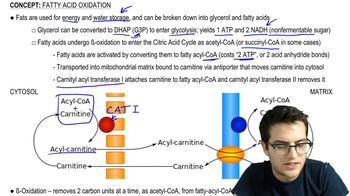
    Carnitine acts as a shuttle to transport fatty acyl CoA into the mitochondrial matrix. It is not consumed in the process but cycles between the cytosol and matrix.
  • Which enzyme attaches carnitine to fatty acyl CoA for mitochondrial transport?

    Carnitine acyltransferase 1 (CAT1) attaches carnitine to fatty acyl CoA. This forms acylcarnitine, which can be transported into the mitochondrial matrix.
  • What is the energy cost of activating a fatty acid for beta oxidation?

    Activating a fatty acid to fatty acyl CoA costs 2 ATP equivalents. This is because one ATP is used and both acid anhydride bonds are broken.
  • During the first step of beta oxidation, which molecule is reduced and what is formed?

    FAD is reduced to FADH2 during the first step of beta oxidation. A trans double bond is introduced into the fatty acyl CoA.
  • What happens to the alcohol group formed in the second step of beta oxidation?

    The alcohol group is oxidized to a carbonyl in the third step of beta oxidation. This reaction produces NADH from NAD+.
  • How does the number of beta oxidation rounds relate to the length of a fatty acid chain?

    The number of beta oxidation rounds is equal to half the number of carbons minus one. For example, a 10-carbon fatty acid undergoes 4 rounds.
  • Why is glycerol considered a non-fermentable sugar?

    Glycerol catabolism produces more NADH than can be reoxidized during fermentation. This excess NADH makes glycerol unsuitable for fermentation.
  • What is the final product released from the fatty acid chain during the last round of beta oxidation?

    The final product released is two molecules of Acetyl CoA. This occurs when the last two-carbon fragment is cleaved and CoA is added.