What are the main structural and functional differences between fibrous and globular proteins?
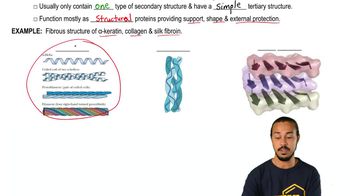
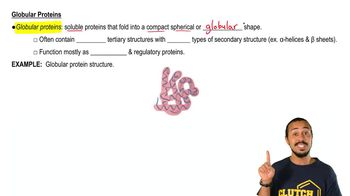
Fibrous proteins are insoluble, have long linear or sheet-like structures with usually one type of secondary structure, and serve mainly structural roles (e.g., support, protection). Globular proteins are soluble, have complex tertiary structures with multiple types of secondary structures, and function mainly as enzymes and regulatory proteins.
Give examples of fibrous proteins and describe their structural features.
Examples of fibrous proteins include alpha keratin (found in hair, skin, nails; mainly alpha helices), collagen (in connective tissues; three intertwined chains without alpha helices), and silk fibroin (insect silk; composed of anti-parallel beta sheets). All have long, linear structures and are insoluble.
Why are globular proteins generally more soluble in water than fibrous proteins?
Globular proteins are more soluble because their compact, spherical shapes allow hydrophilic amino acid residues to be exposed on the surface, interacting with water, while hydrophobic residues are buried inside. In contrast, fibrous proteins have extended structures with less surface area for water interaction.
What is the primary biological function of fibrous proteins?
Fibrous proteins primarily provide structural support, shape, and external protection to cells and tissues.
What is the main structural difference between fibrous and globular proteins?
Fibrous proteins have long, linear or sheet-like structures with usually one type of secondary structure, while globular proteins have compact, spherical shapes with multiple types of secondary structures.
What is the primary biological function of fibrous proteins?
Fibrous proteins primarily provide structural support, shape, and external protection to cells and tissues.
Name three examples of fibrous proteins and describe one structural feature of each.
Alpha keratin (mainly alpha helices, found in hair, skin, nails), collagen (three intertwined chains without alpha helices, found in connective tissue), and silk fibroin (anti-parallel beta sheets, found in insect silk) are examples.
Why are globular proteins generally more soluble in water than fibrous proteins?
Globular proteins are more soluble because their hydrophilic residues are exposed on the surface, allowing interaction with water, while fibrous proteins have less surface area for water interaction.
What types of secondary structures are typically found in fibrous proteins?
Fibrous proteins usually contain only one type of secondary structure, either alpha helices or beta sheets, but not both.
What is the main functional role of globular proteins in the cell?
Globular proteins mainly function as enzymes and regulatory proteins rather than providing structural support.
What is the main protein substance found in nails and hair?
The main protein substance found in nails and hair is alpha keratin.
What are the three types of protein fibers found in connective tissue?
The three types of protein fibers found in connective tissue are alpha keratin, collagen, and silk fibroin.
What is the function of the protein keratin in the body?
Keratin functions as a structural protein, providing support, shape, and external protection in hair, skin, and nails.
Which protein is predominantly present in hair?
Alpha keratin is the protein predominantly present in hair.
Approximately what percentage of hair is composed of protein?
Hair is composed of a high percentage of protein, primarily alpha keratin, though the exact percentage is not specified in the provided materials.