Control buttons has been changed to "navigation" mode.
1/40
Terms in this set (40)
Where does glycolysis occur in the cell?
Glycolysis occurs in the cytoplasm of the cell.
What is the cellular location of glycolysis?
Glycolysis takes place in the cytoplasm.
In which part of the cell does glycolysis take place?
Glycolysis takes place in the cytoplasm.
What are the main products of glycolysis?
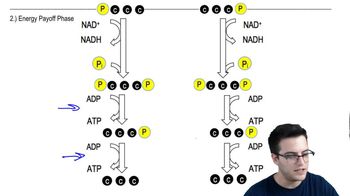
The main products of glycolysis are 2 pyruvate molecules, 2 ATP (net gain), and 2 NADH per glucose molecule.
What are two advantages of glycolysis?
Two advantages of glycolysis are that it produces ATP quickly without requiring oxygen and provides pyruvate for further energy production in cellular respiration.
During glycolysis, glucose is broken down into what compound?
During glycolysis, glucose is broken down into pyruvate.
In which cellular compartment do the reactions of glycolysis occur?
The reactions of glycolysis occur in the cytoplasm.
What is the net gain of ATP from glycolysis per glucose molecule?
The net gain of ATP from glycolysis is 2 ATP per glucose molecule.
What is the final product formed when glucose is broken down during glycolysis?
The final product formed is pyruvate.
List the products of glycolysis.
The products of glycolysis are pyruvate, ATP, and NADH.
What is not required for glycolysis to occur?
Oxygen is not required for glycolysis to occur.
What is the net gain of energy from glycolysis?
The net gain of energy from glycolysis is 2 ATP per glucose molecule.
What is the end product of glycolysis?
The end product of glycolysis is pyruvate.
What is a result of glycolysis?
A result of glycolysis is the production of pyruvate, ATP, and NADH.
Is NADH a substrate or product in glycolysis?
NADH is a product of glycolysis.
In which cellular compartment does glycolysis take place?
Glycolysis takes place in the cytoplasm.
What is the place where glycolysis happens?
Glycolysis happens in the cytoplasm.
What is the main purpose of glycolysis?
The main purpose of glycolysis is to break down glucose into pyruvate and generate ATP and NADH.
Name a product of glycolysis.
A product of glycolysis is pyruvate.
What is the end product of glycolysis?
The end product of glycolysis is pyruvate.
What are the net products of glycolysis per glucose molecule?
The net products are 2 pyruvate, 2 ATP, and 2 NADH per glucose molecule.
What happens to glucose during glycolysis?
Glucose is split into two 3-carbon molecules during glycolysis.
What is the net gain of ATP in glycolysis?
The net gain of ATP in glycolysis is 2 ATP per glucose molecule.
How many ATP molecules are produced during glycolysis per glucose?
A total of 4 ATP are produced, but the net gain is 2 ATP per glucose molecule.
What is the starting molecule for glycolysis?
The starting molecule for glycolysis is glucose.
Where does glycolysis take place in the cell?
Glycolysis takes place in the cytoplasm.
What is the cellular location where glycolysis occurs?
Glycolysis occurs in the cytoplasm.
What is the net gain of ATP during glycolysis?
The net gain of ATP during glycolysis is 2 ATP per glucose molecule.
List the net products of glycolysis.
The net products are 2 pyruvate, 2 ATP, and 2 NADH per glucose molecule.
Where does glycolysis take place in eukaryotic cells?
Glycolysis takes place in the cytoplasm of eukaryotic cells.
What is the net gain of ATP during glycolysis?
The net gain is 2 ATP per glucose molecule.
How many ATP does glycolysis produce per glucose molecule?
Glycolysis produces a net gain of 2 ATP per glucose molecule.
Where does glycolysis occur in the cell?
Glycolysis occurs in the cytoplasm.
Which of the following is not a product of glycolysis: pyruvate, ATP, NADH, FADH2?
FADH2 is not a product of glycolysis.
Which steps of glycolysis are irreversible?
The irreversible steps of glycolysis are the phosphorylation of glucose to glucose-6-phosphate, the phosphorylation of fructose-6-phosphate to fructose-1,6-bisphosphate, and the conversion of phosphoenolpyruvate to pyruvate.
What are the products of glycolysis?
The products are pyruvate, ATP, and NADH.
What are the reactants of glycolysis?
The reactants are glucose, ATP, NAD+, and ADP.
What is the purpose of glycolysis?
The purpose of glycolysis is to break down glucose into pyruvate and generate ATP and NADH.
What is the net production of ATP in glycolysis?
The net production of ATP in glycolysis is 2 ATP per glucose molecule.