Pearson+ LogoPearson+ Logo

Glycolysis 2 quiz #1 Flashcards

Back
Glycolysis 2 quiz #1
Control buttons has been changed to "navigation" mode.
1/10
  • How are ATP molecules produced during glycolysis?

    ATP molecules in glycolysis are produced by substrate-level phosphorylation, where a phosphate group is directly transferred from a metabolic intermediate to ADP, forming ATP.
  • What are the main products of glycolysis?

    The main products of glycolysis are pyruvate, ATP, and NADH.
  • Which of the following is not a product of glycolysis: ATP, NADH, pyruvate, or oxygen?

    Oxygen is not a product of glycolysis.
  • Which molecule is not produced during glycolysis?

    Oxygen is not produced during glycolysis.
  • Which molecule is oxidized during glycolysis?

    During glycolysis, glyceraldehyde 3-phosphate (G3P) is oxidized.
  • By what mechanism is ATP synthesized in glycolysis?

    ATP is synthesized in glycolysis by substrate-level phosphorylation.
  • How is ATP generated in the glycolytic pathway?

    ATP is generated in glycolysis through substrate-level phosphorylation, where a phosphate group is transferred from a glycolytic intermediate to ADP.
  • How many NADH molecules are produced per glucose molecule during glycolysis?

    Two NADH molecules are produced per glucose molecule during glycolysis.
  • What is the significance of a highly negative delta G in a glycolytic reaction step?

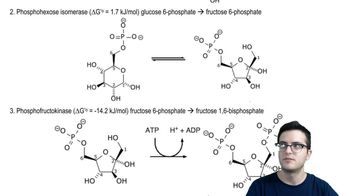
    A highly negative delta G indicates the reaction is essentially irreversible and represents a commitment step in glycolysis. These steps often involve energy expenditure and drive the pathway forward.
  • Which enzyme catalyzes the conversion of glucose to glucose 6-phosphate, and what is required for this reaction?

    Hexokinase catalyzes the conversion of glucose to glucose 6-phosphate. This reaction requires the expenditure of one ATP molecule.