Pearson+ LogoPearson+ Logo

Glycolysis 3 quiz #1 Flashcards

Back
Glycolysis 3 quiz #1
Control buttons has been changed to "navigation" mode.
1/10
  • What is substrate-level phosphorylation in glycolysis, and during which step does it occur?

    Substrate-level phosphorylation in glycolysis refers to the direct transfer of a phosphate group from a phosphorylated intermediate to ADP, forming ATP. This occurs during the conversion of 1,3-bisphosphoglycerate to 3-phosphoglycerate, catalyzed by phosphoglycerate kinase.
  • What are the end products generated from one molecule of glucose during glycolysis?

    The end products of glycolysis from one molecule of glucose are two molecules of pyruvate, two molecules of ATP (net gain), and two molecules of NADH.
  • Which reactions in glycolysis are considered irreversible?

    The irreversible reactions in glycolysis are those with a large negative delta G, making them essentially one-way. These include the reactions catalyzed by hexokinase (glucose to glucose-6-phosphate), phosphofructokinase-1 (fructose-6-phosphate to fructose-1,6-bisphosphate), and pyruvate kinase (phosphoenolpyruvate to pyruvate).
  • Why is carbon numbering important when studying glycolysis intermediates?

    Carbon numbering helps track the origin of each atom from the initial glucose molecule through the pathway. This is crucial for understanding biochemical transformations and answering exam questions accurately.
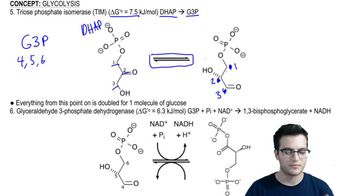
  • Which enzyme catalyzes the conversion of DHAP to G3P, and what is notable about its delta G?

    Triosephosphate isomerase catalyzes the conversion of DHAP to G3P. Its delta G is close to 0, making the reaction readily reversible.
  • How many molecules of G3P are produced from one molecule of glucose during glycolysis?

    Two molecules of G3P are produced from one molecule of glucose. This doubling affects all subsequent reactions in the pathway.
  • What is the role of NAD+ in the glyceraldehyde-3-phosphate dehydrogenase reaction?

    NAD+ acts as an electron acceptor and is reduced to NADH during the conversion of G3P to 1,3-bisphosphoglycerate. Two NADH molecules are produced per glucose molecule.
  • What happens to the phosphate group during the 3-phosphoglycerate mutase reaction?

    The phosphate group is shifted from one position to another on the molecule, converting 3-phosphoglycerate to 2-phosphoglycerate. This reaction is reversible with a delta G close to 0.
  • Why are subsequent glycolysis reactions considered to occur twice for each glucose molecule?

    After the formation of two G3P molecules from one glucose, each subsequent reaction is performed for both G3P molecules. This means all products from these steps are doubled per glucose.
  • How does the carbon numbering in glycolysis diagrams relate to the original glucose molecule?

    The carbon numbers in diagrams often reflect the positions from the original glucose molecule, not just the current intermediate. This helps maintain clarity when tracking atoms through the pathway.