Pearson+ LogoPearson+ Logo

Glycolysis 4 quiz #1 Flashcards

Back
Glycolysis 4 quiz #1
Control buttons has been changed to "navigation" mode.
1/10
  • What is the final product of glycolysis?

    The final product of glycolysis is pyruvate.
  • What is the end product formed at the conclusion of the glycolytic pathway?

    The end product of glycolysis is pyruvate.
  • Which enzyme catalyzes the conversion of 2-phosphoglycerate to phosphoenolpyruvate in glycolysis?

    Enolase catalyzes the conversion of 2-phosphoglycerate to phosphoenolpyruvate (PEP). This reaction also releases water and is reversible with a delta G close to zero.
  • What is released during the enolase-catalyzed reaction in glycolysis?

    Water (H2O) is released during the conversion of 2-phosphoglycerate to phosphoenolpyruvate by enolase. This indicates an oxidation process in the reaction.
  • Which glycolytic reactions are considered irreversible due to their highly negative delta G values?

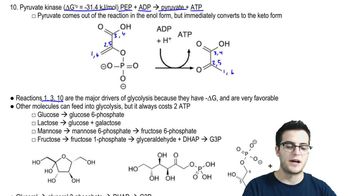
    Reactions 1, 3, and 10 in glycolysis are considered irreversible. Their highly negative delta G values drive the pathway forward.
  • How does pyruvate initially exit the glycolytic pathway after the action of pyruvate kinase?

    Pyruvate is initially produced in its enol form after the action of pyruvate kinase. It quickly converts to the more stable keto form on its own.
  • What is the ATP cost for alternative substrates entering glycolysis per 6 carbons?

    Initiating glycolysis with alternative substrates generally costs 2 ATP per 6 carbons. Glycerol is an exception, costing 1 ATP for its 3 carbons.
  • Why is glycerol not suitable for sustaining glycolysis through fermentation under anaerobic conditions?

    Glycerol generates excess NADH when entering glycolysis, producing 2 NADH per 3 carbons. This excess NADH prevents glycolysis from being sustained by fermentation.
  • How does glycogen enter the glycolytic pathway after being broken down?

    Glycogen is broken down by glycogen phosphorylase into glucose 1-phosphate. Glucose 1-phosphate is then converted into glucose 6-phosphate to enter glycolysis.
  • What happens to galactose after lactose is split before it enters glycolysis?

    Galactose undergoes additional reactions before it is ready to enter the glycolytic pathway. Only after these reactions can it be converted to glucose 6-phosphate and proceed through glycolysis.