Back

Insulin Receptor quiz

Control buttons has been changed to "navigation" mode.
1/15
  • What type of receptor is the insulin receptor (INSR)?

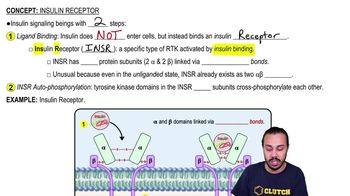
    The insulin receptor is a receptor tyrosine kinase (RTK).
  • How many subunits make up the insulin receptor, and how are they linked?

    The insulin receptor is composed of two alpha and two beta subunits, which are linked by disulfide bonds.
  • What is the ligand for the insulin receptor?

    The ligand for the insulin receptor is insulin.
  • Does insulin enter the cell to exert its effects?

    No, insulin does not enter the cell; it binds to the insulin receptor on the plasma membrane to initiate signaling.
  • How is the insulin receptor different from typical RTKs before ligand binding?

    Unlike typical RTKs, the insulin receptor exists as a dimer even before ligand binding, so no dimerization step is required.
  • What happens to the insulin receptor after insulin binds to it?

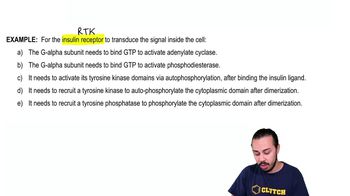
    After insulin binds, the receptor undergoes autophosphorylation of tyrosine residues on its beta subunits, activating its kinase domains.
  • What is autophosphorylation in the context of the insulin receptor?

    Autophosphorylation is when the receptor's kinase domains phosphorylate each other on tyrosine residues, leading to activation.
  • What are insulin receptor substrates (IRS), and what is their main function?

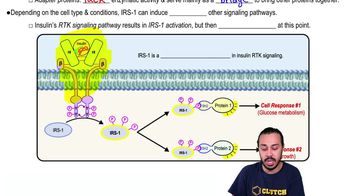
    Insulin receptor substrates (IRS) are small proteins that act as the main targets of the activated insulin receptor, serving as adapter proteins in signaling.
  • Which IRS protein is primarily focused on in insulin signaling pathways?

    IRS-1 is the main insulin receptor substrate discussed in insulin signaling pathways.
  • Do IRS proteins have enzymatic activity?

    No, IRS proteins do not have enzymatic activity; they function as adapter proteins to bring other proteins together.
  • What modification activates IRS-1 after insulin receptor activation?

    IRS-1 is activated by phosphorylation at tyrosine residues by the insulin receptor's kinase domains.
  • What role does IRS-1 play in the insulin signaling pathway?

    IRS-1 acts as a branch point, allowing the insulin signaling pathway to split into multiple downstream responses.
  • What are two possible cellular responses triggered by IRS-1 activation?

    IRS-1 activation can lead to changes in glucose metabolism or regulation of gene expression and cell growth.
  • How do proteins recognize and bind to phosphorylated IRS-1?

    Proteins with SH2 domains bind to the phosphorylated tyrosine residues on IRS-1.
  • Why can insulin signaling produce diverse biological effects?

    Insulin signaling produces diverse effects because IRS-1 acts as a branch point, leading to different pathways and cellular responses depending on the proteins recruited.