Back

Kcat quiz

Control buttons has been changed to "navigation" mode.
1/15
  • What does the catalytic constant (kcat) measure in enzyme kinetics?

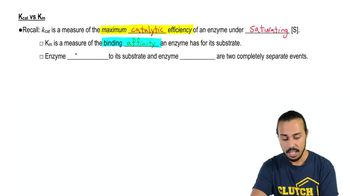
    The kcat measures the maximum number of substrate molecules converted to product per second by one enzyme molecule at saturating substrate concentrations.
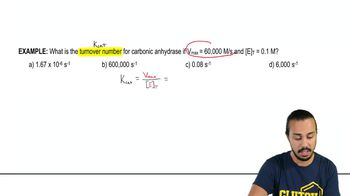
  • How is kcat calculated using Vmax and enzyme concentration?

    kcat is calculated as the ratio of Vmax to the total enzyme concentration, or kcat = Vmax / [E]total.
  • What is another common name for kcat?

    kcat is also known as the turnover number.
  • What are the units of kcat?

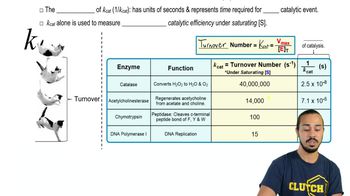
    The units of kcat are inverse seconds (s⁻¹).
  • Under what substrate conditions is kcat measured?

    kcat is measured under saturating substrate concentrations.
  • Which step of an enzyme-catalyzed reaction does kcat represent?

    kcat represents the rate constant for the rate-limiting (slowest) step, typically product formation.
  • In simple enzyme reactions, which rate constant is equivalent to kcat?

    In simple enzyme reactions, k2 (the rate constant for product formation) is equivalent to kcat.
  • What does a high kcat value indicate about an enzyme?

    A high kcat value indicates that the enzyme can convert many substrate molecules to product per second, reflecting high catalytic efficiency.
  • What does the reciprocal of kcat (1/kcat) represent?

    The reciprocal of kcat represents the time required for one catalytic event by a single enzyme molecule, with units of seconds.
  • How does kcat differ from the Michaelis constant (Km)?

    kcat measures catalytic efficiency (turnover), while Km measures the binding affinity of the enzyme for its substrate.
  • Can an enzyme have a high binding affinity (low Km) but a low kcat?

    Yes, an enzyme can bind substrate tightly (low Km) but still convert substrate to product slowly (low kcat).
  • Why is it important to consider both kcat and Km when studying enzymes?

    Both kcat and Km provide distinct information: kcat about catalytic efficiency and Km about substrate binding, both of which are important for understanding enzyme function.
  • What does a kcat of 40,000,000 s⁻¹ for catalase mean?

    It means one molecule of catalase can convert 40,000,000 substrate molecules to product per second when saturated with substrate.
  • Why does DNA polymerase I have a much lower kcat compared to catalase?

    DNA polymerase I has a lower kcat (e.g., 15 s⁻¹) to minimize errors during DNA replication, reflecting a slower but more accurate process.
  • What is the main takeaway about the relationship between substrate binding and catalysis in enzymes?

    Substrate binding (Km) and catalysis (kcat) are separate events; strong binding does not guarantee fast catalysis.