Back

Lipids 1 quiz

Control buttons has been changed to "navigation" mode.
1/15
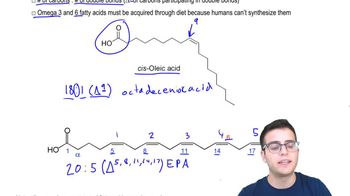
  • How is cis oleic acid formally named using the fatty acid naming convention?

    Cis oleic acid is named 18:1 (delta 9), indicating 18 carbons, 1 double bond, and the double bond starting at carbon 9.
  • What do the numbers in the fatty acid name 20:5 (delta 5, 8, 11, 14, 17) represent?

    20 is the number of carbons, 5 is the number of double bonds, and the numbers in parentheses show the positions of the double bonds.
  • How does the omega system of naming fatty acids differ from the delta system?

    The omega system counts from the methyl (end) of the chain, while the delta system counts from the carboxyl end.
  • What is an omega-3 fatty acid?

    An omega-3 fatty acid has its first double bond at the third carbon from the methyl end of the chain.
  • Why are omega-3 and omega-6 fatty acids considered essential?

    They are essential because humans cannot synthesize them and must obtain them from the diet.
  • What is the configuration of double bonds in naturally occurring unsaturated fatty acids?

    Naturally occurring unsaturated fatty acids always have cis double bonds.
  • How does chain length affect the melting point and solubility of fatty acids?

    As chain length increases, melting point increases and solubility in water decreases.
  • How does unsaturation affect the melting point of fatty acids?

    Unsaturation (double bonds) lowers the melting point of fatty acids.
  • Why do trans fats have higher melting points than cis fats?

    Trans fats have a linear structure, allowing tighter packing and stronger intermolecular forces, which raises their melting point.
  • What is the simplest fat molecule found in biology and what is it made of?

    The simplest fat molecule is a triacylglycerol, made from glycerol and three fatty acids linked by ester bonds.
  • Where is an unsaturated fatty acid located in a triacylglycerol if only one is present?

    If only one fatty acid is unsaturated, it is always located on carbon 2 of the glycerol backbone.
  • What type of bond links fatty acids to glycerol in triacylglycerols?

    Ester bonds link fatty acids to the glycerol backbone in triacylglycerols.
  • What is the effect of a cis double bond on the shape of a fatty acid chain?

    A cis double bond introduces a kink in the fatty acid chain, preventing tight packing.
  • From which foods are omega-3 and omega-6 fatty acids typically obtained?

    Omega-3s are found in vegetables, nuts, and fish, while omega-6s are mainly from animal products like red meat and dairy.
  • Why do trans fatty acids fit together more tightly than cis fatty acids?

    Trans fatty acids are linear, allowing them to pack closely together, unlike the kinked cis fatty acids.